




- Subjects >
- Science >
- Key stage 1 >
- Year 2 >
Unit outcomes
Pupils who are secure will be able to:
- Identify and name a variety of plants and animals.
- Recall that minibeasts live in microhabitats.
- Describe microhabitats and their conditions.
- Describe how microhabitats provide for the basic needs of animals and plants.
- Describe the job role of a botanist.
When working scientifically, pupils who are secure will be able to:
- Group minibeasts and create simple classification keys.
- Ask questions and recognise that they can be answered in different ways.
- Gather and record data and use it to answer questions.
- Plan what observations to make in an experiment.
- Order the steps of a method.
- Describe the appearance of flowering plants.
- Use an identification chart to name flowering plants.
Please note that Kapow Primary Science lessons are designed to be 1 hour and 30 minutes long to reflect the requirements of a core subject.
Suggested prior learning
Living things: Habitats
Get started
Lessons
Lesson 1: Identifying and classifying minibeasts
Lesson 2: Introduction to scientific enquiry
Lesson 3: Minibeast hunt
Lesson 4: Planning an experiment
Lesson 5: Woodlice experiment
Lesson 6: What is a botanist?
Key skills
Posing questions
- Exploring the world

This content is for subscribers only. Join for access today.
Key knowledge
To know:
- A variety of
This content is for subscribers only. Join for access today.
Key vocabulary
food chain
microhabitat
This content is for subscribers only. Join for access today.
Equipment list
Equipment needed across all lessons in this unit.
This list does not include equipment which is usually readily available in the classroom (e.g pencils, A4 paper etc)
 Download
Full equipment list for the subject
Quantities marked × will update. Items without quantities are unaffected
-
A tray of leaf litter containing minibeasts.
×1 - Digital camera ×8
-
Clear, litre plastic bottle
×1 -
Soil (approximately a third of a litre)
-
Sand (approximately a third of a litre)
-
Leaf litter (a handful).
×1 -
Trowel or large spoon
×1 -
A3 sheet of black paper or card
×1 - Sticky tape ×1
-
Bug pots with lids
×15 -
Medium-sized paintbrushes
×15 - Magnifying glasses ×15
- Clipboards ×30
-
Lidded box with air holes containing leaf litter and 25 woodlice.
×1 - Petri dishes ×5
-
Stopwatches
×15 - Paper towels ×30
This content is for subscribers only. Join for access today.
Related content
Unit resources


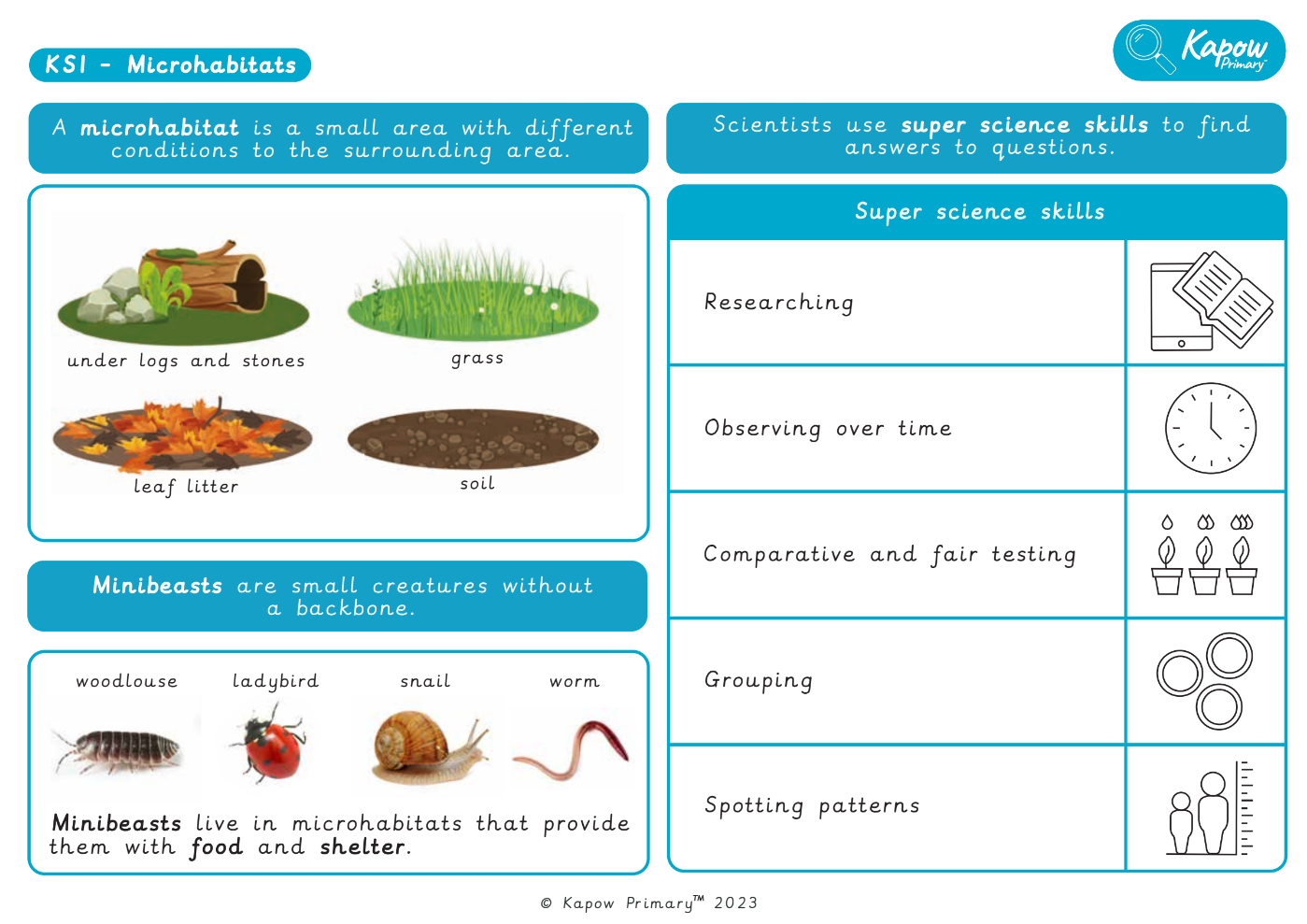
Knowledge organiser – Science Y2: Microhabitats
Aimed at pupils, a single page which gives key facts and definitions from the unit ‘Microhabitats’.
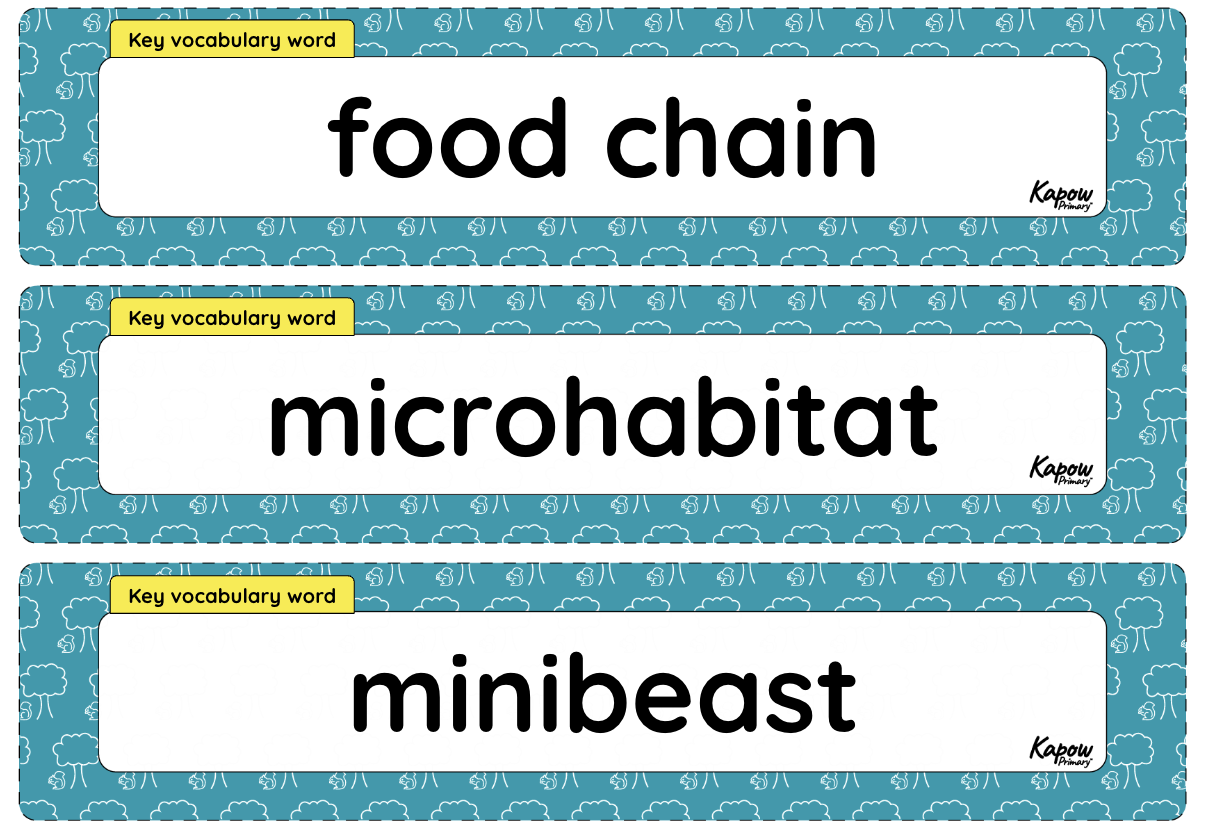
Vocabulary display – Science Y2: Microhabitats
A display version of the key vocabulary from the unit 'Microhabitats'.
Subject resources
This content is for subscribers only. Join for access today.
Cross-curricular opportunities
English: Reading – comprehension; Writing – vocabulary, grammar and punctuation.
Geography: Geography skills and fieldwork.
British values: Mutual respect.
