




Unit outcomes
Pupils who are secure will be able to:
- Recognise South African, Caribbean and South American musical styles when they hear this music. Even if the children cannot recall the specific information about the musical styles, it shows as much learning to identify the pieces because they ‘sound like’ the pieces they have been learning to play. For example, “I think it is salsa because it sounds like ‘Vamos, let’s go!’ shows an equal level of musical understanding as “I think it is calypso because of the political lyrics.”
- Use some music vocabulary to talk about what they have heard.
- Recall that gamelan music is cyclical, that the melodies last eight notes, and that the Slendro scale is used.
- Sing the ‘Blue sky’ melody with some accuracy.
- Mostly correctly answer Activity: Exploring octaves, and play.
- Compose an eight-note tune using the Slendro scale, and write it down at different octaves.
- Define timbre, describe the timbres of different instruments, and make suggestions for how to combine these in a performance.
- Play their tuned percussion part accurately.
See Music: Instrumental scheme for guidance on how to incorporate the instrumental scheme into your planning.
Suggested prior learning
Unit 3: South America (Instrumental lessons)
Get started
Lessons
Lesson 1: Review of learning
Lesson 2: Gamelan music
Lesson 3: Exploring octaves
Lesson 4: Cyclic patterns
Lesson 5: Finishing touches
Key skills
Year 3
- Discussing

This content is for subscribers only. Join for access today.
Key knowledge
- To know
This content is for subscribers only. Join for access today.
Equipment list
Equipment needed across all lessons in this unit.
This list does not include equipment which is usually readily available in the classroom (e.g pencils, A4 paper etc)
 Download
Full equipment list for the subject
Quantities marked × will update. Items without quantities are unaffected
- Tuned percussion instrument – Choose from chromatic glockenspiels, with sharp and flat notes, xylophones, metallophones, chime bars (two octave set) ×15
- Untuned percussion instruments (claves, guiros, egg shakers, gongs / cymbals) ×15
This content is for subscribers only. Join for access today.
Related content
Unit resources


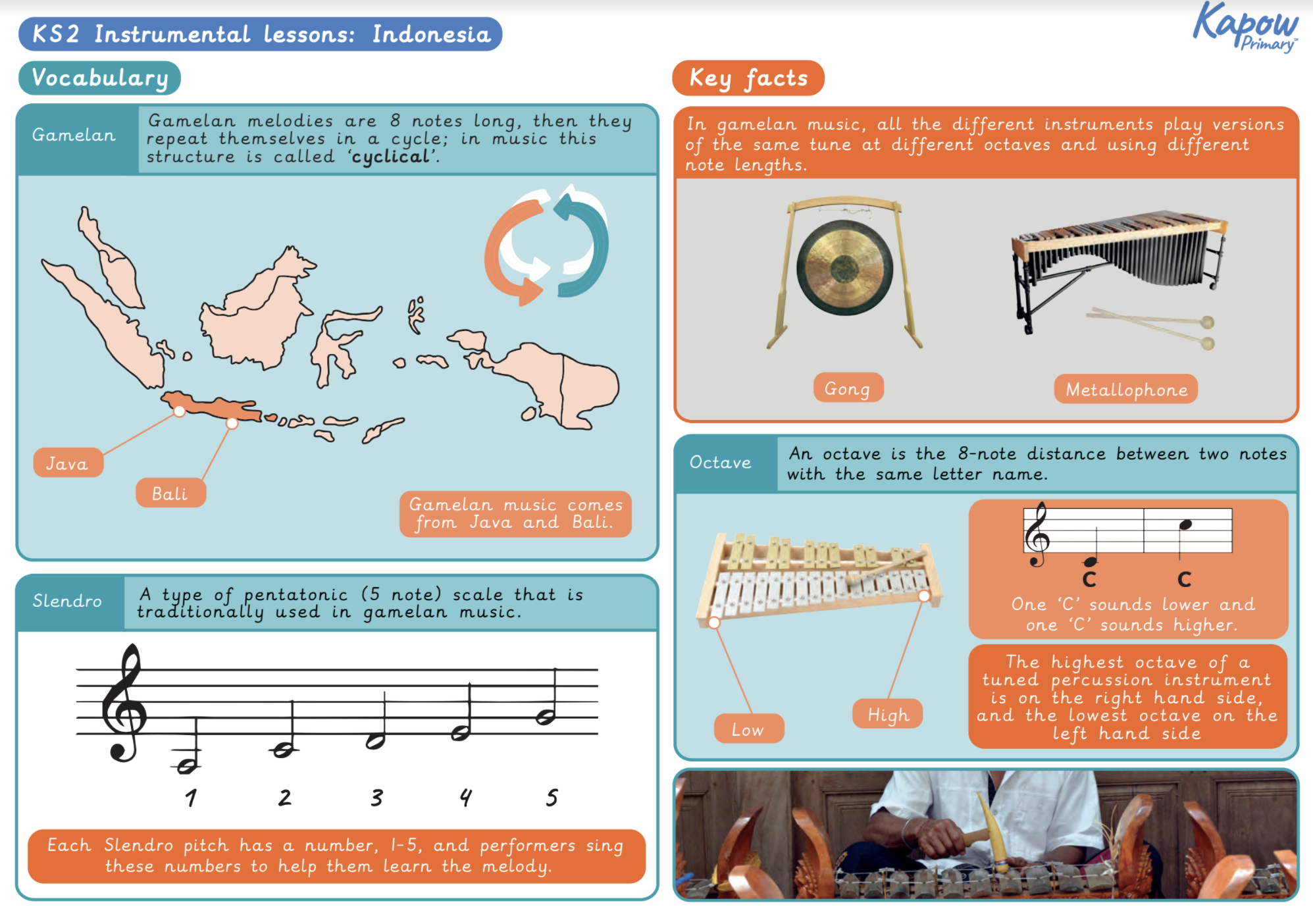
Knowledge organiser: KS2 Instrumental Music: Indonesia
Aimed at pupils, a single page which gives key facts and definitions from the unit "Indonesia (Instrumental lessons)".
Vocabulary display: Instrumental lesson – Indonesia
A display version of the key vocabulary for the 'Instrumental lesson - Indonesia' unit.
Subject resources
This content is for subscribers only. Join for access today.
Cross-curricular opportunities
Science: How sounds are made.
Build on the learning
Unit 5: India (Instrumental lessons)
Get started
