




- Subjects >
- Science >
- Key stage 1 >
- Year 1 >
Unit outcomes
Pupils who are secure will be able to:
- Draw and label human body parts.
- Identify the body parts associated with each sense.
When working scientifically, pupils who are secure will be able to:
- Compare and group body parts.
- Begin to recognise patterns in data and use these to answer questions.
- Record data in a table.
- Measure using non-standard units.
Please note that Kapow Primary Science lessons are designed to be 1 hour and 30 minutes long to reflect the requirements of a core subject.
Note: during this unit, observe seasonal changes in winter. Allow the pupils to complete the Activity: Observing seasons over time (see Science, Year 1, Seasonal changes, Lesson 5: Observing over time).
Suggested prior learning
This is the first unit in the Kapow Primary scheme.Lessons
Lesson 1: Body parts
Lesson 2: The senses
Lesson 3: Taste and touch
Lesson 4: Sight and smell
Lesson 5: Hearing
Lesson 6: Senses in action
Key skills
Posing questions
- Recognising

This content is for subscribers only. Join for access today.
Key knowledge
To know:
- The
This content is for subscribers only. Join for access today.
Key vocabulary
compare
group
This content is for subscribers only. Join for access today.
Equipment list
Equipment needed across all lessons in this unit.
This list does not include equipment which is usually readily available in the classroom (e.g pencils, A4 paper etc)
 Download
Full equipment list for the subject
Quantities marked × will update. Items without quantities are unaffected
-
Roll of large drawing paper the size of a child
×10 -
Small bag of popcorn
×1 - A blindfold
- Building blocks and connecting cubes ×1
-
Cardboard box
×1 -
Everyday objects for a feeling challenge (e.g. feather, seashell, potato, key and coin)
×1 -
Rubber gloves
×1 -
Sweet, salty, bitter and sour food samples for tasting (e.g. sweets, crisps, spinach and lemon)
×1 - Disposable gloves For the teacher: 1
- Aromatic items for a smelling test (e.g. coffee, banana, garlic, toothpaste and spices) ×1
-
12 opaque containers covered with fabric
- Clipboards ×30
-
Rubber floor markers or beanbags
×30 - Pots ×5
- 6 items for a listening challenge (e.g. rice, marbles, leaves and coins).
This content is for subscribers only. Join for access today.
Related content
Unit resources


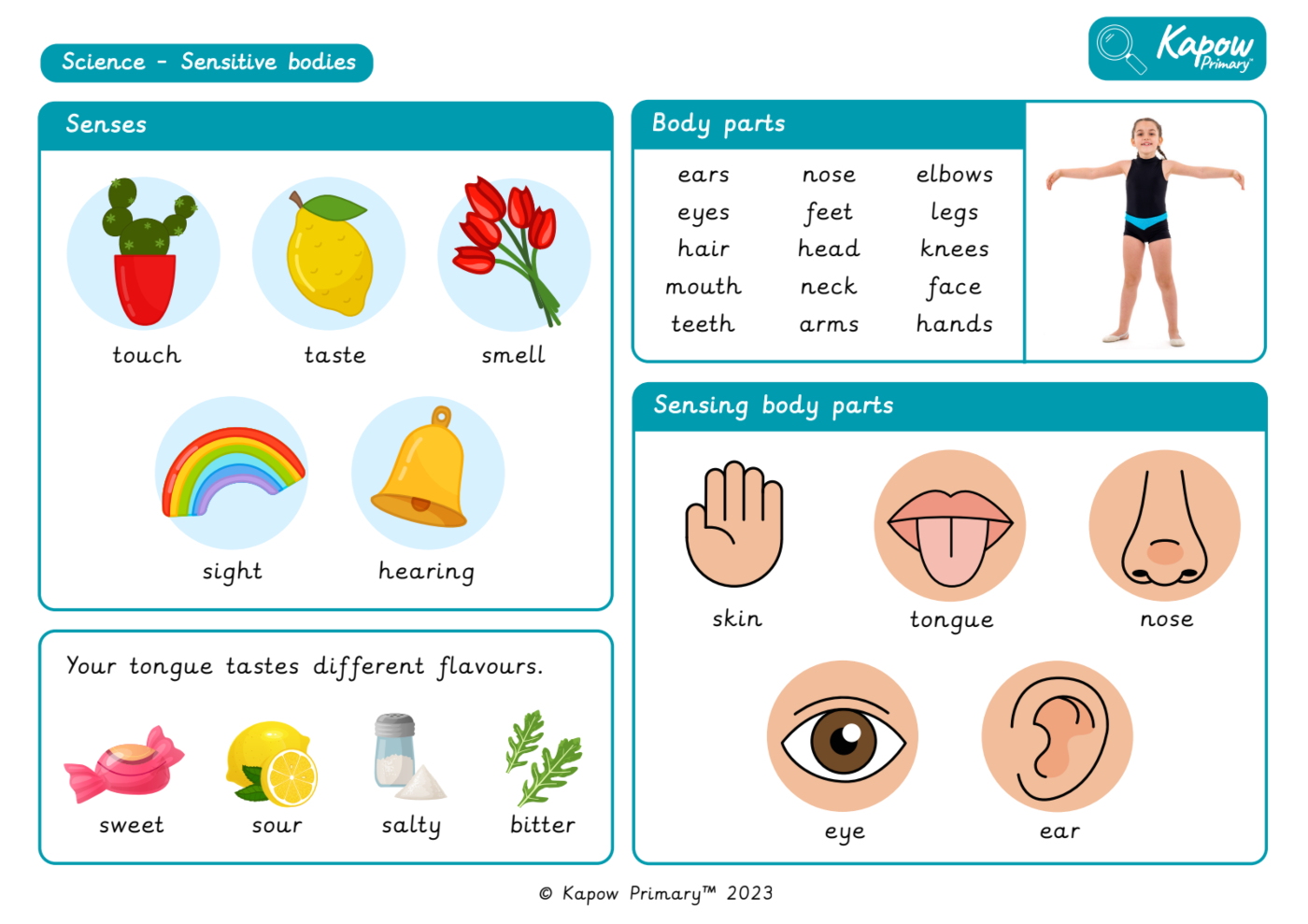
Knowledge organiser – Science Y1: Animals, including humans: Sensitive bodies
Aimed at pupils, a single page which gives key facts and definitions from the unit ‘Sensitive bodies?’.
Vocabulary display – Science Y1: Animals, including humans: Sensitive bodies
A display version of the vocabulary for the unit 'Sensitive bodies'.
Subject resources
This content is for subscribers only. Join for access today.
Cross-curricular opportunities
Mathematics: measure and begin to record lengths; count, read and write numbers to 100.
English: word reading, transcription.
British values: democracy, mutual respect.
Build on the learning
Animals, including humans: Life cycles and health
Get started
