




- Subjects >
- Science >
- Key stage 2 >
- Year 5 >
Unit outcomes
Pupils who are secure will be able to:
- Define the term mixture and name some common examples.
- Define the term sieving and explain how sieving separates mixtures.
- Define the term filtering and explain how filtering separates mixtures.
- Define the terms solution and dissolve and name some common examples of solutions.
- Recall some factors that affect the time taken to dissolve.
- Describe the effect of temperature on the time taken to dissolve.
- Define the term evaporating and explain how evaporating separates solutions.
- Identify when sieving, filtering and evaporating should be used.
When working scientifically pupils who are secure will be able to:
- Research a mixture to find out what substances it is made from.
- Draw and annotate a diagram to explain how sieving separates a solid-solid mixture.
- Identify and justify which type of enquiry to use to answer my testable question.
- Identify solutions by observing and describing their appearance.
- Suggest which variables to change, measure and control when investigating how temperature affects the time taken to dissolve.
- Choose which measurements to take and how long to take them for.
Please note that Kapow Primary Science lessons are designed to be 1 hour and 30 minutes long to reflect the requirements of a core subject.
Suggested prior learning
Materials: States of matter
Get started
Lessons
Lesson 1: Mixtures
Lesson 2: Sieving
Lesson 3: Filtering
Lesson 4: Solutions
Lesson 5: Dissolving
Lesson 6: Evaporating
Key skills
Researching

This content is for subscribers only. Join for access today.
Key knowledge
To know:
-
This content is for subscribers only. Join for access today.
Key vocabulary
control variable (LKS2)
dissolve
This content is for subscribers only. Join for access today.
Equipment list
Equipment needed across all lessons in this unit.
This list does not include equipment which is usually readily available in the classroom (e.g pencils, A4 paper etc)
 Download
Full equipment list for the subject
Quantities marked × will update. Items without quantities are unaffected
-
Substances (salt, sugar, pepper, sand, soil, flour).
×8 -
Materials (e.g. coffee filters, pasta, rice, cotton wool, paper towel, pebbles, gravel, face masks, charcoal)
- Plastic gold nuggets ×8
-
Extra chunky gold glitter
×1 -
Metal paper clips
×15 - Iron filings ×8
-
Magnets
×8 -
Litre plastic bottle
2 -
Small plastic bottles
×8 - Gauzes ×8
-
Stopwatches
×8 - Thermometers ×1
- Teabags ×8
-
Food colouring
×1 -
Skittles® or chocolate mini eggs
×8 -
Sugar cubes
×8 -
Large jugs
×8 - Large mixing bowl ×8
-
Large plastic tray
×8 -
Tea towels
×8 -
Recycled lids
×8 -
Colanders
×8 -
Sieves
×8 -
Plastic and paper cups
×8 - Paper straws ×15
-
Plastic spoons
×8 - Paper plates ×30
- PE hoops ×15
- Pom-poms ×15
- Laptops/tablets ×15
This content is for subscribers only. Join for access today.
Related content
Unit resources


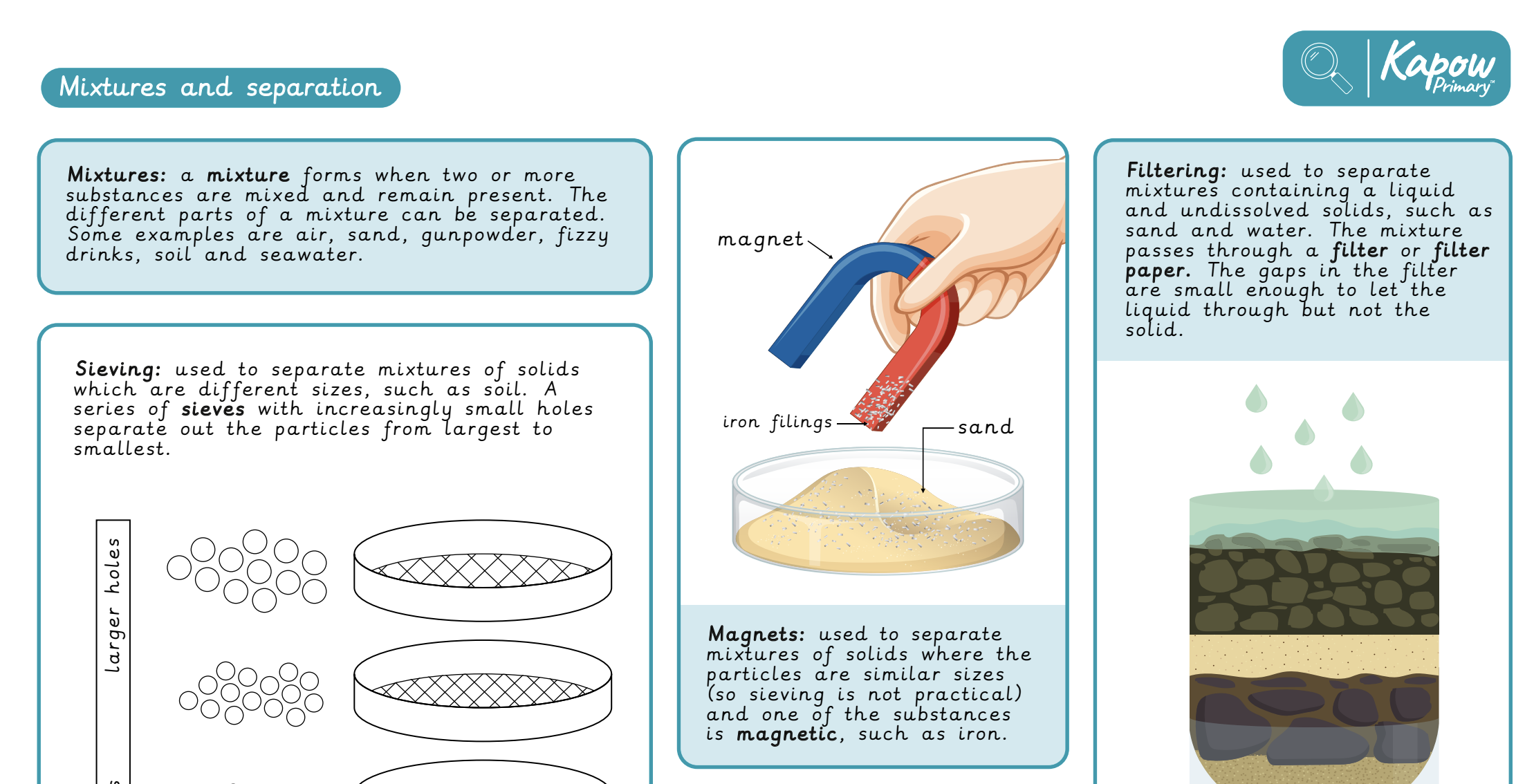
Knowledge organiser – Science Y5: Materials: Mixtures and separation
Aimed at pupils, two pages providing key facts and definitions from the unit ‘Mixtures and separation’.
Vocabulary display – Science Y5: Materials: Mixtures and separation
A display version of the vocabulary from the unit 'Mixtures and separation'.
Subject resources
This content is for subscribers only. Join for access today.
Cross-curricular opportunities
British values: mutual respect.
Build on the learning
Materials: Properties and changes
Get started

This resource is being accessed through your school’s Kapow licence.
Thank you for respecting the work of the teachers who create these materials.