




Unit outcomes
Pupils who are secure will be able to:
- Use statements and prior knowledge to identify connections between religions, explaining these connections by referring to people, places and beliefs.
- Talk about why making connections can be helpful.
- Explain similarities and differences between the ways people from different worldviews understand God.
- Use scripture to find out what people might believe.
- Explain why equality and harmony are important to many Sikhs.
- Use a range of sources to find out what might be important to some people from the Bahá’í faith.
- Compare what people with different worldviews may think about other religions.
- Express ideas creatively about how and why World Religion Day is important.
Due to the conflict in Israel and Palestine, extra care should be taken when teaching this unit, especially with regard to any children who may have connections with Israel, Palestine or the broader region.
If you are aware of any particular issues a child has, you might want to discuss the unit with the child beforehand and adapt it to accommodate them. Consider having an adult work with them for additional support. If issues arise during the lesson, it would be advisable to refer to your Senior Leadership Team.
Suggested prior learning
Why is fire used ceremonially?
Get started
Teacher video: Are all religions equal?

Lessons
Lesson 1: How are different religious worldviews connected?
Lesson 2: Is there more than one way to understand God?
Lesson 3: Why is religious harmony important?
Lesson 4: How can people from different worldviews live in harmony?
Lesson 5: How and why should we celebrate religious equality?
Lesson 6: How can we live together in harmony when we have different worldviews?
Key skills
Personal
- Presenting different views thoughtfully

This content is for subscribers only. Join for access today.
Key knowledge
Substantive
To know:
- People from different
This content is for subscribers only. Join for access today.
Key vocabulary
Bahá'í
Bahá’ulláh
This content is for subscribers only. Join for access today.
Equipment list
Equipment needed across all lessons in this unit.
This list does not include equipment which is usually readily available in the classroom (e.g pencils, A4 paper etc)
 Download
Full equipment list for the subject
Quantities marked × will update. Items without quantities are unaffected
- Wonder box ×1
-
Space for the children to sit in a circle
×1 -
Skipping ropes or pieces of string pairs
×15 -
Different coloured markers (teacher use)
6 -
Colour pens (one colour per group)
×8 - Sugar paper 12
- Devices with access to the internet ×15
- Flipchart ×1
- Sugar paper 10
- A4 paper ×30
- Sticky notes ×1
The equipment below is optional
- Atlas ×15
- A3 paper ×15
- Scrap paper ×30
-
Access to devices with video and presentation capabilities
×8
This content is for subscribers only. Join for access today.
Related content
Unit resources


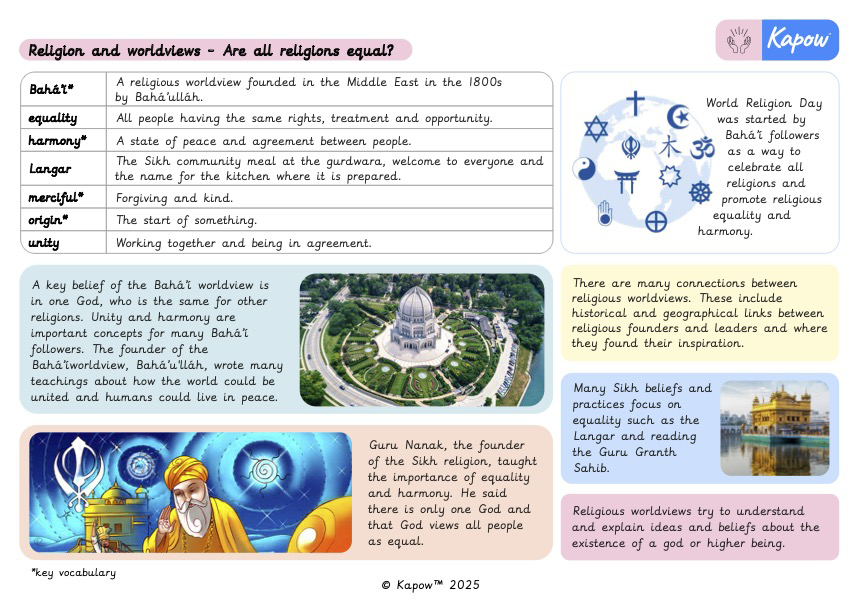
Knowledge organiser – R&W Y4: Are all religions equal?
Aimed at pupils, a double page document that gives key facts and definitions from the 'Are all religions equal?' unit.
Vocabulary display – R&W Y4: Are all religions equal?
Subject resources
This content is for subscribers only. Join for access today.
Cross-curricular opportunities
Build on the learning
What makes some texts sacred?
Get started
