


Display the Presentation: Easter quiz.
Read the questions aloud and ask the children to answer the questions on their mini whiteboards.

Presentation mode. Choose what to show your class.
Gift this lesson to a teacher friend to give them free access for 30 days!
Share lessons with your friends and colleagues for free. Learn more

Downloading may not be your best option. Be sure you are looking at the most up-to-date version by always viewing your resources online.
Bookmark or save the link to this lesson so you can find it quickly! Click on the format below to continue download.
A Year 5 optional lesson exploring the symbolism of Jesus’ resurrection to consider beliefs about death.
New statutory RSHE guidance is here. We’re creating our brand new RSE & PSHE scheme ready for September 2026. Learn more
See REC Curriculum Framework for RE in England (non-statutory guidance) – Religious Education Council of England & Wales.
English
Reading – comprehension
Pupils should be taught to:
Spoken language
Pupils should be taught to:
See National curriculum - English - Key stages 1 and 2.
RSE
Respectful relationships
Pupils should know:
See RSE Statutory guidance – contains public sector information licensed under the Open Government Licence v3.0.
British values
See Promoting fundamental British values as part of SMSC in schools (non-statutory advice) – contains public sector information licensed under the Open Government Licence v2.0.
Check all images, videos, links and presentation slides are suitable for your class.
Print in advance of the lesson.

The Knowledge organiser provides a visual summary of the key facts and vocabulary for the unit. The children can use it throughout the unit to check keyword meanings or spellings and to help them remember important information when completing an activity.
Find further ideas for using the Knowledge organiser to support adaptive teaching here.
The pages have relevant information for each of the Key stages. As knowledge builds from year to year, it is recommended that the Knowledge organiser for the previous key stage be printed on the reverse for Key stage 2.
Subject knowledge
Easter
Prophecies and the ‘divine voice’
The Last Supper
Misconceptions
The children may believe that:
Lesson organisation
External visitors
If you know a child has specific issues, consider discussing the lesson with them in advance and adapting it as needed. They might benefit from adult support.
If problems emerge during the lesson, consult your Senior Leadership Team.
It is the teacher’s responsibility to check all resources and lesson content to ensure it is suitable for their class setting.
Sensitivities
Death
The wonder box
Display the Presentation: Easter quiz.
Read the questions aloud and ask the children to answer the questions on their mini whiteboards.
Stick or pin the words from the Resource: Concept words in different areas around the classroom.
Ask children to move to the word around the room that best represents their ideas of death. Invite some children to share why they chose it.
Then ask the children to move to the word around the room that best represents what they think a Christian’s ideas of death might be.
As a class, discuss the following question:
Display the Presentation: Reconnecting with God and read out the quote from a member of a Christian community.
Explain that many Christians believe ‘eternal life’ means that after someone dies, their soul will live with God in heaven forever. Ensure the children understand that this does not mean they will never die or that their body will come back to life after death.
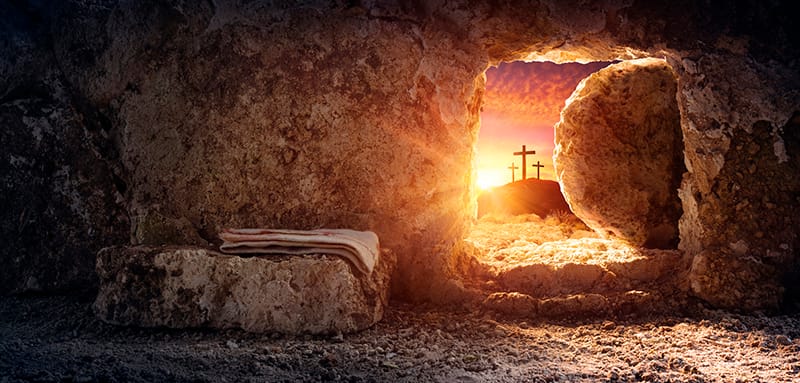
Display the Presentation: Eternal life showing images of Jesus’ resurrection and later ascension.
Remind the children that because there are no known descriptions of Jesus from his time, all images of Jesus are based on later artists’ ideas and interpretations of how they believe events may have looked at the time.
Ask the children to discuss what is happening at this point in the Easter story.
Take feedback and explain that the images show artists’ interpretations of Jesus’ crucifixion and his resurrection. Ensure the children understand that ‘crucifixion’ refers to being nailed or tied to a cross as a form of execution and ‘resurrection’ refers to the act of coming back to life.
Take feedback and explain that many Christians believe Jesus’ death and resurrection are proof of eternal life after death.
Divide the children into groups of four and hand out a copy of the Activity: Eternal life and a couple of highlighters to each group.
Explain that in their groups, they will read through different Bible passages and quotes to find out what eternal life might mean to some Christians and what the Easter story might suggest about life after death.
Take feedback using the following questions to guide the discussion:
Explain to the children that at Easter time, Christians celebrate the day Jesus died on Good Friday. Ask them to discuss in pairs why they think a day about the death of someone is named ‘good’ and take feedback.
Use slides 2–6 of the Presentation: Eternal life to explain that many Christians believe Jesus’ death and the events of Holy Week fulfilled ancient prophecies.
Explain that for many Christians, Jesus’ death on Good Friday symbolises sacrifice, restoring humanity’s relationship with God, hope and forgiveness.
Remind the children that for forty days after his resurrection, Christians believe Jesus spent time on Earth with his disciples before returning to God in heaven. Ask them to discuss what he might have said to them in pairs and take feedback.
Hand out the Activity: Messages (one each) and ask the children to write down a message Jesus may have shared with his disciples.
Encourage the children to think about different parts of Holy Week, the symbolism of different events and what might be comforting for them to know.
Display the Resource: Jesus’ messages on the flipchart and invite some children to share their ideas and stick them around the image.
Display the Presentation: Wrapping up words.
Ask the children to discuss in pairs:
Learning objective
Success criteria
Vocabulary
Using the extended display mode will allow you to view your lesson plan on one screen, while displaying presentation mode on the other.
Follow this guide or watch our explainer video to extend your display.
How to extend your display to view the lesson page and presentation mode simultaneously. Choose your operating system below to watch the video
If you need further support with extending your display,
please contact [email protected].
Extended-mode explainer video: For Mac
Extended-mode explainer video: For Windows
Pupils needing support:
Could use the Resource: Knowledge organiser to recap the Easter story for the Recap and recall; could use Activity: Eternal life (support) to find examples of forgiveness and eternal life; could talk through the Resource: Concept words (support) or review them before the lesson.
Pupils working at greater depth:
Should consider any additional values, meanings or messages that could be uncovered from the Easter story (e.g. friendship, trust, etc) and think about what these might suggest about death; should explore alternative accounts of the passages from the Gospels or read the full passages in the Bible.
Pupils with secure understanding indicated by: discussing why Jesus’ death and resurrection are significant to many Christians; listing some Christian beliefs about life after death; explaining why Good Friday is named as such.
Pupils working at greater depth indicated by: comparing different accounts of Jesus’ death and resurrection; exploring further passages from the Bible.
The event in which Christians believe Jesus rose into heaven.
Killing someone by nailing or tying them to a cross.
Explaining or understanding the meaning of something.
The act of coming back to life.
We welcome your feedback to help make our resources even better
Assessment - R&W Y5: What happens when we die? (Part 2)

Lesson 1: If there is a soul, where does it go?
Lesson 2: What is samsara?
Lesson 3: How might someone reach moksha?
Lesson 4: How can people find comfort after death?
Lesson 5: What is nirvana?
Lesson 6: What does enlightenment look like?
Optional Easter lesson: What might the Easter story suggest about life after death?
Originally created by:
Maintained by: Kapow Primary team
Last update: 23rd April, 2026
Exploring the significance of Jesus' death and resurrection to some Christians.
