




- Subjects >
- Science >
- Key stage 2 >
- Year 5 >
Unit outcomes
Pupils who are secure will be able to:
- Determine the hardness of different materials and link this to their uses.
- Determine the transparency of different materials and link this to their uses.
- Determine the thermal and electrical conductivity of different materials and link this to their uses.
- Demonstrate, identify and describe reversible and irreversible changes.
When working scientifically pupils who are secure will be able to:
- Evaluate the hardness test to determine the degree of trust in the results.
- Plan and draw a table of results.
- Write a detailed, organised and easy to follow method.
- Write a prediction using prior knowledge of the states of matter.
- Analyse observations about rusting and use them to support a conclusion.
- Measure accurately in centimetres.
Suggested prior learning
Materials: Mixtures and separation
Get started
Lessons
Lesson 1: Hardness
Lesson 2: Transparency
Lesson 3: Conductivity
Lesson 4: Reversible changes
Lesson 5: Irreversible changes: Burning and rusting
Lesson 6: Irreversible changes: Mixing
Key skills
Planning
- Writing a

This content is for subscribers only. Join for access today.
Key knowledge
- To describe
This content is for subscribers only. Join for access today.
Key vocabulary
burning
control variable (LKS2)
This content is for subscribers only. Join for access today.
Equipment list
Equipment needed across all lessons in this unit.
This list does not include equipment which is usually readily available in the classroom (e.g pencils, A4 paper etc)
 Download
Full equipment list for the subject
Quantities marked × will update. Items without quantities are unaffected
- Materials to test and sort according to hardness ×8
- Materials to test and sort according to transparency ×8
- Materials to test according to thermal conductivity ×8
-
Materials to melt
×1 -
Materials to burn
×1 -
Light meter app, data loggers or light meters
×1 - Magnifying glasses ×30
- Thermometers ×1
- Stopwatch / timer ×8
- Permanent markers ×30
- Sticky tape ×1
- Battery-operated tea lights ×8
-
Candle lighters or long matches
×8 -
Heat mat or foil trays of sand
×1 -
Foil cupcake cases
×8 -
Tongs
×8 -
Metal spoon
×8 -
A steel wool scouring pad
×1 -
Vinegar
×1 - Bicarbonate of soda ×1
- Tablets ×15
- Plastic cups ×30
- Plastic bottle ×8
-
Plastic trays
×8 -
A jar of water with lid
×1 -
A bucket of water
×1 -
Safety goggles
×8 - Balloons As needed
- String ×1
- Nails ×10
- Paper clips ×30
- Petroleum jelly ×1
This content is for subscribers only. Join for access today.
Related content
Unit resources


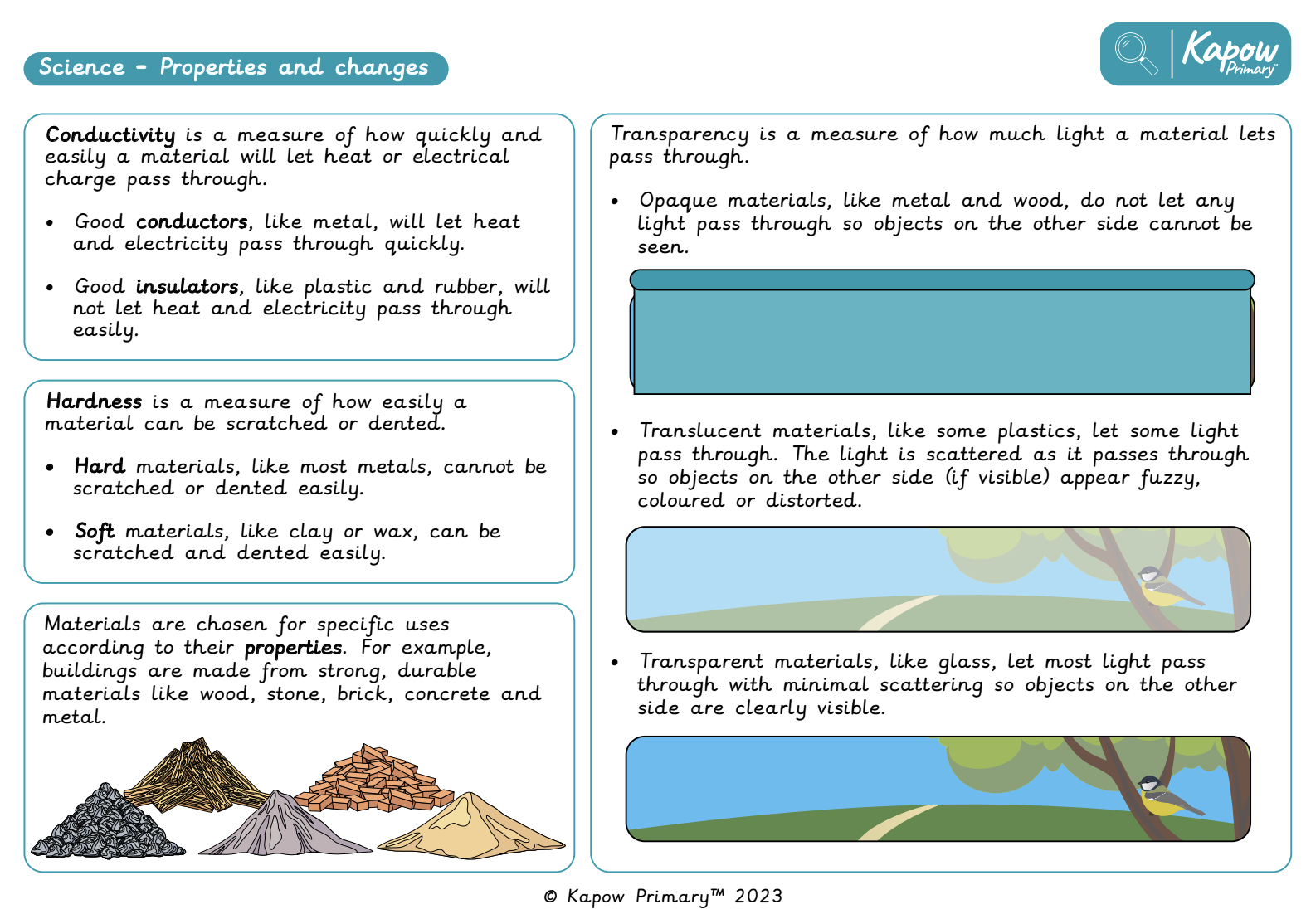
Knowledge organiser – Science Y5: Materials: Properties and changes
Aimed at pupils, two pages providing key facts and definitions from the unit ‘Properties and changes'.
Vocabulary display – Science Y5: Materials: Properties and changes
A display version of the vocabulary for the unit ‘Properties and changes’.
Subject resources
This content is for subscribers only. Join for access today.
Cross-curricular opportunities
British values: mutual respect.
