




- Subjects >
- Science >
- Key stage 2 >
- Year 6 >
Unit outcomes
Pupils who are secure will be able to:
- Describe the function of key electrical components and explain how the models used in the lesson represent these.
- Correctly predict if an electrical circuit will work or not, explaining why using their knowledge of complete loops, power sources and presence of components.
- Describe the relationship between the number of bulbs in a circuit, the bulb brightness and the amount of resistance.
- Explain that increasing the number of components increases the resistance, affecting the flow of current and energy transferred.
- Identify that batteries are a voltage source; they come in different voltages, affecting bulb brightness.
- Describe that voltage can be changed using different numbers of cells in a circuit and that more cells or a higher voltage causes brighter bulbs.
- Use the relationship between voltage and bulbs to predict what will happen with buzzers and motors.
- Build an electrical circuit with a switch to control its function, explain how the switch and the electrical circuit solve the problem and recall different examples of problems that can be solved using an electrical circuit.
When working scientifically, pupils who are secure will be able to:
- Draw circuit diagrams with straight lines and using standard circuit symbols.
- Design a results table with an appropriate number of columns and headings with units.
- Identify the changed, measured and control variables in an enquiry to plan a method.
Please note that Kapow Primary Science lessons are designed to be 1 hour and 30 minutes long to reflect the requirements of a core subject.
Suggested prior learning
Energy: Electricity and circuits
Get started
Lessons
Lesson 1: Components and circuits
Lesson 2: Circuit diagrams
Lesson 3: Current and resistance
Lesson 4: Batteries and voltage
Lesson 5: Voltage and bulb brightness
Lesson 6: Practical circuits
Key skills
Planning
- Suggesting which variables will

This content is for subscribers only. Join for access today.
Key knowledge
To know:
- A variety of
This content is for subscribers only. Join for access today.
Key vocabulary
anomaly
cell
This content is for subscribers only. Join for access today.
Equipment list
Equipment needed across all lessons in this unit.
This list does not include equipment which is usually readily available in the classroom (e.g pencils, A4 paper etc)
 Download
Full equipment list for the subject
Quantities marked × will update. Items without quantities are unaffected
-
A range of batteries (including different sizes of 1.5 V button cell batteries, 3V button cell batteries, AAA, AA, C, D, 9V and a camera battery).
×1 -
Cups
×30 - Bowls 2
-
Wrapped sweets or counting cubes
×30 - Sticky tack ×1
- Rulers ×30
-
Circuit kits (including: 4 cells/batteries, 5 wires with and without clips, switches, 5 bulbs, a buzzer)
×8 -
Ammeters (one for the teacher; optional for the class)
×1 -
Motors (teacher demonstration).
×1 - Dice ×15
-
Large space such as a playground or hall
×1 - Large plastic hoops ×15
- Calculators ×30
- Devices with internet access ×15
-
Short lengths of cardboard tube.
×8 -
Data loggers or light meters to record light intensity/brightness in lux (apps on devices would also work).
×1 -
One data logger or decibel meter to measure volume, or decibel app on a device (teacher demonstration).
×1 -
Equipment for practical circuit building to be shared (tin foil, sticky tape, double-sided tape, paper clips, sharp pencils and modelling dough).
×8 -
Equipment for building a greetings card (A4 white card, colouring pencils or pens, 2 cells, a buzzer or bulb/LED, wires, optional copper tape, a switch).
×8 -
Equipment for building a burglar alarm (thick card from a box, tin foil, cells, a buzzer and a bulb, wires)
×8 -
Equipment for building a dog’s push button (sponge, split pins, thin cardboard, cells, wires, a buzzer and a bulb).
×8 -
Equipment for building a water butt alarm (milk bottle lids, a jar or small bucket, tin foil, lolly sticks or similar, modelling dough or sticky tack, cells, wires, a buzzer and a bulb).
×8
The equipment below is optional
- Chalk ×30
-
Tricky circuit building kit (9V battery, paper, LED, 6B or 8B graphite pencil, copper tape or foil, a paper clip)
×1 -
A camera for recording
×1
This content is for subscribers only. Join for access today.
Related content
Unit resources


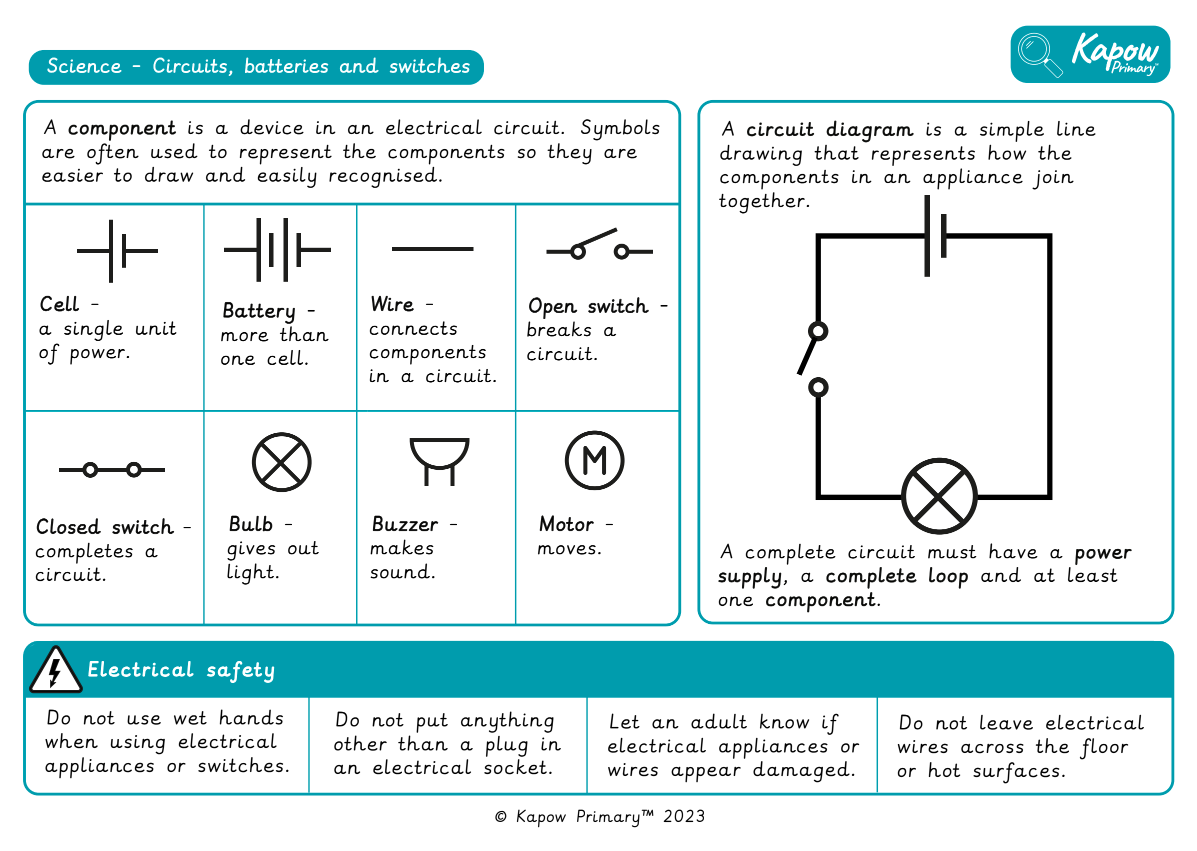
Knowledge organiser – Science Y6: Energy: Circuits, batteries and switches
Aimed at pupils, two pages providing key facts and definitions from the unit 'Circuits, batteries and switches'.
Vocabulary display – Science Y6: Energy: Circuits, batteries and switches
A display version of the vocabulary from the unit 'Circuits, batteries and switches'.
Subject resources
This content is for subscribers only. Join for access today.
Cross-curricular opportunities
English: Spoken language.
Mathematics: Number – addition, subtraction, multiplication and division; Measurement; Statistics.
Design and technology: Design; Technical knowledge.
British values: Mutual respect; Democracy.
