




- Subjects >
- Spanish >
- Key stage 2 >
- Year 3 >
Unit outcomes
Pupils who are secure will be able to:
- Count to 12 in Spanish, focusing on good pronunciation.
- Recognise and sound out phonemes for letters ‘u’ and ‘z’, ‘ñ’.
- Identify the structure for saying how old they are and modify the sentence using different number words.
- Begin to recognise the verb ‘to have’ in first person present (Tengo).
- Explain what a cognate is and suggest examples.
- Apply and describe different detective skills: using logic, context and knowledge of language.
- Compare Christmas traditions from Spain with other countries.
Suggested prior learning
Unit 1: Spanish greetings with puppets
Get started
Lessons
Lesson 1: Counting to six
Lesson 2: Ten little fingers
Lesson 3: How many?
Lesson 4: How old are you?
Lesson 5: Asking questions
Lesson 6: Festivities in Spain
Key skills
Language comprehension
- Listening

This content is for subscribers only. Join for access today.
Key knowledge
Phonics
- To become
This content is for subscribers only. Join for access today.
Key vocabulary
uno
dos
This content is for subscribers only. Join for access today.
Equipment list
Equipment needed across all lessons in this unit.
This list does not include equipment which is usually readily available in the classroom (e.g pencils, A4 paper etc)
 Download
Full equipment list for the subject
Quantities marked × will update. Items without quantities are unaffected
- Dice ×15
- Counters ×30
- Teddy or soft toy 1
- Scissors right- and left-handed options recommended. ×30
The equipment below is optional
- Tennis balls or balloons Per group: 7
This content is for subscribers only. Join for access today.
Spanish phonics videos
Related content
Unit resources


Knowledge organiser: Spanish – Numbers and ages
Aimed at pupils, two pages providing key facts and definitions from the unit "Spanish numbers and ages".
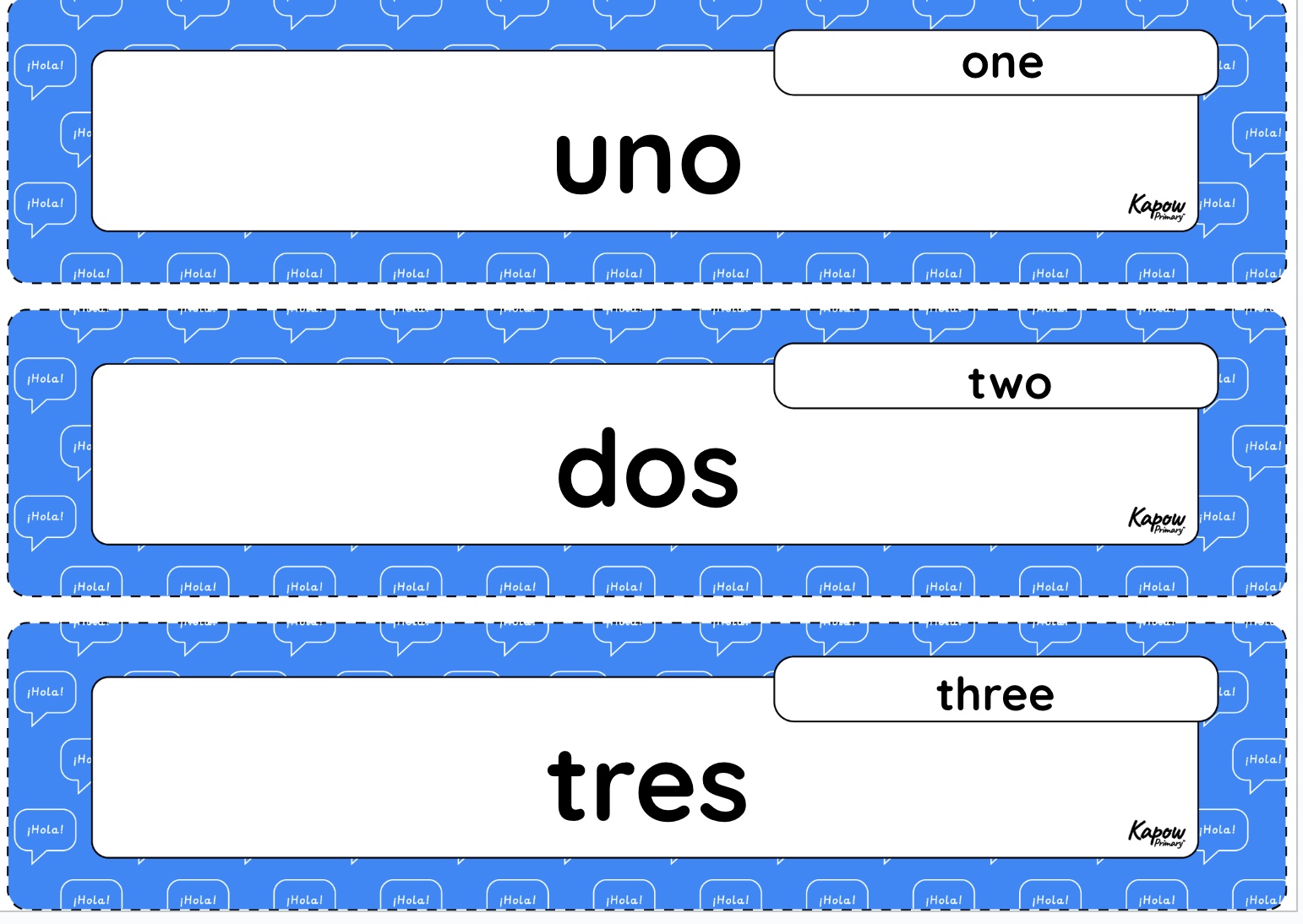
Vocabulary display: Spanish numbers and ages
A display version of the key vocabulary from the unit 'Spanish numbers and ages'.
Translations: Spanish numbers and ages
Translations of key texts and transcripts from resources in this unit.
Subject resources
This content is for subscribers only. Join for access today.
Cross-curricular opportunities
Mathematics
Number – addition and subtraction: Solve problems, including missing number problems, using number facts, place value, and more complex addition and subtraction.
Number and place value (KS1): Read and write numbers from 1 to 20 in numerals and words.
English
Writing – composition: Draft and write by: Composing and rehearsing sentences orally (including dialogue), progressively building a varied and rich vocabulary and an increasing range of sentence structures.
Music: Listen with attention to detail and recall sounds with increasing aural memory.
Build on the learning
Unit 3: Shapes and colours in Spanish
Get started
