Lesson 4: Does being good always mean less suffering?
Interpreting what some stories from scripture might suggest about why people experience suffering.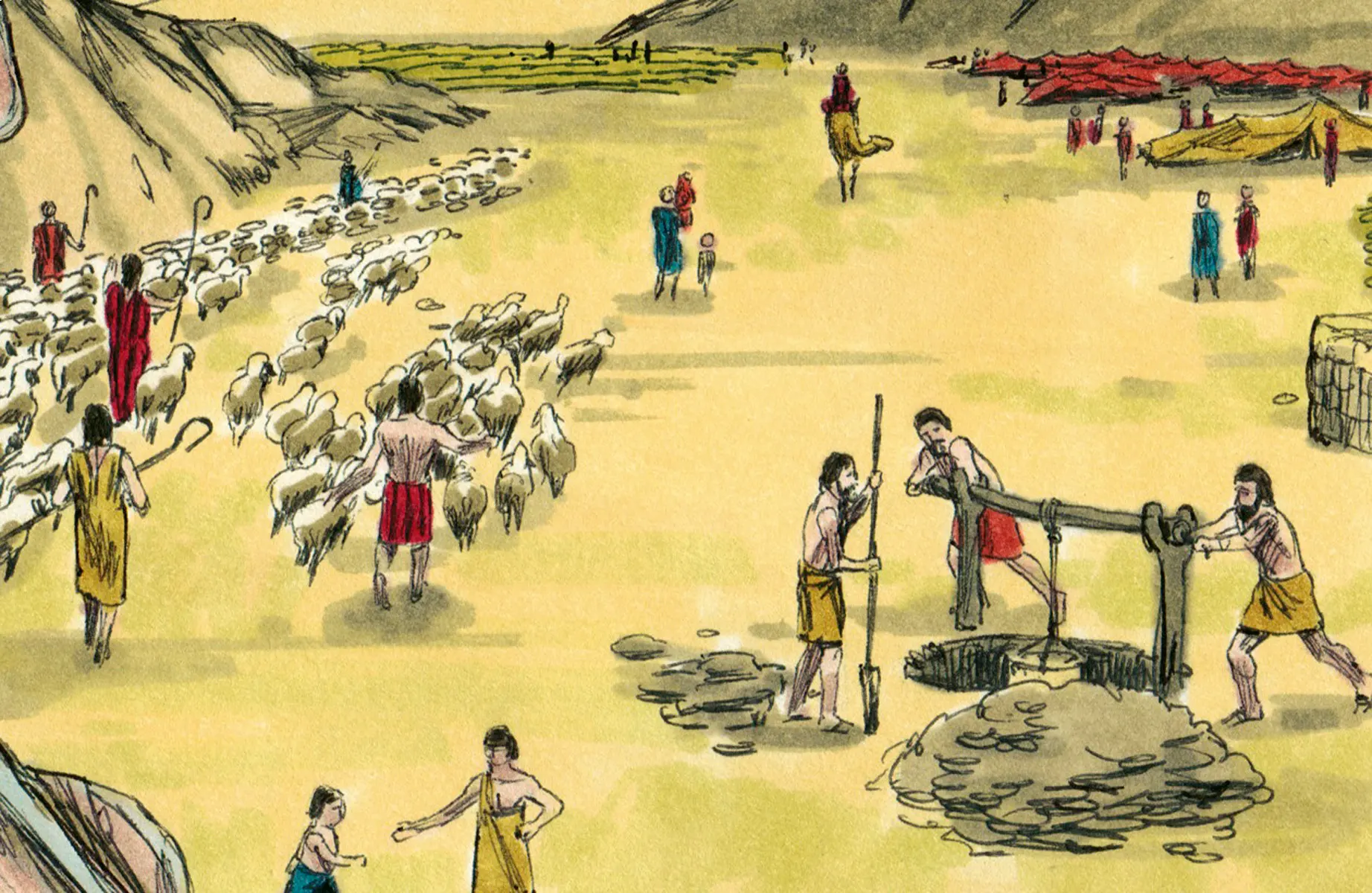
Learning objective
- To explore beliefs about suffering and goodness through scripture and personal responses.
Success criteria
- I can interpret stories from scripture.
- I can consider what the stories of Job and Noah suggest about suffering.
- I can discuss beliefs about God based on interpretations of the stories.
Before the lesson
Check all images, videos, links and presentation slides are suitable for your class.
Presentation: Odd one out.
Presentation: Bad news.
Presentation: The story of Job.
Presentation: Noah's ark.
Presentation: Suffering snowflake.
Presentation: Controversial and contradictory.
Whiteboards and pens (optional - one each, see main event).
A children's Bible (optional - see Main event).
Children's copies of the Activity: Suffering snowflake (see Lesson 3: Why do we cause suffering?).
Subject knowledge
Divine intervention
Divine intervention is the belief that a god or higher power steps in to help or change a situation in the world. Some people believe that supernatural or divine powers can cause or stop suffering.
The story of Job
The story of Job is a narrative found in the Book of Iyov (Job) in the Tenak (Hebrew Bible) and also in the Christian Bible and the Qur’an. The version in this lesson is written based on Christian interpretations of Satan, although the lessons about suffering taken from the story are often similar for many Christian, Jewish and Muslim interpretations.
Job is described as a wealthy, righteous and God-fearing man living in the land of Uz. Satan suggests to God that Job is only righteous because he has been so blessed and that if he experienced hardship and suffering, he would turn from God. God allows Satan to test Job as long as he does not kill him.
Job’s faith is tested through a series of devastating losses, including his livestock, servants and all of his children. Despite these tragedies, Job initially remains strong in his faith and does not curse God.
Job is then afflicted with painful sores all over his body. His wife encourages him to curse God and die but Job refuses, struggling to understand the reason for his suffering.
Job is visited by three friends who suggest that his suffering must be a punishment for sin. Job rejects this, maintaining his innocence and questioning why sometimes good people suffer while those who do wrong prosper.
Throughout the dialogues, Job expresses deep anguish and questions God but does not reject God. God responds, reminding Job and his friends that there are many things they do not know or understand about the world.
The story can be interpreted in different ways so it is important to encourage children to consider what the story might suggest and discuss different ways parts of the story can be viewed.
The versions of the story used in the lesson are based on the scripture text, written to be appropriate and accessible for the children.
Satan
Satan, sometimes referred to as the devil, is a force or figure that appears in various religious worldviews, particularly within Christian, Jewish and Muslim scripture and teachings, with differing interpretations.
For many Christians, Satan is traditionally seen as a fallen angel, originally named Lucifer, who rebelled against God. He's often associated with the serpent in the Garden of Eden, though this is an interpretation rather than explicit in scripture. Portrayed as the tempter and the accuser, he is seen as the embodiment of evil, opposing God and leading humans into sin.
In the Tenak, 'Ha satan' - meaning the satan, the adversary or the negative force - is used rather than using Satan as a name. In Jewish teachings, this force is not considered an actual entity which could be considered an equal power to God.
Known as Iblis or Shaytan in Muslim teachings, he is described as a Jinn (an intelligent spirit lower than an angel and able to appear in human and animal forms and to possess humans). It is believed that Iblis refused to bow to Adam at God’s command, as a result, he was cast out of heaven but given respite until the Day of Judgment. Considered a tempter who whispers evil suggestions into the hearts of men and women, he is seen as leading humans away from the path of righteousness. Most Muslims believe Satan's power is limited; he cannot force people to do evil but only suggests or whispers.
If you know a child has specific issues, consider discussing the lesson with them in advance and adapting it as needed. They might benefit from adult support. If problems emerge during the lesson, consult your Senior Leadership Team.It is the teacher’s responsibility to check all resources and lesson content to ensure it is suitable for their class setting.
Sensitivities
Please be aware that this unit of learning deals with the concept of suffering and explores various beliefs and practices surrounding it. As suffering is something that will impact all children at some point in their lives, it is important to create a safe space for them to discuss and consider their ideas about it. This will help them develop their own worldview while also preparing them for future experiences. The subject of suffering can be sensitive and may be personally affecting for some children. It is important to approach this topic with compassion and consideration for the experiences and emotions of all children.
Satan
This lesson includes references to Satan, sometimes referred to as the devil, which some children may find uncomfortable or distressing. Ensure that the content and discussion are suitable for the context of your class and remain age-appropriate, tailoring the content and discussions to be sensitive to your children's maturity.
Enslavement
The story of Job includes references to servants, who, given the historical context, were likely to be slaves. When discussing the topic of enslaved people, it is crucial to approach the subject with sensitivity and respect. Acknowledge the profound suffering and injustice experienced by those who were enslaved, and recognise the lasting impact on their descendants and communities. Teachers should create a respectful environment where pupils feel safe to express their thoughts and emotions.
Lesson plan
Explain that the children will look at the pictures and decide which picture in each group could be the odd one out and why. Display the Presentation: Odd one out and arrange the children in pairs. Ask them to discuss which picture is the odd one out and why.
Invite children to share their ideas and encourage them to justify their answers. They may suggest:
The people praying because the other two show ideas about reasons for suffering, whereas the praying is a response to suffering.
The balance scale as the other two are both linked to Muslim ideas about inner jihad.
The scale, because it represents ideas about positive and negative spirits, but the others are more about focusing on God.
Note: there are multiple possible answers to this question.
Display the Presentation: Bad news and ask the children to think about how they might feel and react if they experienced the things in the images.
Hand out the Activity: Bad events to each table group and ask the children to record their ideas. They could use thought bubbles, emojis and words around the images to record their ideas.
Share ideas and explain that during the lesson, they will explore a story about someone who experienced all of these things and interpret what the story might suggest to people about suffering.
The story of Job
Display the Presentation: The story of Job. Use slide 1 to explain some of the story's context to the children by clicking on each image to reveal some information.
Optional: hand out the Resource: The story of Job and ask the children to use a piece of paper or a whiteboard to cover the rest of the text as they read so they don't reveal what happens next.
Display slide 2 and listen to the audio of the story from the point of view of Job.
Questions
- What do you think will happen?
- What do you expect the rest of Job’s life will be like?
- Why might you expect that?
Display slide 3 and listen to the next part of the story using the audio.
Questions
- What do you think will happen next?
- What might Job do?
- What might God do?
Work through the remaining slides to listen to the rest of the story.
Questions
- Did anything in the story surprise you?
- Has anything like what happened to Job ever happened to you?
- Why do you think God did not stop Job’s suffering? (Answers may include: to test Job's faith and loyalty; to show that someone can be faithful even in difficult times; to teach a lesson that faith is not dependent on one's circumstances; it might suggest that suffering is a part of life that still happens to good people; because he had made a deal with Satan.)
- What might the story suggest to some people about God? (Answers may include: God tests humans; God allows suffering for a greater purpose or lesson; God is cruel, as he does not stop Job's suffering; God has power over human circumstances.)
Hand out the Activity: The story of Job (one each). Explain to the children that they should draw or write an example from the story that demonstrates the possible reasons for suffering shown on the grid, using the Resource: The story of Job (one between two) to remind them of what happened and how Job responded.
For example:
Learning: God teaches Job and his friends that they should not try to understand everything that happens.
Balance of good and bad: Job tells his wife that they should accept good and bad from God.
Later blessings: good things happen for Job at the end of the story.
Connection with God: Job talks to God, and God responds.
Developing trust: when Job does not understand, he has to trust God.
Building relationships: Job talks to his friends about what is happening.
Take feedback and discuss what the children think the story suggests about the reasons for suffering to them personally. The children can record their responses at the bottom of the Activity: The story of Job.
Noah's ark
Explain that they will now look at another story, which is recorded in the Tenak, Christian Bible and Qur'an, and see what it might suggest about suffering.
Display slides 1 and 2 of the Presentation: Noah's ark and share the information before reading the story using the Resource: Noah's ark or using an appropriate children's Bible (Genesis 6:9–8:19).
Ask the children to identify the suffering in the story (the flood caused suffering to people and animals), the cause of the suffering (God) and the reason for the suffering (as a punishment or cleansing).
Use slide 3 to display the following questions and discuss them as a class, ensuring that the children understand there are different interpretations of the story as with all scripture and that they must respect interpretations different to their own.
Questions
- How does this story relate to what God said in the creation story? (In the creation story, God said everything was good but in this story, God does not like what is happening on Earth.)
- Why does God think the world is not good anymore? (Because people are corrupt—doing bad things—and it is full of violence.)
- What might this story suggest about suffering? (Answers may include: God caused the flood because of people's bad choices so maybe wrong choices can cause suffering; Noah was saved because he was good, which suggests that God protects good people; even after bad things happen, there can be good things or a fresh start; God promised at the end not to cause a flood again, some people might think this means God can control natural disasters; for some people the story suggests that God causes suffering and they might think this means God is cruel.)
Read slides 4 to 6 and explain that this is the end of the story of Noah's ark. Discuss as a class how this part of the story may help some people to understand and cope with suffering.
Discussion points may include:
For some people, this may give them hope that suffering this extreme will not happen again.
It could make some people trust God to be in control of suffering.
Even if someone does not believe in God the ending of the story may help them to feel hopeful as it has a positive ending.
Many people find rainbows hopeful and happy; it might be linked to this story or just because they are colourful.
Display slide 1 of the Presentation: Suffering snowflake and hand out the children's copies of the Activity: Suffering snowflake.
Display some examples on slide 2.
Remind the children that, based on what they have learnt in this lesson, they should write one or two different reasons people believe suffering exists.
Ask the children to record how much they agree with the new reasons by putting a mark on the lines connecting the boxes. The more they agree with the statement, the closer to the box and so further from the centre they should put their mark.
Point out that when reading and discussing the stories, there were different ideas about their meanings (interpretations). Explain that stories can be interpreted in different ways and that people, even within a worldview, do not always agree on what they mean but discussing them and listening to other ideas can help deepen understanding.
Display the Presentation: Controversial and contradictory and talk through the meaning of each word using the definitions and examples.
Ask the children to look at the reasons for suffering on their snowflakes so far and discuss any they think are contradictory or controversial.
For example:
Saying that God causes suffering as a punishment could be controversial, as many people who believe in God say he is loving and forgiving.
The ideas of suffering being caused by human choices and suffering being caused by Satan could be seen as contradictory.
Activity
Write a question-and-answer interview with either Job or Noah about their experiences, reactions and reflections on the stories from the lesson. This could be done in pairs, with one child writing the questions and the other writing the answers from the point of view of Job or Noah.
Full-screen slides, ready for your classroom, chosen by you.
- To explore beliefs about suffering and goodness through scripture and personal responses.
We value your feedback
We welcome your feedback to help make our resources even better
In this unit