




Unit outcomes
Pupils who are secure will be able to:
- Recognise some ways Hindu worship is influenced by geography, history and culture.
- List how some people in the Hindu community practise their religion in the UK.
- Suggest similarities and differences between how people practise their religion in the UK and India.
- Understand that being part of a religion does not always mean a person is a theist.
- Consider how a person may identify as a Sikh.
- List ways some Sikhs feel part of the community.
- Consider the symbolism of light in different worldview stories.
- List some similarities and differences between the way Buddhist monks and lay people spend their day.
- Describe different ways a Buddhist can practice to fulfil a discipline.
Suggested prior learning
Why does religion look different around the world? (Part 1)
Get started
Teacher video: What does religion look like around the world?

Lessons
Lesson 1: How can God be linked to a place?
Lesson 2: What can it be like as a Hindu in the UK?
Lesson 3: What does being Sikh mean to different people?
Lesson 4: Why are festivals of light important in different worldviews?
Lesson 5: How do some Buddhists practise beliefs in their daily lives?
Lesson 6: Do all Buddhists practise in the same way?
Optional: Who celebrates Christmas?
Key skills
Disciplinary
- Asking challenging

This content is for subscribers only. Join for access today.
Key knowledge
Substantive
To know:
- Some of the
This content is for subscribers only. Join for access today.
Key vocabulary
diversity
Jain
This content is for subscribers only. Join for access today.
Equipment list
Equipment needed across all lessons in this unit.
This list does not include equipment which is usually readily available in the classroom (e.g pencils, A4 paper etc)
 Download
Full equipment list for the subject
Quantities marked × will update. Items without quantities are unaffected
- Wonder box ×1
- Flipchart ×1
- Paper ×30
- Colouring pencils ×15
- A variety of activity stations: each featuring a chosen activity and the relevant resources ×1
This content is for subscribers only. Join for access today.
Related content
Unit resources


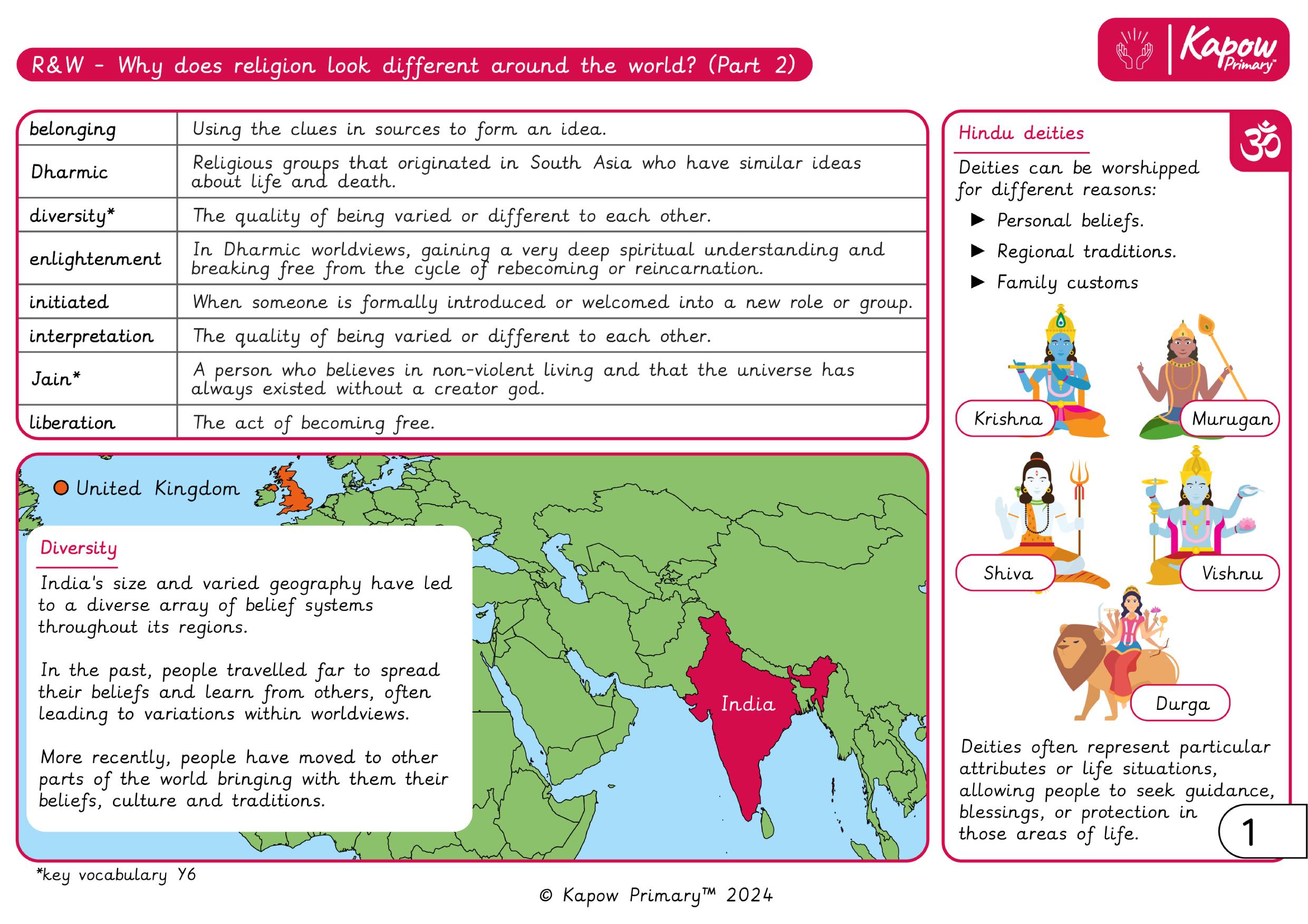
Knowledge organiser – R&W Y6: Why does religion look different around the world? (Part 2)
Aimed at pupils, a double page document that gives key facts and definitions from the unit "Why does religion look…
Vocabulary display – R&W Y6: Why do religions look different around the world? (Part 2)
A display version of the vocabulary from the 'Why do religions look different around the world? (Part 2)' unit.
Subject resources
This content is for subscribers only. Join for access today.
Cross-curricular opportunities
British Values: Tolerance of different cultures and religions, mutual respect.
English: Reading comprehension, writing, spoken language.
Geography: Human and physical geography.
RSE: Respectful relationships.
Build on the learning
Why is it better to be there in person?
Get started
