




Please note
This unit has been replaced by the unit *New* Electrical systems: Wobble bots.
Unit outcomes
Pupils who are secure will be able to:
- Identify simple circuit components (battery, bulb and switch) with a basic explanation of their function.
- Explain that a series circuit is assembled in a loop to allow the electricity to flow along one path.
- Describe a motor as a circuit component that changes electrical energy into movement.
- Provide examples of motorised products that use movement to rotate or spin different parts.
- Remove and replace different parts of a Doodler, as part of a team.
- Suggest ways to switch the configuration to amend the form or function of the Doodler.
- Explain, in an investigation report, each of the changes they made and the effect this had on the Doodler’s ability to draw scribbles (function) and appearance (form).
- Develop design criteria with consideration for the target user, the purpose of their Doodler, a key function and the Doodler’s form and final appearance (e.g. fun, bright, soft).
- Explain simply why their Doodler has a certain configuration based on the findings of their investigation (e.g. I used four pens because the Doodler would fall over with two).
- Create a functional Doodler that creates scribbles on paper with or without a switch.
- Identify and list each of the required materials, tools and circuit components required to build a Doodler.
- Explain simply the steps to assemble a Doodler as part of a set of instructions (or storyboard).
- Write instructions to build a functional circuit, explaining how to identify if it is functional or not.
- Provide suggestions to improve a peer’s set of instructions after testing how effective they are at guiding someone.
Suggested prior learning
Electrical systems: Torches
Get started
Lessons
Lesson 1: Electrical systems and motors
Lesson 2: Meet the Doodlers
Lesson 3: Doodler design and construction
Lesson 4: Doodler DIY kits
Key skills
- Identifying factors that could

This content is for subscribers only. Join for access today.
Key knowledge
- To know that, in
This content is for subscribers only. Join for access today.
Key vocabulary
circuit component
configuration
This content is for subscribers only. Join for access today.
Equipment list
Equipment needed across all lessons in this unit.
This list does not include equipment which is usually readily available in the classroom (e.g pencils, A4 paper etc)
 Download
Full equipment list for the subject
Quantities marked × will update. Items without quantities are unaffected
You will need to pre-build your own Doodlers before starting this unit
- Simple circuit components: crocodile wires, AA batteries and holders, DC motors and holders, switches
- Examples of motorised products, such as: fan, remote control car, record player (optional)
- Large paper ×30
- Scissors right- and left-handed options recommended. ×30
- Hot glue sticks As needed
- Plasticine ×30
- Pencils ×30
- Masking tape
- Paper cups ×30
- Wax Crayons ×30
- Decorative craft items, such as: googly eyes, pom-poms, stickers, sequins etc
- Colouring pencils ×30
This content is for subscribers only. Join for access today.
Related content
Unit resources


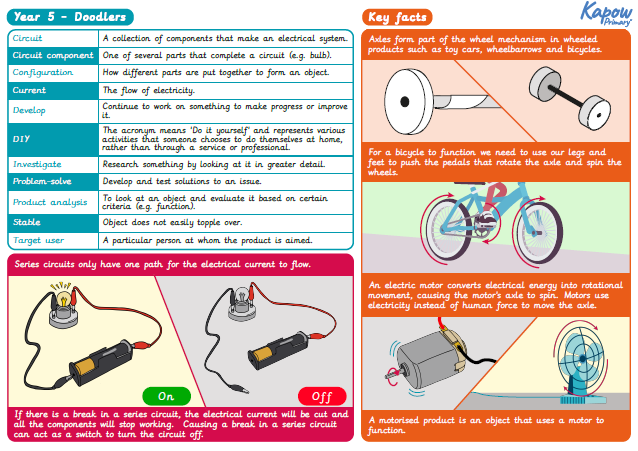
Knowledge organiser – DT: Y5 Electrical systems: Doodlers
Aimed at pupils, a single page which gives key facts and definitions from the unit "Electrical systems: Doodlers".
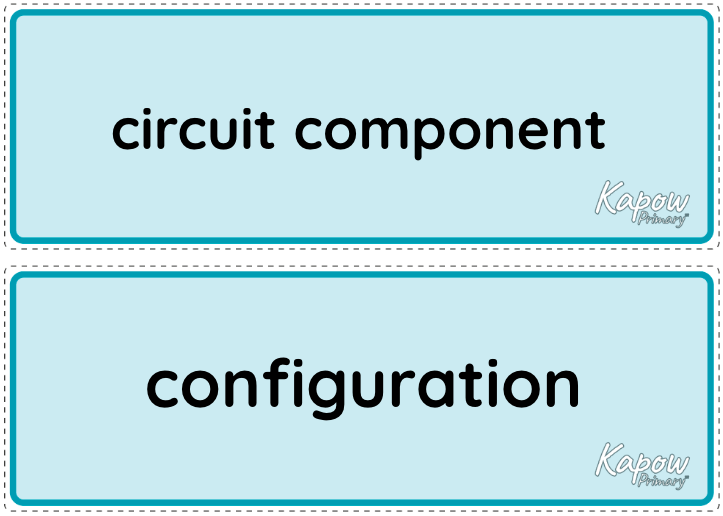
Vocabulary display – D&T Y5: Electrical systems: Doodlers
A display version of the vocabulary from the unit 'Doodlers'.
Subject resources
This content is for subscribers only. Join for access today.
Cross-curricular opportunities
Science
‘Pupils should be taught to:
- construct a simple series electrical circuit, identifying and naming its basic parts, including cells, wires, bulbs, switches and buzzers’
See National curriculum - Science key stages 1 to 2.
English
‘Pupils should be taught to:
- evaluate and edit by:
- assessing the effectiveness of their own and others’ writing
- proposing changes to vocabulary, grammar and punctuation to enhance effects and clarify meaning’
Build on the learning
Electrical systems: Steady hand game
Get started
Popular content
- Design and technology: Curriculum portal
- Design and technology: Curriculum information
- Y3 > Structures: Constucting a Castle > Lesson 3: Nets and Structures
- Y3 > Mechanical Systems: Pneumatic Toys > Lesson 1: Exploring Pneumatics
- Y4 > Textiles: Fastenings > Lesson 2: Designing my Book Sleeve
- Y4 > Electrical Systems: Torches > Lesson 3: Torch Design
