




Unit outcomes
Development matters
Communication and language
- Listen to and talk about stories to build familiarity and understanding.
- Engage in storytimes.
Understanding the world
- Recognise that people have different beliefs and celebrate special times in different ways.
See Development Matters (non-statutory curriculum guidance) – contains public sector information licensed under the Open Government Licence v3.0.
Understanding the world
ELG: Comprehension
- Anticipate – where appropriate – key events in stories.
- Use and understand recently introduced vocabulary during discussions about stories, non-fiction, rhymes and poems and during role-play.
ELG: People culture and communities
Children at the expected level of development will:
- Know some similarities and differences between different religious and cultural communities in this country, drawing on their experiences and what has been read in class.
See Statutory framework for the early years foundation stage, 2021.
Suggested prior learning
Why are some things special?
Get started
Choose your lessons
Lesson 1: How do some people treat special books?
Lesson 2: What is your favourite story?
Lesson 3: What makes a story special?
Lesson 4: What can we learn from a Christian story?
Lesson 5: What can we learn from a Hindu story?
Key skills
- Asking questions about things

This content is for subscribers only. Join for access today.
Key knowledge
To know:
- Beliefs are things
This content is for subscribers only. Join for access today.
Key vocabulary
care
Christian
This content is for subscribers only. Join for access today.
Equipment list
Equipment needed across all lessons in this unit.
This list does not include equipment which is usually readily available in the classroom (e.g pencils, A4 paper etc)
 Download
Full equipment list for the subject
Quantities marked × will update. Items without quantities are unaffected
- A3 paper ×8
- Felt tip pens ×30
-
A copy of your favourite story
×1 -
A selection of the children’s favourite storybooks from the classroom or books they have brought in from home
×8 -
An example bookmark
×1 -
Strips of white card, approximately 5 cm wide x 15 cm long
×30 -
Colouring pencils or crayons
×30 -
A beanbag or soft toy
×1 -
Objects connected to the story
×1 - Smooth stones (8-10 cm) ×30
-
Water-based paint pens or felt tips
×30 - Colouring pencils ×30
- Scissors right- and left-handed options recommended. ×15
The equipment below is optional
-
Objects connected to the story, such as a mango (real or plastic), a peacock feather, a globe, a Ganesha statue and a heart cut out of paper
×1 -
Equipment for Story stones
×1 - Pva glue, pots and spreaders ×1
- Scissors right- and left-handed options recommended. ×30
- Equipment for the Activity: Story stone ×1
This content is for subscribers only. Join for access today.
Teacher video: Why are some stories special?

Related content
Unit resources

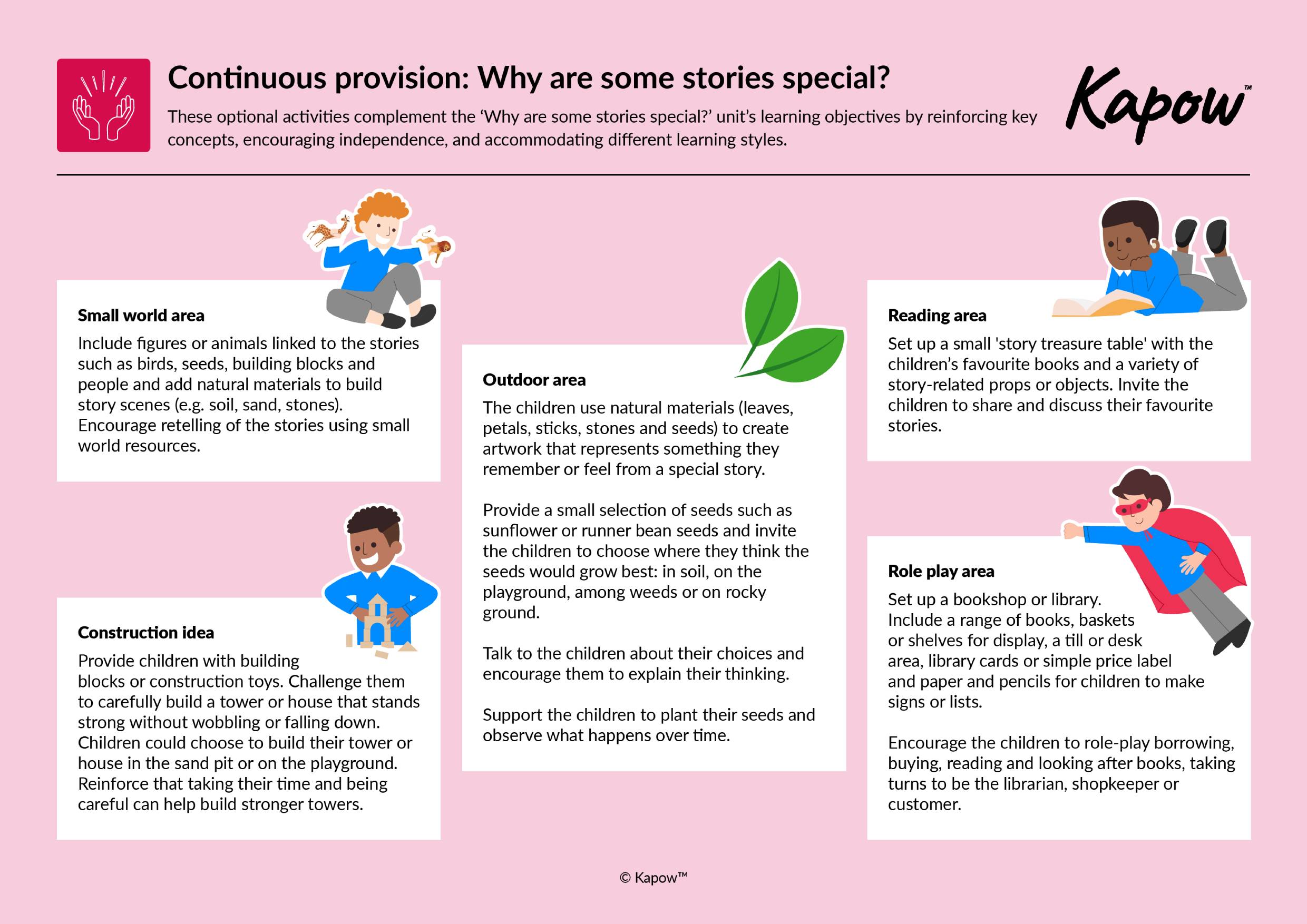
Continuous provision ideas – R&W EYFS: Why are some stories special?
Subject resources
This content is for subscribers only. Join for access today.
Build on the learning
How did the world begin?
Get started
