




Unit outcomes
Development matters
- Talk about members of their immediate family and community.
- Recognise that people have different beliefs and celebrate special times in different ways.
- Explore the natural world around them.
- Describe what they see, hear and feel whilst outside.
See Development Matters (non-statutory curriculum guidance) – contains public sector information licensed under the Open Government Licence v3.0.
Understanding the world
ELG: Past and present
Children at the expected level of development will:
- Talk about the lives of the people around them and their roles in society.
ELG: People culture and communities
Children at the expected level of development will:
- Know some similarities and differences between different religious and cultural communities in this country, drawing on their experiences and what has been read in class.
ELG: The Natural World
Children at the expected level of development will:
- Explore the natural world around them, making observations and drawing pictures of animals and plants.
See Statutory framework for the early years foundation stage, 2021.
Suggested prior learning
Why are some places special?
Get started
Choose your lessons
Lesson 1: What is special about our world?
Lesson 2: Where do some people believe the world came from?
Lesson 3: Why should we look after our world?
Lesson 4: How can we care for the world?

Lesson 5: What is the Easter story?
Key skills
- Asking questions about things

This content is for subscribers only. Join for access today.
Key knowledge
To know:
- Beliefs are things
This content is for subscribers only. Join for access today.
Key vocabulary
belief
believe
This content is for subscribers only. Join for access today.
Equipment list
Equipment needed across all lessons in this unit.
This list does not include equipment which is usually readily available in the classroom (e.g pencils, A4 paper etc)
 Download
Full equipment list for the subject
Quantities marked × will update. Items without quantities are unaffected
-
Colourful chalk
×30 - Wonder box ×1
-
Modelling dough of various colours
×30 -
Simple modelling tools such as rolling pins and safe sculpting tools
×15 - Shaped cutters e.g. a moon, star, tree or people ×15
- Items for making habitat hotels or bird boxes ×8
- A selection of natural materials such as twigs, pinecones, dry leaves, straw and moss.
- A selection of recycled materials such as cardboard boxes and tubes, egg cartons, plant pots, milk cartons and wooden crates
- A5 paper ×30
-
Colouring pencils or crayons
×8
The equipment below is optional
-
Egg boxes with each compartment marked with a different colour
×8 - Device for taking photographs ×8
-
Props to tell the creation story
×1
This content is for subscribers only. Join for access today.
Teacher video: What makes the world special?

Related content
Unit resources

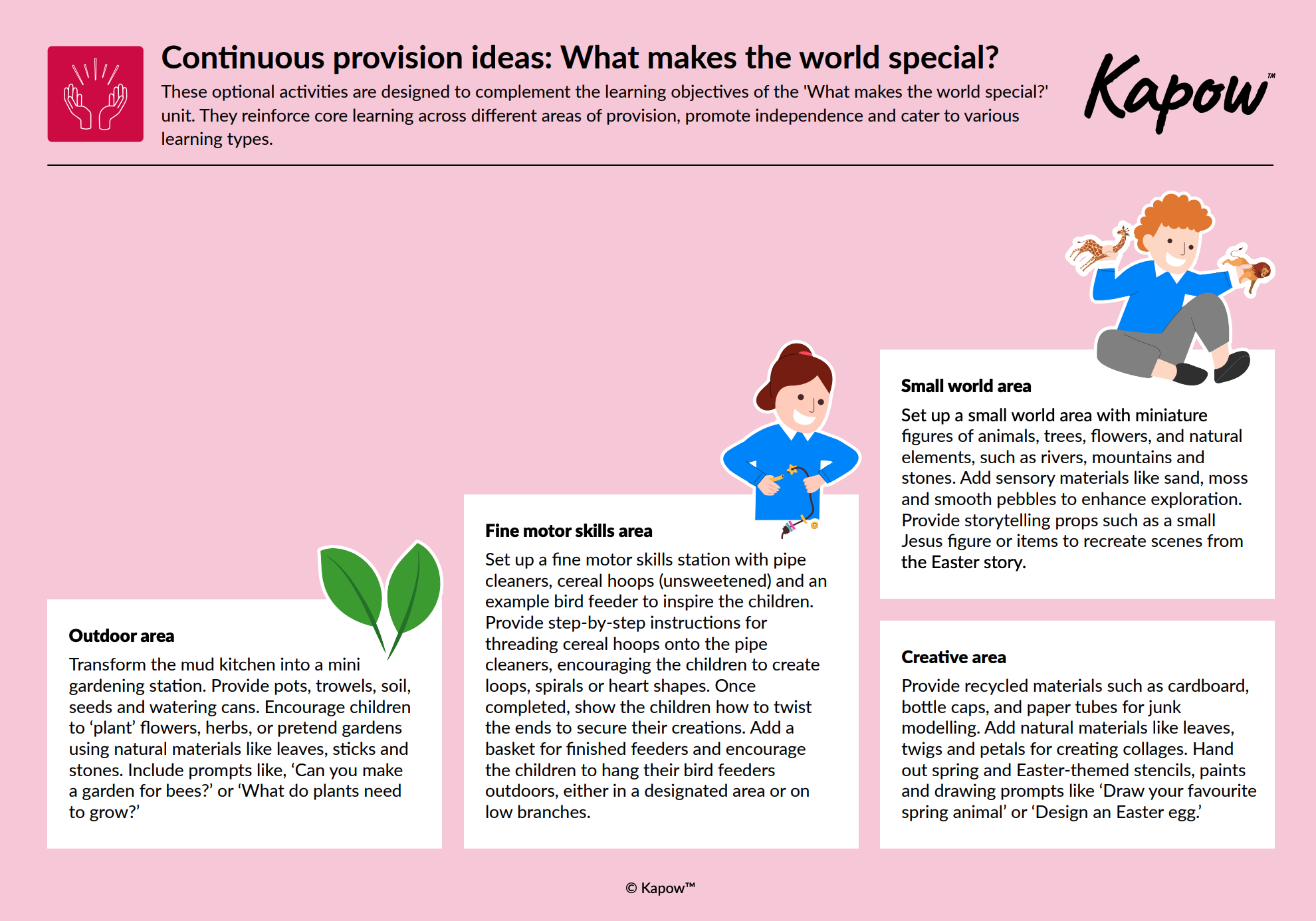
Continuous provision ideas – R&W EYFS: What makes the world special?
Continuous provision activities to complement the EYFS unit 'What makes the world special?'.
Subject resources
This content is for subscribers only. Join for access today.
Build on the learning
Why are some things special?
Get started
