




- Subjects >
- Geography >
- Key stage 2 >
- Year 4 >
Unit outcomes
Pupils who are secure will be able to:
- Identify that different foods grow in different biomes and say why.
- Explain which food has the most significant negative impact on the environment.
- Consider a change people can make to reduce the negative impact of food production.
- Describe the intentions around trading responsibly.
- Explain that food imports can be both helpful and harmful.
- Describe the journey of a cocoa bean.
- Locate countries on a blank world map using an atlas.
- Use a scale bar correctly to measure approximate distances.
- Collect data through an interview process.
- Analyse interview responses to answer an enquiry question.
- Discuss any trends in data collected.
Lesson 5 involves fieldwork on the school grounds. It is important to risk-assess the proposed route taking into account any relevant school risk assessment policies and procedures. Refer to the Before the lesson section in Lesson 5 to prepare for this lesson. Please be aware this lesson may take longer than 1 hour.
Lesson 2 requires a device (one each).
Suggested prior learning
Why are rainforests important to us?
Get started
Lessons
Lesson 1: How can our food choices impact the environment?
Lesson 2: What does it mean to trade responsibly?
Lesson 3: How do we get our chocolate?
Lesson 4: Where does our food come from?
Lesson 5: Are our school dinners locally sourced?
Lesson 6: Is it better to buy local or imported food?
Key skills
- Locating some

This content is for subscribers only. Join for access today.
Key knowledge
- To know
This content is for subscribers only. Join for access today.
Key vocabulary
air freight
carbon footprint
This content is for subscribers only. Join for access today.
Equipment list
Equipment needed across all lessons in this unit.
This list does not include equipment which is usually readily available in the classroom (e.g pencils, A4 paper etc)
 Download
Full equipment list for the subject
Quantities marked × will update. Items without quantities are unaffected
- IPads ×15
- Laptops, computers, tablets ×30
- Colouring pencils
-
Recycled food packaging (with labels, collected by children in L4)
×8 - Calculators ×30
- Atlases ×30
-
Member of staff with knowledge on where food from school dinners comes from
×1
for interview. - Glue sticks ×30
- Scissors right- and left-handed options recommended. ×30
The equipment below is optional
-
A1 card or foam boards
×5
This content is for subscribers only. Join for access today.
Related content
Unit resources


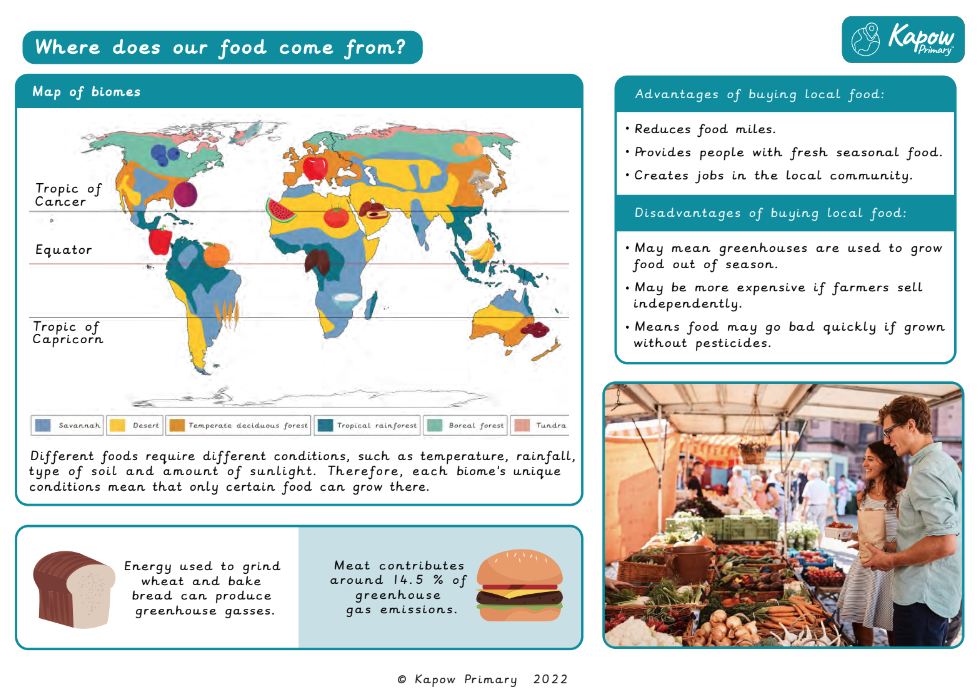
Knowledge organiser: Geography – Y4 Where does our food come from?
Aimed at pupils, two pages providing key facts and definitions from the unit 'Where does our food come from?'.
Vocabulary display – Geography Y4: Where does our food come from?
A display version of the vocabulary from the unit ‘Where does our food come from?’.
Subject resources
This content is for subscribers only. Join for access today.
Cross-curricular opportunities
English: Spoken language, reading, writing – composition
Science: Living things and their habitats, properties and changes of materials
Mathematics: Measurement, statistics
British values: Individual liberty, democracy
Design and technology
Computing
RSE/PSHE
Build on the learning
What are rivers and how are they used?
Get started
