




- Subjects >
- Science >
- Key stage 2 >
- Year 6 >
Unit outcomes
Pupils who are secure will be able to:
- Define the term ‘organism’ and name the seven life processes of all living things.
- Describe the work of Carl Linnaeus.
- Define the term ‘vertebrate’ and name the vertebrate groups.
- Describe the characteristics of fish, amphibians, reptiles, birds and mammals.
- Compare the characteristics of the vertebrate groups.
- Define the term ‘invertebrate’.
- Describe the characteristics of worms, snails, spiders and insects.
- Compare the characteristics of the invertebrate groups.
- Name the plant groups.
- Describe the characteristics of flowering plants, ferns, mosses and conifers.
- Define the term ‘micro-organism’ and name some examples.
When working scientifically pupils who are secure will be able to:
- Use a classification key to group and identify organisms.
- Make a simple classification key.
Please note that Kapow Primary Science lessons are designed to be 1 hour and 30 minutes long, to reflect the requirements of a core subject.
Suggested prior learning
Living things: Classification and changing habitats
Get started
Lessons
Lesson 1: Carl Linnaeus and classification
Lesson 2: Cold-blooded vertebrates
Lesson 3: Warm-blooded vertebrates
Lesson 4: Invertebrates
Lesson 5: Plants
Lesson 6: Micro-organisms
Key skills
Grouping and classifying
-

This content is for subscribers only. Join for access today.
Key knowledge
- To know
This content is for subscribers only. Join for access today.
Key vocabulary
classification key (LKS2)
classify (LKS2)
This content is for subscribers only. Join for access today.
Equipment list
Equipment needed across all lessons in this unit.
This list does not include equipment which is usually readily available in the classroom (e.g pencils, A4 paper etc)
 Download
Full equipment list for the subject
Quantities marked × will update. Items without quantities are unaffected
-
Clay or playdough
×30 - Magnifying glasses ×30
-
Jars or plastic cups
×15 - Craft materials ×1
This content is for subscribers only. Join for access today.
Related content
Unit resources


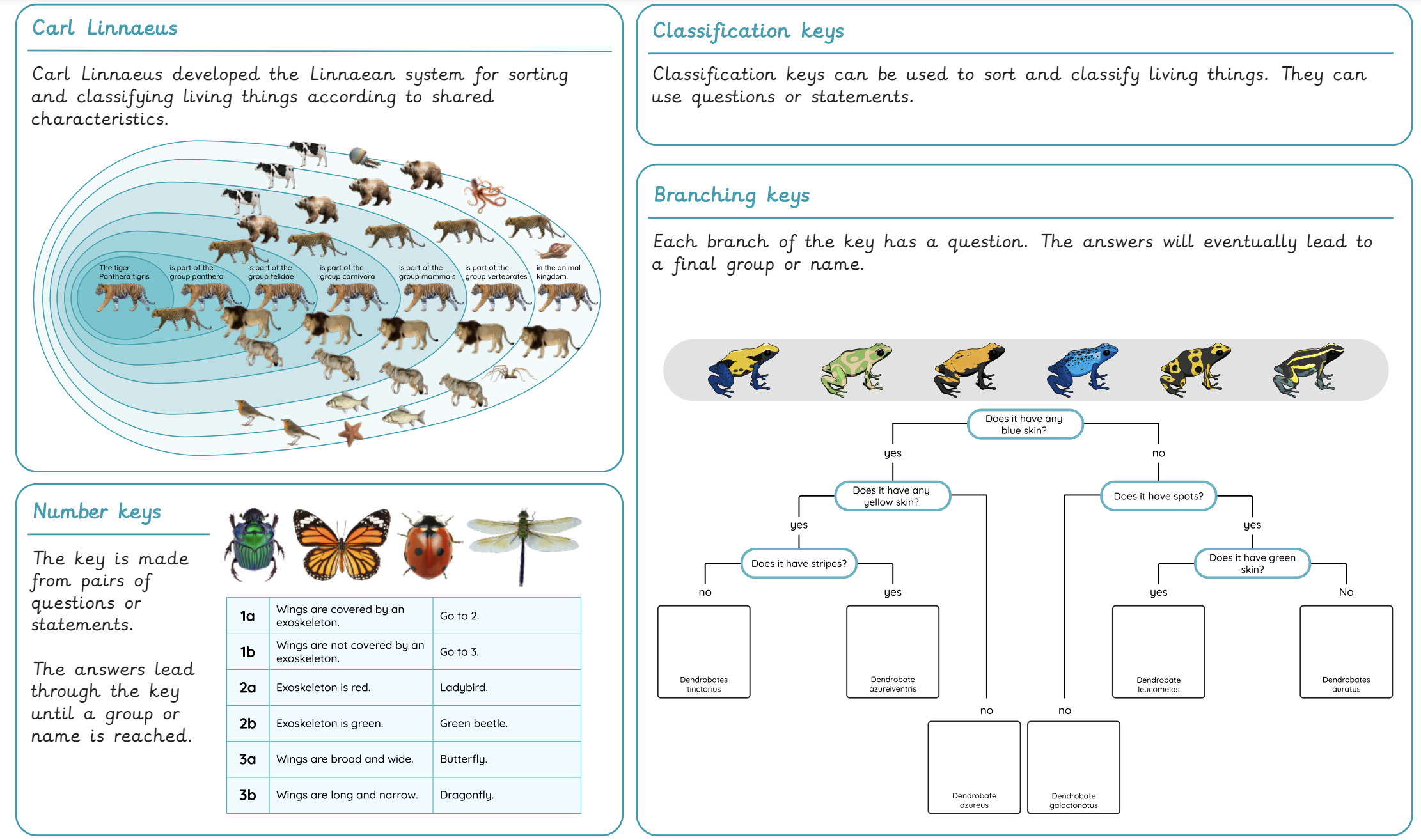
Knowledge organiser – Science Y6: Living things: Classifying big and small
Aimed at pupils, two pages providing key facts and definitions from the unit ‘Classifying big and small’.
Vocabulary display – Science Y6: Living things: Classifying big and small
A display version of the vocabulary from the unit 'Classifying big and small'.
Subject resources
This content is for subscribers only. Join for access today.
Cross-curricular opportunities
British values: mutual respect.
Art: clay sculpture.
English: writing.
Build on the learning
Living things: Evolution and inheritance
Get started
