




Unit outcomes
Pupils who are secure will be able to:
- Describe features of biscuits using taste, texture and appearance.
- Explain why some biscuits might be made for children, adults or special occasions.
- Remember and follow simple rules for working in a safe and clean way.
- Follow a recipe with support.
- Use a budget to plan a recipe.
- Adapt a recipe using additional ingredients to fit a design or budget.
- Measure and mix ingredients properly.
- Contribute to a discussion about criteria for evaluation.
For lesson 5, it is important that a participant is invited to the lesson for market research for each group.
Suggested prior learning
Cooking and nutrition: Eating seasonally
Get started
Lessons
Lesson 1: Existing biscuits
Lesson 2: Basic biscuits
Lesson 3: Budgeting
Lesson 4: Packaging
Lesson 5: Testing a new recipe
Lesson 6: Evaluating biscuits
Key skills
Design
- Designing a biscuit within

This content is for subscribers only. Join for access today.
Key knowledge
To know:
- The
This content is for subscribers only. Join for access today.
Key vocabulary
adapt
addition
This content is for subscribers only. Join for access today.
Equipment list
Equipment needed across all lessons in this unit.
This list does not include equipment which is usually readily available in the classroom (e.g pencils, A4 paper etc)
 Download
Full equipment list for the subject
Quantities marked × will update. Items without quantities are unaffected
- Six different types of biscuits for taste-testing ×30
- Plates ×30
- Basic biscuit recipe ingredients: butter, caster sugar, egg yolk, vanilla extract, plain flour.
- Additional ingredients: cocoa powder, chocolate chips, porridge oats, honey, mini marshmallows, raisins, desiccated coconut, dried fruit, cinnamon, lemon or orange zest, sprinkles, chocolate, icing.
- Butter knife Use child-safe knives; adult cutting knife for adult use only. ×30
- Bowls
- Wooden spoons ×8
- Weighing scales ×8
- Baking trays
- Baking parchment As needed
- Oven
-
Empty biscuit boxes
- A3 card ×30
- Additional adults ×1
The equipment below is optional
-
Computers with access to Excel
This content is for subscribers only. Join for access today.
Related content
Unit resources


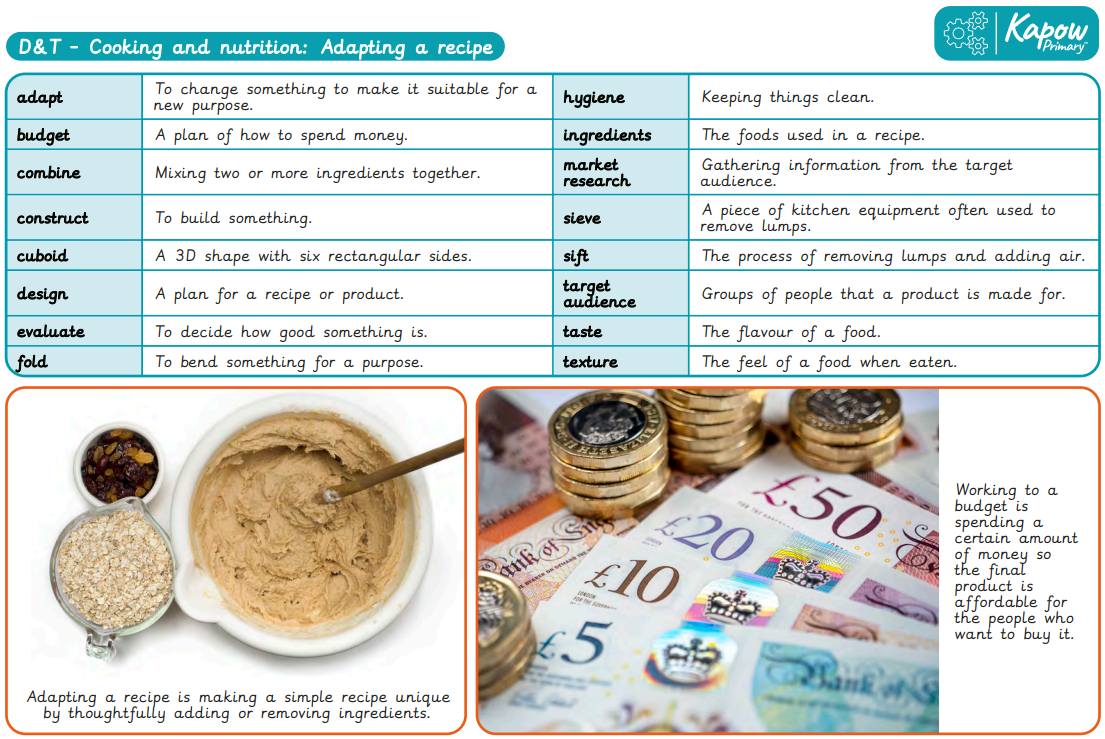
Knowledge organiser – D&T Y4: Cooking and nutrition: Adapting a recipe
Aimed at pupils, two pages providing key facts and definitions from the unit 'Cooking and nutrition: Adapting a recipe'.
Vocabulary display – D&T Y4: Cooking and nutrition: Adapting a recipe
A display version of the vocabulary from the unit 'Adapting a recipe'.
Subject resources
This content is for subscribers only. Join for access today.
Cross-curricular opportunities
Mathematics
Number – multiplication and division – solve problems using multiplying and adding
Geometry – properties of shape – make 3D shapes using modelling materials
Measurement – estimate, compare and calculate different measures, including money in pounds and pence
Build on the learning
Cooking and nutrition: Developing a recipe
Get started
Popular content
- Design and technology: Curriculum portal
- Design and technology: Curriculum information
- Y3 > Structures: Constucting a Castle > Lesson 3: Nets and Structures
- Y3 > Mechanical Systems: Pneumatic Toys > Lesson 1: Exploring Pneumatics
- Y4 > Textiles: Fastenings > Lesson 2: Designing my Book Sleeve
- Y4 > Electrical Systems: Torches > Lesson 3: Torch Design
