




- Subjects >
- Geography >
- Key stage 2 >
- Year 5 >
Unit outcomes
Pupils who are secure will be able to:
- Identify the lines of latitude where hot desert biomes are located.
- Describe the characteristics of a hot desert biome.
- Locate the largest deserts in each continent.
- Describe ways the Mojave Desert is used.
- Name and describe the physical features found in a desert.
- Identify how humans use the desert.
- Explain how human activity may contribute to the changing climate and landscape of a desert.
- Recognise that the Mojave Desert has a different time zone to the UK.
- Describe some of the threats to deserts.
- Give the benefits and drawbacks of living in a desert environment.
- Identify characteristics of two contrasting biomes and compare land use.
- Discussing if a desert environment is hospitable and why.
Lessons 2 and 6 require a device (one between two).
Suggested prior learning
Why do oceans matter?
Get started
Lessons
Lesson 1: What is a hot desert biome?
Lesson 2: Where are deserts located?
Lesson 3: What physical features are found in a desert?
Lesson 4: How can people use deserts?
Lesson 5: What are the threats to deserts?
Lesson 6: Would you like to live in the desert?
Key skills
- Locating more

This content is for subscribers only. Join for access today.
Key knowledge
- To know
This content is for subscribers only. Join for access today.
Key vocabulary
agriculture
airstrip
This content is for subscribers only. Join for access today.
Equipment list
Equipment needed across all lessons in this unit.
This list does not include equipment which is usually readily available in the classroom (e.g pencils, A4 paper etc)
 Download
Full equipment list for the subject
Quantities marked × will update. Items without quantities are unaffected
-
A torch
×1 -
A globe
×1 - Atlases ×15
- Access to a device ×15
- Access to a free BBC iPlayer account ×1
This content is for subscribers only. Join for access today.
Related content
Unit resources


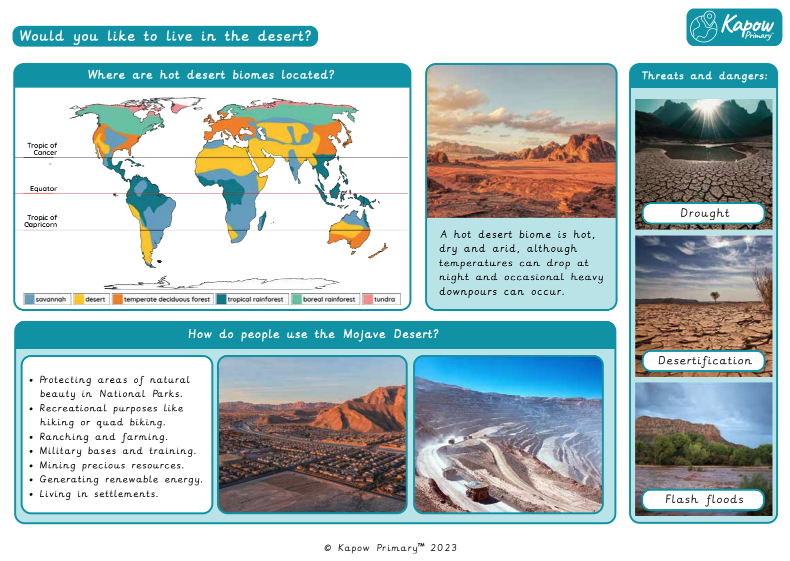
Knowledge organiser: Geography – Y5 Would you like to live in the desert?
Aimed at pupils, two pages providing key facts and definitions from the unit. "Would you like to live in the…
Vocabulary display – Geography Y5: Would you like to live in the desert?
A display version of the vocabulary from the unit 'Would you like to live in the desert?'.
Subject resources
This content is for subscribers only. Join for access today.
Cross-curricular opportunities
English: Spoken language, writing – composition
Science: evolution and inheritance, states of matter, earth and space, living things and their habitats
Mathematics: number – number and place value, statistics
Computing
Build on the learning
Why does population change?
Get started
