




- Subjects >
- Science >
- Key stage 2 >
- Year 3 >
Unit outcomes
Pupils who are secure will be able to:
- Identify what plants need to grow healthily.
- Describe the structure and function of the parts of flowering plants.
- Investigate how plants transport water.
- Describe the life cycle of a flowering plant.
- Explain seed dispersal methods.
When working scientifically, pupils who are secure will be able to:
- Pose relevant questions.
- Design and record in results tables.
- Plan a simple enquiry.
- Complete, read and interpret data in a bar chart.
- Identify and suggest changes to an enquiry.
- Use results to draw conclusions.
Please note that Kapow Primary Science lessons are designed to be 1 hour and 30 minutes long to reflect the requirements of a core subject.
Suggested prior learning
Plants: Plant growth
Get started
Lessons
Lesson 1: Plant growth
Lesson 2: Structure and function
Lesson 3: Transporting water
Lesson 4: Flowers
Lesson 5: Evaluating an enquiry
Lesson 6: Seed dispersal
Key skills
Posing questions
- Beginning to

This content is for subscribers only. Join for access today.
Key knowledge
To know:
- The
This content is for subscribers only. Join for access today.
Key vocabulary
bar chart
conclusion
This content is for subscribers only. Join for access today.
Equipment list
Equipment needed across all lessons in this unit.
This list does not include equipment which is usually readily available in the classroom (e.g pencils, A4 paper etc)
 Download
Full equipment list for the subject
Quantities marked × will update. Items without quantities are unaffected
-
2 of the same plants (bean plants or geraniums)
-
Clear plastic bags and twist ties (enough to cover the leaves of one of the plants).
×2 -
Flowering plant examples
×5 -
Geranium plants
3 - Measuring cylinders ×5
-
Food colouring
×1 -
Kitchen paper
×15 - Beakers or glasses ×15
-
Chrysanthemum flower stems (preferably white).
2 -
Sticks of celery
×15 - Magnifying glasses ×5
- Table knives Use child-safe knives; adult cutting knife for adult use only. ×8
- Spoons ×5
-
Cress seeds (between 20 to 40)
-
Cotton wool pads
2 -
Petri dishes or small dishes
2 -
Opaque mystery box with items related to flowers (e.g. honey, a floral scent, seeds and fruit).
1 -
Lilies (one flower).
×8 -
Different fruits (e.g. kiwi, oranges, apples, seedless grapes, avocado and pepper)
6 -
Junk modelling materials (e.g. thin and corrugated card, plastic bottles, tissue paper, coloured paper and bubble wrap).
×1 - Masking tape
- A device that takes photographs ×8
This content is for subscribers only. Join for access today.
Related content
Unit resources


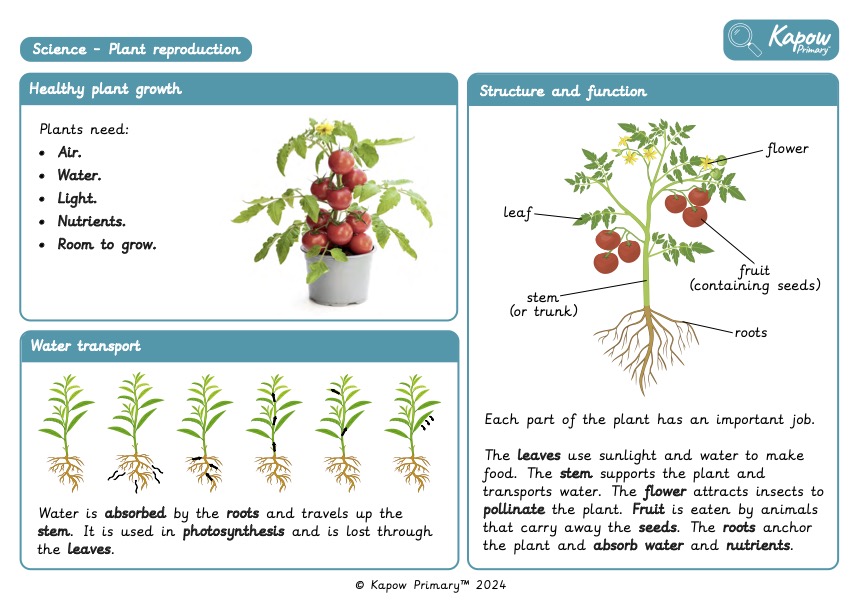
Knowledge organiser – Science Y3: Plants: Plant reproduction
Aimed at pupils, two pages providing key facts and definitions from the unit 'Plant reproduction'.
Vocabulary display – Science Y3: Plants: Plant reproduction
A display version of the vocabulary for the unit 'Plant reproduction'.
Subject resources
This content is for subscribers only. Join for access today.
Cross-curricular opportunities
English: Spoken language.
Maths: Statistics; Number – number and place value.
Design and technology: Design; Make.
British values: Mutual respect.
Build on the learning
Living things: Life cycles and reproduction
Get started
