




- Subjects >
- Science >
- Key stage 2 >
- Year 3 >
Unit outcomes
Pupils who are secure will be able to:
- Identify examples of pushes, pulls and twists.
- Define a force, including describing, naming and classifying contact and non-contact forces.
- Describe the relationship between friction and the roughness of a surface.
- Identify examples of friction being useful or not.
- Predict attraction and repulsion between like and opposite poles.
- Identify examples of magnetic and non-magnetic materials.
- Name some examples of types of magnets and compare their strengths.
- Describe some examples of the uses of magnets.
When working scientifically, pupils who are secure will be able to:
- Use arrows and scientific vocabulary to show the direction of a contact force.
- Use evidence to support conclusions.
- Identify the variables to change, measure and control.
- Write a method to explain how to use a magnet to sort and classify materials as magnetic or non-magnetic.
- Label the axes of a bar chart.
- Draw bars on a chart accurately.
- Identify key information from a source.
- Use more than one source to research a question.
Please note that Kapow Primary Science lessons are designed to be 1 hour and 30 minutes long to reflect the requirements of a core subject.
Suggested prior learning
There are no previous units on forces, however the unit does build on some knowledge covered in the Year 2 unit 'Uses of everyday materials'.Lessons
Lesson 1: Pushes, pulls and twists

Lesson 2: Friction
Lesson 3: Investigating friction
Lesson 4: Magnets
Lesson 5: Investigating magnet strength
Lesson 6: Uses of magnets
Key skills
Planning
- Beginning to

This content is for subscribers only. Join for access today.
Key knowledge
To know:
- Examples of contact
This content is for subscribers only. Join for access today.
Key vocabulary
attract
bar chart
This content is for subscribers only. Join for access today.
Equipment list
Equipment needed across all lessons in this unit.
This list does not include equipment which is usually readily available in the classroom (e.g pencils, A4 paper etc)
 Download
Full equipment list for the subject
Quantities marked × will update. Items without quantities are unaffected
-
Modelling dough (one ball for the teacher).
- Sticky tack
-
Table tennis or small balls
×15 - Paper cups ×15
- String
- Sticky tape
- Envelopes ×30
-
Large space with a shiny floor (e.g. school hall)
×1 -
10 m tape measure (one for the teacher).
×1 -
Sticky notes (yellow and blue).
×1 -
Plastic bottle caps (one plain and one with sandpaper on the bottom)
×10 - Toy car ×10
- Ramps ×10
-
Props for ramps
×10 -
Meter rulers
×10 - Various materials to put on ramps to investigate friction (e.g. foil, cardboard, bubble wrap, sandpaper, tea towel) ×10
- Bar magnets ×30
- Digital camera ×15
-
Sandwich bags of magnetic and non-magnetic materials (e.g. coins, keys, bolts, aluminium foil, copper wire and marbles)
×15 - Highlighters ×10
This content is for subscribers only. Join for access today.
Related content
Unit resources


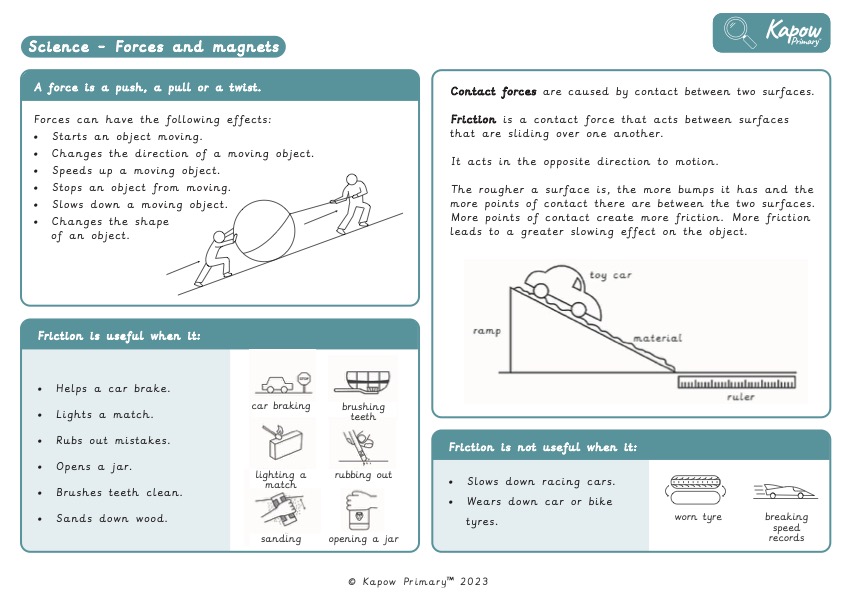
Knowledge organiser – Science Y3: Forces and space: Forces and magnets
Aimed at pupils, two pages providing key facts and definitions from the unit ‘Forces and magnets’.
Vocabulary display – Science Y3: Forces and space: Forces and magnets
A display version of the key vocabulary from the unit 'Forces and magnets'.
Subject resources
This content is for subscribers only. Join for access today.
Cross-curricular opportunities
English:
- Writing, non-fiction writing.
Maths:
- Measurement, measuring length.
- Statistics, drawing bar charts.
British values:
- Mutual respect.
