




Unit outcomes
Pupils who are secure will be able to:
- Explain simply what is meant by ‘form’ (the shape of a product) and ‘function’ (how a product works).
- State what they like or dislike about an existing children’s toy and why.
- Learn about skills developed through play and apply this knowledge in a survey of one or more children’s toys.
- Identify the components of a steady hand game.
- Design a steady hand game of their own according to their design criteria, using four different perspective drawings.
- Create a secure base for their game, with neat edges, that relates to their design.
- Make and test a functioning circuit and assemble it within a case.
Suggested prior learning
Electrical systems: Wobble bots
Get started
Lesson plans
Lesson 1: Developing through play
Lesson 2: Game plan
Lesson 3: Base building
Lesson 4: Electronics and assembly
Key skills
Design

This content is for subscribers only. Join for access today.
Key knowledge
Design
To know:
-
This content is for subscribers only. Join for access today.
Key vocabulary
assemble (Y5/6)
battery (Y3/4)
This content is for subscribers only. Join for access today.
Equipment list
Equipment needed across all lessons in this unit.
This list does not include equipment which is usually readily available in the classroom (e.g pencils, A4 paper etc)
 Download
Full equipment list for the subject
Quantities marked × will update. Items without quantities are unaffected
- Access to a device ×15
- Range of children’s toys ×8
- Colouring pencils ×30
- Marker ×30
- Scissors right- and left-handed options recommended. ×30
- Glue stick ×1
- Set squares (extension) ×30
- Electrical wires – preferably with crocodile clips ×15
- Buzzers OR bulbs and bulb holders ×15
- Battery packs ×15
- AA batteries ×15
- Tinned copper wire ×30
- Wire cutters ×1
- Pliers ×1
- Switches ×15
- Plasticine ×30
This content is for subscribers only. Join for access today.
Related content
Unit resources


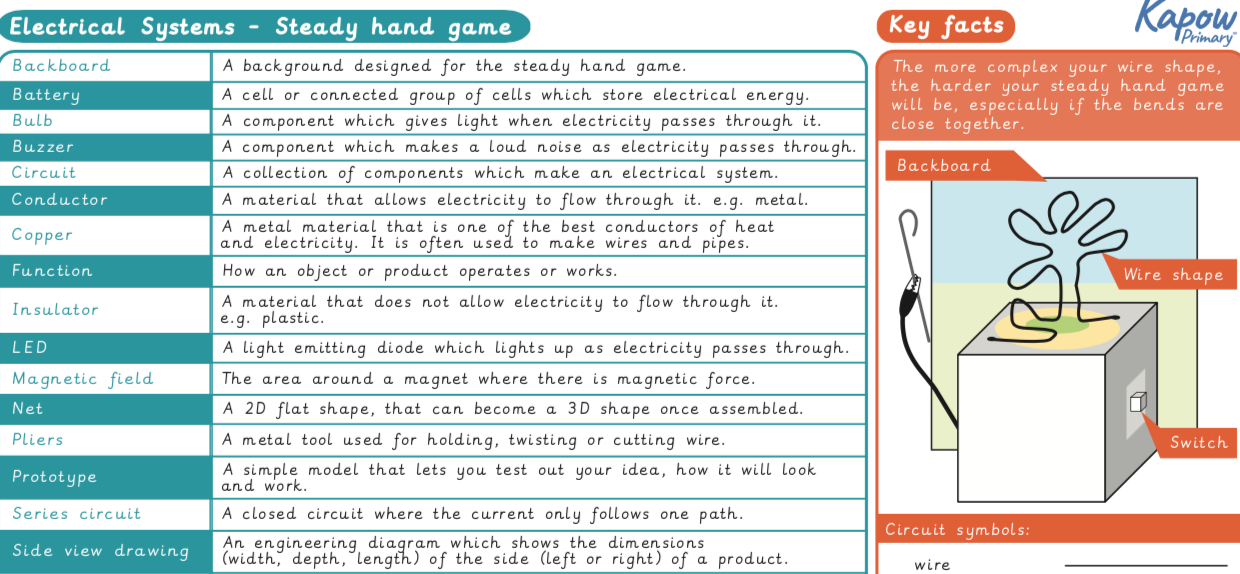
Knowledge organiser – DT Y6: Steady hand game
Aimed at pupils, a single page which gives key facts and definitions from the unit 'Electrical systems: Steady hand game.'
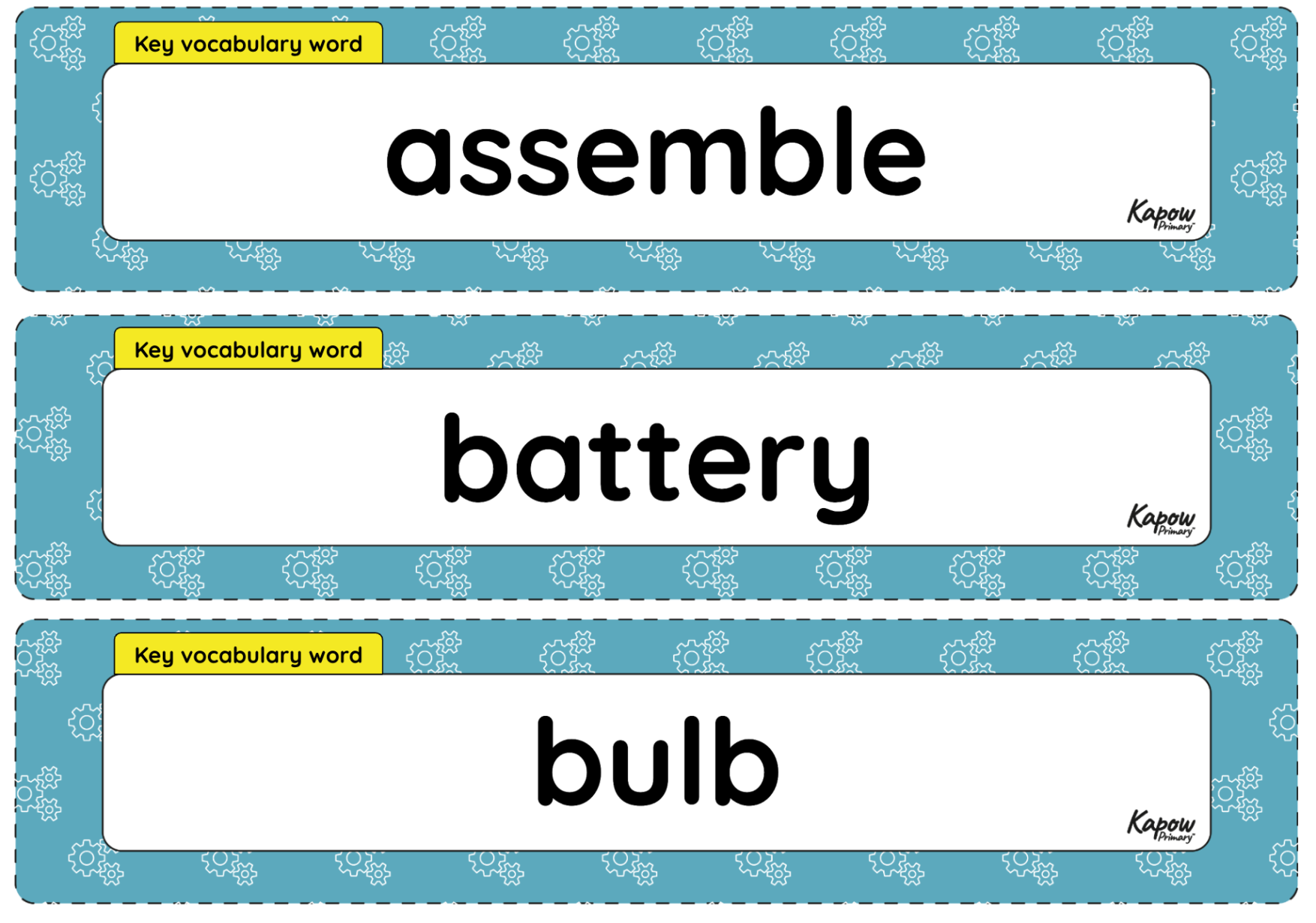
Vocabulary display – D&T Y6: Electrical systems: Steady hand game
A display version of the vocabulary from the unit 'Steady hand game'.
Subject resources
This content is for subscribers only. Join for access today.
Cross-curricular opportunities
Computing
‘Pupils should be taught to:
- use search technologies effectively, appreciate how results are selected and ranked, and be discerning in evaluating digital content’
See National curriculum - Computing key stages 1 to 2.
Science
‘Pupils should be taught to:
- compare and give reasons for variations in how components function, including the brightness of bulbs, the loudness of buzzers and the on/off position of switches
- use recognised symbols when representing a simple circuit in a diagram’
See National curriculum - Science key stages 1 to 2.
Mathematics
‘Pupils should be taught to:
- recognise, describe and build simple 3-D shapes, including making nets’
Build on the learning
Mechanical systems: Automata toys
Pupils build on their understanding of form and function from evaluating their steady hand game to create a functional automata toy with moving parts.
Popular content

This resource is being accessed through your school’s Kapow licence.
Thank you for respecting the work of the teachers who create these materials.