Lesson 1: Gravity
Exploring the force of gravity and its relationship to mass through investigating the gravity of different planets.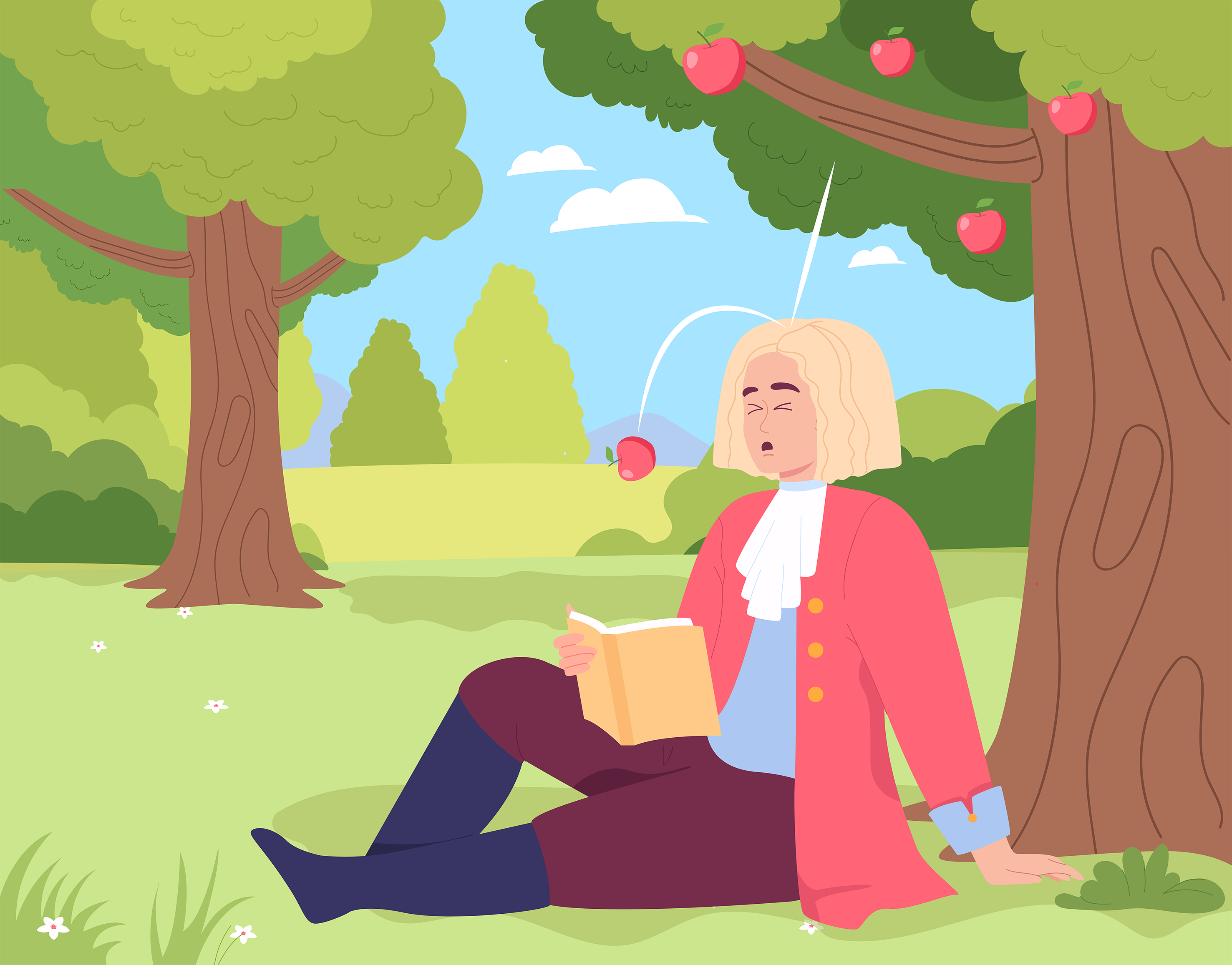
Learning objectives
Knowledge
-
To describe gravity and its effects.
Working scientifically
-
To analyse data to write a conclusion.
Success criteria
Knowledge
-
I can define the term gravity.
-
I can explain why unsupported objects fall towards the Earth.
-
I can describe the relationship between mass and gravity.
Working scientifically
-
I can analyse data and identify anomalies.
-
I can compare data to a prediction.
-
I can describe the relationship between two variables.
Before the lesson
Check all images, videos, links and presentation slides are suitable for your class.
- Presentation: Investigating gravity.
- Presentation: What affects gravity?
A large outside space (e.g. playground - see Main event).
- Equipment for drawing and measuring the diameter of celestial bodies (see Main event):
10 tape measures (15 m);
10 pieces of chalk;
10 devices with internet access;
10 green highlighters;
10 red, orange or pink highlighters;
masking tape (optional - see Teacher knowledge).
- Sticky tack (to stick data from the Resource: NASA relative gravity data around the room).
The Knowledge organiser provides a visual summary of the key facts and vocabulary for the unit. The children can use it throughout the unit to check keyword meanings or spellings and to help them remember important information when completing an activity. Find further ideas for using the Knowledge organiser to support adaptive teaching here.
Save the Knowledge organiser for use at the end of the year in the unit Science, Year 5, Making connections: Does the size of an asteroid affect the diameter of its crater?
This unit is a physics topic. Physics is the study of the relationships between matter, forces and energy. Informing the pupils about the different branches of Science can help them transition more smoothly to KS3 Science.
Subject knowledge
Gravity is a non-contact force that pulls objects towards each other.
Despite being a force, gravity cannot be seen or touched; only its effects can be observed.
Everything that has mass (matter) is pulled by gravity.
The Earth's gravity keeps us on the ground, making things fall when dropped.
- Sir Isaac Newton discovered that gravity is affected by both mass and distance:
the greater the mass of an object, the greater its gravitational pull;
the greater the distance between objects, the less the gravitational pull.
Galileo Galilei conducted experiments that showed all objects fall at the same rate regardless of their mass, as long as there is no air resistance.
Gravity keeps the Moon in orbit around the Earth and the planets in orbit around the Sun.
The Moon's gravity is what causes the tides.
The gravity on Earth gives weight to objects; without gravity, we would float away.
Generally, planets with more mass than Earth have stronger gravity and those with less mass have weaker gravity.
Astronauts experience less gravity on the Moon, which is why they can jump higher there.
Enquiry type
This lesson includes a pattern seeking enquiry. It looks for a broad relationship between size and gravity. For further information on enquiry types, see the Teacher video: Scientific enquiry types in the link:Working scientifically resource bank.
Misconceptions
The children may think that:
'Gravity is only on Earth' - gravity is a universal force caused by any mass.
'Everything falls at the same rate' - in a vacuum, objects fall at the same rate regardless of their mass.
'Gravity pulls things down' - gravity pulls objects downward and acts horizontally in orbits; it pulls towards the object's centre.
'Gravity only affects heavy objects' - gravity affects all objects.
'There is no gravity in space' - objects appear to float in space due to freefall but gravity exists in space. Gravity decreases as the distance from a celestial body increases.
'Gravity is a pushing force' - gravity is an attractive force that pulls objects toward each other.
'Gravity stops working when not in contact' - gravity acts at a distance and does not require direct contact between objects; it is a non-contact force.
Lesson organisation
- In advance of the lesson, cut up the Resource: NASA relative gravity data along the dashed lines to give ten strips of paper with data that should be stuck around the classroom for the children to find to complete their data sheets.
- The Resource: NASA relative gravity data uses data taken from the NASA website that converts the diameter of planets in the Solar system and gravity relative to Earth. The scale of these values makes it easier for the children to work with and draw comparisons for conclusions.
If an outside space is unavailable, use masking tape to measure the diameter of the celestial bodies on the floor of a large inside space.
Stretch and challenge
- Use the Resource: Stretch and challenge: Unbalanced forces as an extension and revision opportunity. The children can select activities and complete them independently in their books throughout the unit.
Lesson plan
Before starting this unit, check the children can recall the following ways of using forces to change the shape of materials from the unit Science, Year 3, Forces and magnets:
Forces (push, pull and twist).
Contact forces (friction).
Non-contact forces (magnetism and gravity).
Use the Activity: Unbalanced forces mind map (one each) to elicit the children’s prior knowledge if required.
Show the Pupil video: Gravity, which covers the work of Galileo Galilei and Isaac Newton, who helped develop the theory of gravitation.
Ask the class to discuss the following questions with a partner:
- What type of force is gravity, a push, a pull or a twist? (A pull.)
- Which objects have gravity? (All objects.)
- Which object would have more gravity, a planet or a mouse? (A planet.)
- Why? (A planet has more mass.)
Take feedback and clarify that mass is the amount of matter in an object: it tells us how much stuff is in that object.
Display slide 1 of the Presentation: Investigating gravity and inform the class that they will conduct a pattern seeking enquiry to investigate the question:
- Does the size of an object affect its gravity?
Continue to slide 2 and read through the three options for predicting the results of the investigation.
Ask the children to discuss the predictions with a partner and then vote on which they think is true. Record the class prediction (the most popular choice) using the pen tool, which should be choice three: the larger the object, the larger the gravity because it has more mass.
Arrange the class into ten groups and assign each group a celestial body and its relative diameter from the Resource: Diameters of celestial bodies (pre-cut, one planet per group). Explain that the diameters are calculated relative to the Earth if the Earth is one metre in diameter. Provide each group with a 15-metre tape measure, a piece of chalk, a pencil and the Activity: Celestial bodies data table.
Take the class to a large outdoor space where they can draw on the floor with the chalk. Instruct the groups to measure the correct diameter of their celestial body using the tape measure. Explain that they should then use the chalk to draw a circle of that diameter to represent their celestial body. Ask them to label their celestial body (e.g. Moon, Earth, Mars, etc.).
Allow the groups to draw and label their celestial body and instruct them to rotate around to each of the ten and measure and record the diameter of each on their data table.
Return to the classroom and show slide 3, which shows the correct data. Allow the groups to check and correct their data. Ask the groups to discuss the following questions and take feedback:
- What pattern does the data in the diameter column show? (The diameter is increasing/getting bigger.)
- What pattern do you expect to see in the next column (gravity)? (The gravity is also increasing/getting bigger).
Explain to the class they will use data from NASA to find out if, as predicted, there is a relationship between gravity and diameter; specifically that gravity increases as diameter increases. Ask them to find the data from the Resource: NASA relative gravity data stuck around the room (see Teacher knowledge) and record the gravity for each celestial body in their data table.
Click the 'Gravity' data column to reveal the correct data and encourage the groups to check their data.
Analysing and conclusion writing
Hand out a green and a red (or orange or pink) highlighter to each group and ask them to look through the data in the third column (gravity) carefully and highlight the data as follows:
If the number is larger than the preceding number, highlight it in green because it fits the predicted pattern of showing an increase in gravity with size.
If the number is smaller than the preceding number, highlight it in red (or orange or pink) because it does not fit the predicted pattern and shows that gravity does not increase with size.
Click the data in the gravity column again to reveal the correctly highlighted data and ask the class to discuss the following questions:
- Which two data points do not fit the predicted pattern of gravity increasing with size? (Mars and Uranus.)
- What happens to the gravity of these two data points? (The gravity decreases/gets smaller, even though these planets are larger than the preceding planets.)
Continue to slide 4, which uses questions to prompt how to structure a conclusion. Ask the groups to discuss the questions and write a conclusion in their books.
Click on each question to build the conclusion; read through the model conclusion. Allow time for the pupils to compare to their own conclusions.
Display slide 1 of the Presentation: What affects gravity?, which has a graph showing relative mass compared to the relative gravity of celestial bodies.
Ask the groups to discuss the following questions:
- Does the line show a trend that the larger the mass, the larger the gravity? (Answers may include yes, the line is going up in general; no, there are parts where the line dips.)
- Are there any data points that are exceptions (anomalies) to the statement, 'The larger the mass, the larger the gravity.'? (Yes, there are two points where the line goes down.)
- Is the statement, 'The larger the mass, the larger the gravity.' true? (No, it is not always true.)
Explain to the class that neither the size (diameter) of the planet nor the mass of the planet showed a pattern that was always true.
Remind them that Newton theorised that gravity was affected by both mass and distance. Continue to slide 2, which shows the data tables for mass and diameter compared to gravity. Ask the groups to discuss the following question:
- Why do Mars and Mercury have similar gravity despite having different masses and diameters? (Do not reveal the answer yet).
Take feedback from the class and continue to slide 3, which shows a diagram to explain why the gravity on Mars and Mercury is similar.
Explain that the gravity you feel on a planet depends not only on its mass but also on its size, specifically the distance from its centre to its surface. Mars has about double the mass of Mercury, which would make its gravity stronger if both planets were the same size. However, Mars is also much larger than Mercury, meaning its surface is farther away from its centre than Mercury. This greater distance reduces the gravity you would feel on the surface of Mars.
Full-screen slides, ready for your classroom, chosen by you.
Knowledge
-
To describe gravity and its effects.
Working scientifically
-
To analyse data to write a conclusion.
We value your feedback
We welcome your feedback to help make our resources even better