




- Subjects >
- Spanish >
- Key stage 2 >
- Year 3 >
Unit outcomes
Pupils who are secure will be able to:
- Match spoken classroom instructions with a corresponding symbol; respond to most classroom instructions with an action.
- Name the seven classroom items in Spanish, usually remembering which article, un or una, is needed; sort classroom items into two groups of either masculine or feminine and understand how we might identify the gender of each noun.
- Speak in short sentences, starting with Tengo and including a plural noun phrase by choosing a number in Spanish to quantify and adding an ‘s’ at the end of the noun.
- Answer a question in Spanish using the negative, No tengo… – I do not have…, followed by a classroom item.
- Read and understand short sentences in Spanish, including conjunctions, to match the labels with each rucksack picture with reasonable levels of success.
- Write a short paragraph to describe what they have in a rucksack, which meets most of the success criteria.
Suggested prior learning
Unit 2: Spanish numbers and ages
Get started
Lessons
Lesson 1: Follow the instructions
Lesson 2: Un or una?
Lesson 3: What classroom items do you have?
Lesson 4: I do not have…
Lesson 5: What is in your school bag?
Lesson 6: En mi mochila
Key skills
Language comprehension
- Listening

This content is for subscribers only. Join for access today.
Key knowledge
Phonics:
To know:
- The key phonemes
This content is for subscribers only. Join for access today.
Key vocabulary
una regla
una goma
This content is for subscribers only. Join for access today.
Equipment list
Equipment needed across all lessons in this unit.
This list does not include equipment which is usually readily available in the classroom (e.g pencils, A4 paper etc)
 Download
Full equipment list for the subject
Quantities marked × will update. Items without quantities are unaffected
- Counters Per child: 8
A feely bag with
- Pens 1
- Pencils 1
- Rulers 1
- Rubbers 1
- Water bottle 1
- Exercise book 1
- Pencil case 1
One set for each table
- Pens ×5
- Pencils ×5
- Rulers ×5
- Rubbers ×5
- Water bottle ×5
- Exercise book ×5
- Pencil case ×5
The equipment below is optional
- Sticky notes
- A blindfold ×15
- Scissors right- and left-handed options recommended. ×30
- Glue stick ×30
- Highlighters
- Video recording devices
This content is for subscribers only. Join for access today.
Spanish phonics videos
Related content
Unit resources


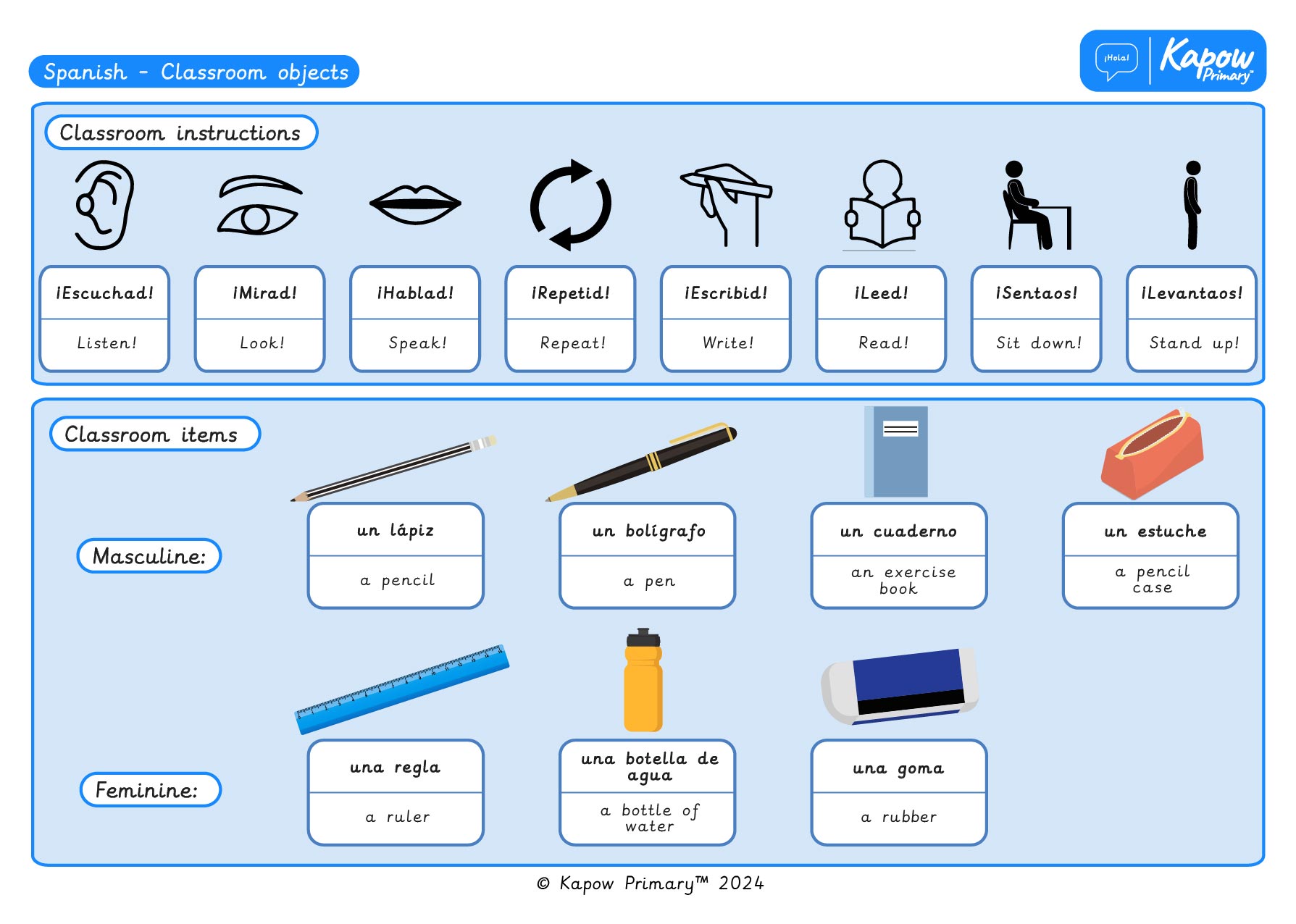
Knowledge organiser: Spanish – Classroom objects
Aimed at pupils, two pages providing key facts and definitions from the unit 'Unit 4: Classroom objects in Spanish.'.
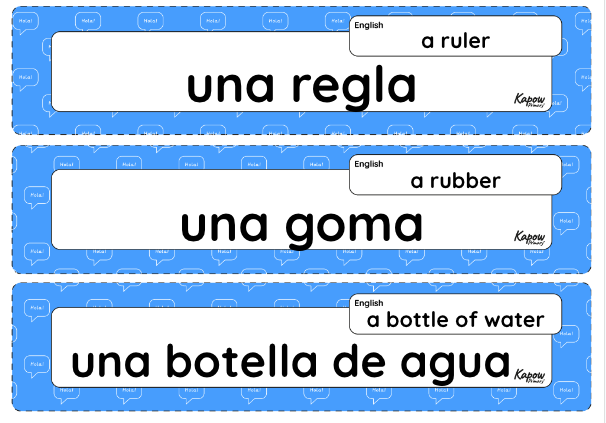
Vocabulary display: Classroom objects in Spanish
A display version of the key vocabulary from the unit 'Classroom objects in Spanish'.
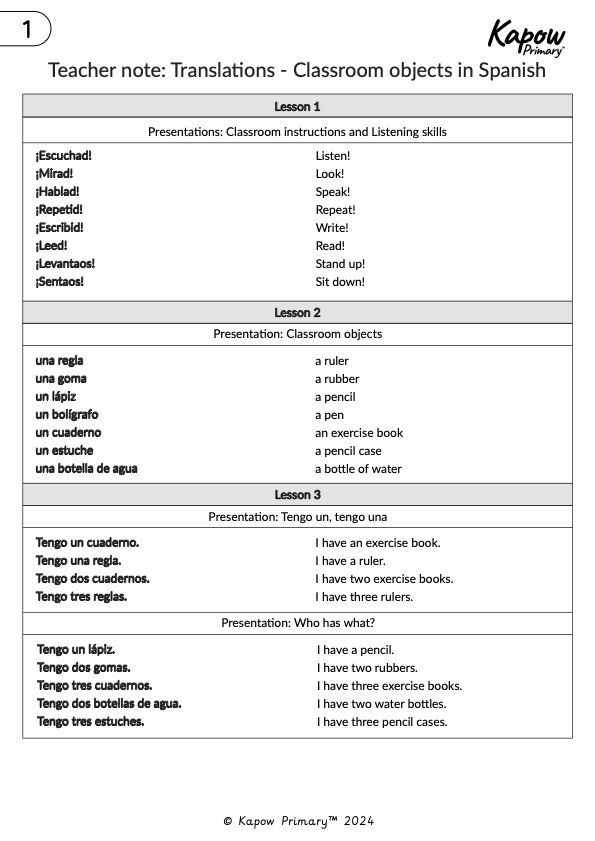
Translations: Classroom objects in Spanish
Translations of key texts and transcripts from resources in this unit.
Subject resources
This content is for subscribers only. Join for access today.
Cross-curricular opportunities
English
Writing – vocabulary, grammar and punctuation (Year 2)
Pupils should learn how to use:
- Sentences with different forms: statement, question, exclamation, command.
- Subordination (using when, if, that or because) and co-ordination (using or, and or but).
Writing – vocabulary, grammar and punctuation (Year 3)
Pupils should be taught to:
Develop their understanding of the concepts set out in English Appendix 2 by:
- Extending the range of sentences with more than one clause by using a wider range of conjunctions, including when, if, because, although.
See National curriculum - English - Key stages 1 and 2.
Build on the learning
Unit 5: Where do you live in Spain?
Get started
