




Before you continue

This unit is archived. Our revised unit is aligned to current guidance. Visit the new unit
Please note
This unit has been replaced and will no longer be updated. Kapow no longer updates these lessons, and they may not reflect the National curriculum or current guidance. They remain a permanent part of the subscription and will continue to be available for reference and use. We recommend exploring the new versions of the lessons.
Unit outcomes
Pupils who are secure will be able to:
- Describe some oral traditions in some ancient societies.
- Understand the reasons written traditions developed.
- Discuss why new languages develop as a result of diaspora.
- Consider the role of Biblical Hebrew and Classical Arabic for many Jewish and Muslim people today.
- Identify religious and cultural uses of Hebrew and Arabic.
- Describe why some believers choose to learn and read the language of their religious scripture.
- Identify an ancient language, a translation and a commentary in a copy of a page of scripture.
- Consider what might be holy to a believer.
- Describe how translations, the creation of scripts like Gurmukhi and artwork made religious teachings more accessible.
- Reflect on why some scriptures have no art or symbols.
Teacher video: Does the language of scripture matter?

Lessons
Lesson 1: What came before written scripture?

Lesson 2: How has Biblical Hebrew evolved?
Lesson 3: Is all Arabic the same?
Lesson 4: Should prayers be said in their ‘original’ languages?
Lesson 5: How important are translations of religious scripture?
Lesson 6: Why does some religious scripture contain artwork?
Key skills
Disciplinary
- Asking questions about what

This content is for subscribers only. Join for access today.
Key knowledge
Substantive
To know:
- Religious and non-religious
This content is for subscribers only. Join for access today.
Key vocabulary
culture
Hadith
This content is for subscribers only. Join for access today.
Related content
Unit resources


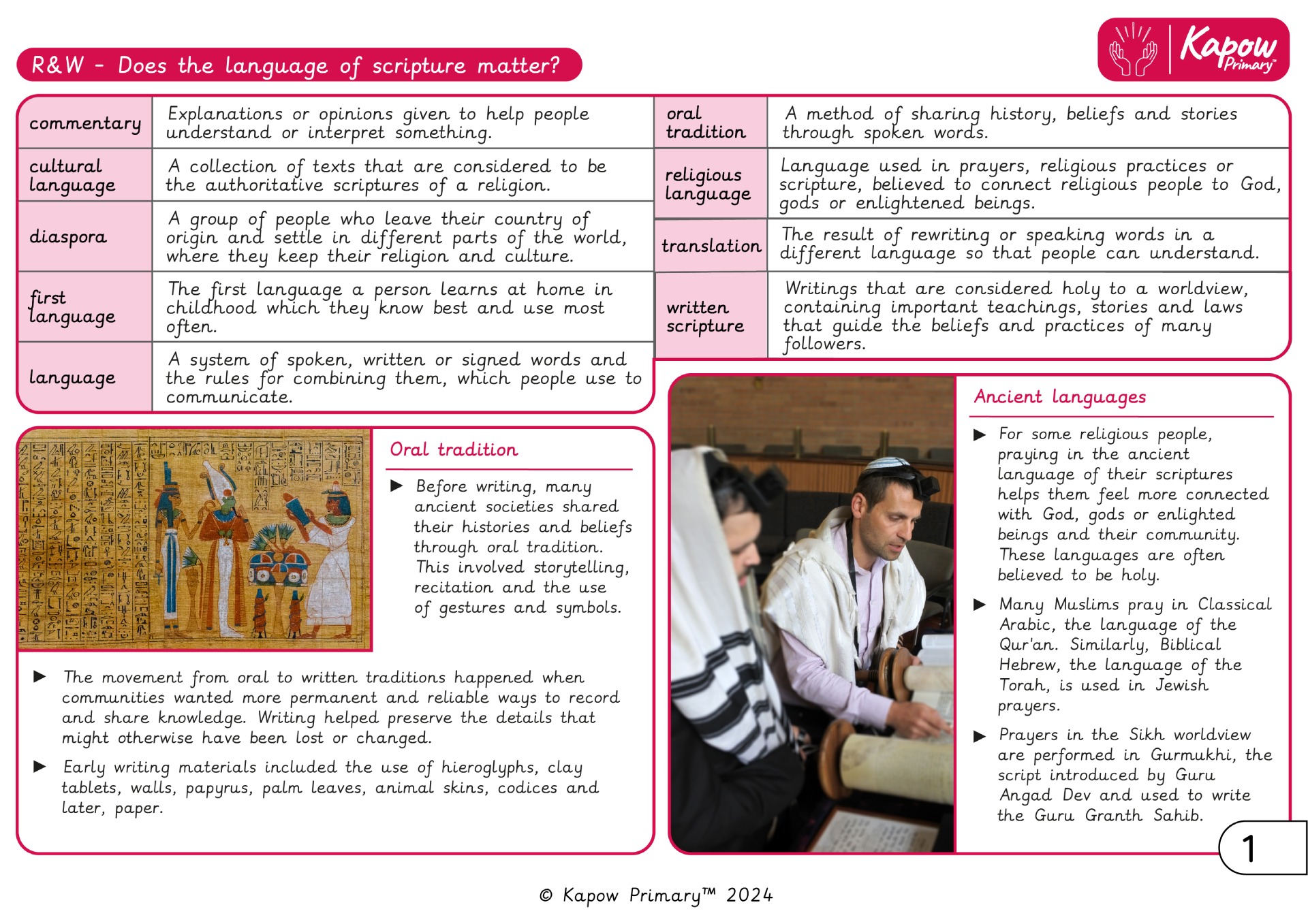
Knowledge organiser – R&W Y4: Does the language of scripture matter?
Aimed at pupils, two pages providing key facts and definitions from the unit 'Does the language of scripture matter?'
Vocabulary display – R&W Y4: Does the language of scripture matter?
A display version of the vocabulary from the 'Does the language of scripture matter?' unit.
Cross-curricular opportunities
English: Reading- comprehension; Spoken language.
History
RSE: Respectful relationships.
British values: Mutual respect; Tolerance of those with different faiths and beliefs; Rule of law.
