




- Subjects >
- Science >
- Key stage 2 >
- Year 6 >
Unit outcomes
Pupils who are secure will be able to:
- Compare sources of light and explain how the eye is protected from light.
- Describe how light travels and how we see luminous and non-luminous objects.
- Recall factors that affect the size of a shadow and describe how the distance between an object and the surface its shadow is cast on affects the size of the shadow.
- Use ray diagrams to explain why shadows change size and why the shape of a shadow matches the object that was cast.
- Recall what happens to light when it reaches a smooth mirror surface.
- Identify the incoming and reflected rays and describe the relationship between their angles.
- Use mirrors to make a working periscope and explain how a periscope works using ray diagrams.
- Recall a range of uses of mirrors and reflection, describe how a mirror reflects light in different situations and explain how light is reflected using knowledge of light and reflection.
When working scientifically, pupils who are secure will be able to:
- Make observations about the properties of light.
- Use my observations as evidence to support conclusions about light.
- Draw ray diagrams.
- Pose testable questions in response to observations.
- Record my measurements as a line graph.
- Use my line graph to extrapolate data and make predictions about missing values.
- Recall various jobs or inventions that use mirrors and reflection.
Please note that Kapow Primary Science lessons are designed to be 1 hour and 30 minutes long to reflect the requirements of a core subject.
Suggested prior learning
Energy: Light and shadows
Get started
Lessons
Lesson 1: The pathway of light
Lesson 2: See the light
Lesson 3: Measuring shadows
Lesson 4: Reflecting light
Lesson 5: Making a periscope
Lesson 6: Using mirrors
Key skills
Posing questions
- Identifying testable questions.
- Selecting

This content is for subscribers only. Join for access today.
Key knowledge
To know:
- Light travels in
This content is for subscribers only. Join for access today.
Key vocabulary
anomaly
conclusion (LKS2)
This content is for subscribers only. Join for access today.
Equipment list
Equipment needed across all lessons in this unit.
This list does not include equipment which is usually readily available in the classroom (e.g pencils, A4 paper etc)
 Download
Full equipment list for the subject
Quantities marked × will update. Items without quantities are unaffected
- Cardboard tubes ×8
- Small objects such as coins or dice. ×15
-
Short lengths of hose or opaque tubing.
×15 - Torches ×8
-
A6-size card with holes pierced through.
×15 - Rulers ×30
- Mirrors ×30
-
String or ribbon.
×1 -
Toys with eyes, such as teddy bears or dolls.
×8 -
Coloured acetate (or cut up coloured translucent folders).
×8 -
Football or other simple-shaped object
×1 -
Opaque black card or paper.
×15 - Lolly sticks ×30
- Modelling clay ×30
-
Assorted shaped objects
×15 - Protractors ×15
-
Glue dots or double-sided tape.
×1 -
Cuboid cardboard packaging
×8
The equipment below is optional
-
Bulldog clips
×30 - Glass of water ×1
-
Arrow drawn on paper in marker pen
×1 -
Large plastic bottle filled with water
×1 -
Something to pierce a hole in the bottle
×8 - Laser pointer ×1
-
Bucket or container to catch the stream of water
×1 -
Fibre optic light
×1 - Screens to divide the classroom ×1
This content is for subscribers only. Join for access today.
Related content
Unit resources


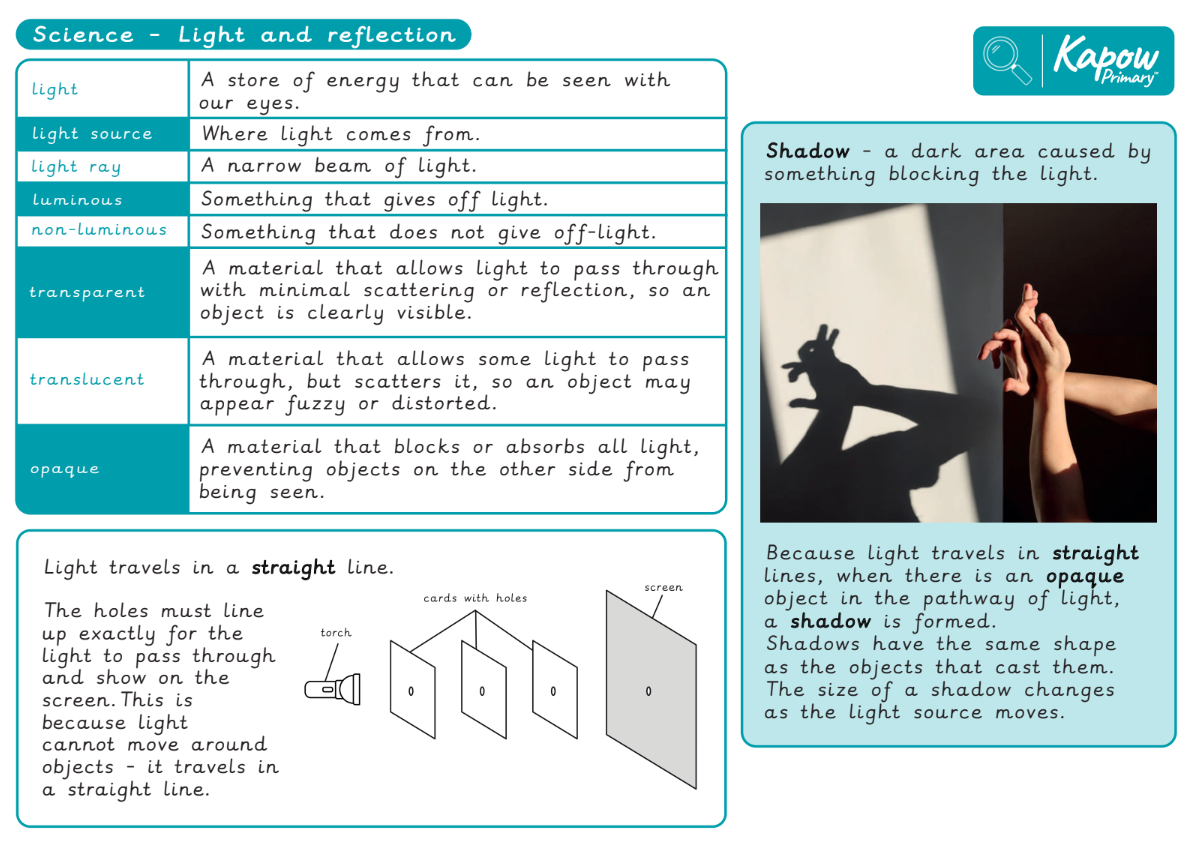
Knowledge organiser – Science Y6: Energy: Light and reflection
Aimed at pupils, two pages providing key facts and definitions from the unit ‘Light and reflection’.
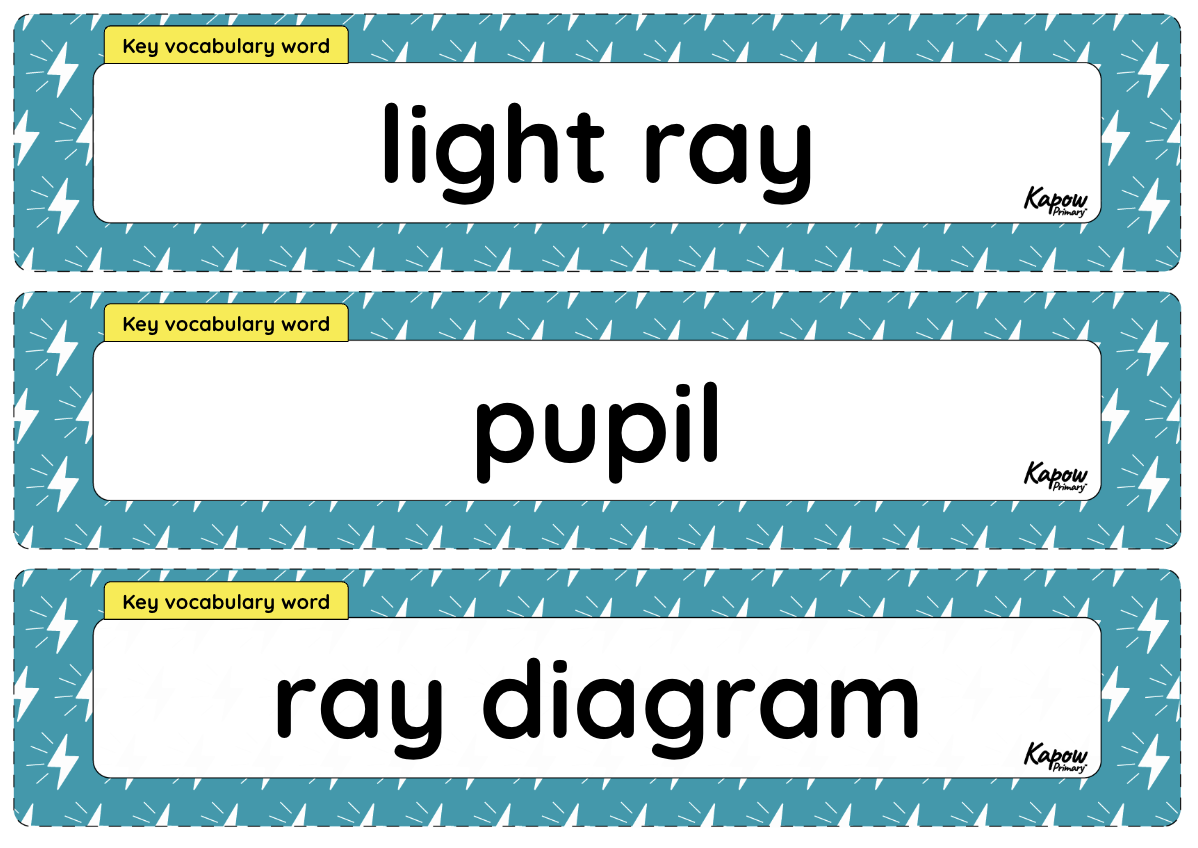
Vocabulary display – Science Y6: Energy: Light and reflection
A display version of the unit vocabulary from the unit 'Light and reflection'.
Subject resources
This content is for subscribers only. Join for access today.
Cross-curricular opportunities
English: Spoken language; Writing – composition.
Mathematics: Number – addition, subtraction, multiplication and division; Statistics
History.
Art and design.
British values: Mutual respect; Democracy; Rule of law.
Build on the learning
Energy: Circuits, batteries and switches
Get started
