




EYFS outcomes
Development matters
- Recognise some environments that are different from the one in which they live.
- Recognise some similarities and differences between life in this country and life in other countries.
- Draw information from a simple map.
See Development Matters (non-statutory curriculum guidance).
Early learning goals
ELG: Understanding the World – People, Culture and Communities
- Describe their immediate environment using knowledge from observation, discussion, stories, non-fiction texts, and maps.
- Know some similarities and differences between different religious and cultural communities in this country, drawing on their experiences and what has been read in class.
- Explain some similarities and differences between life in this country and life in other countries, drawing on knowledge from stories, non-fiction texts and – when appropriate – maps.
ELG: Understanding the World – The Natural World
- Know some similarities and differences between the natural world around them and contrasting environments, drawing on their experiences and what has been read in class.
See Statutory framework for the early years foundation stage.
Chose your lesson
Activity 1: Home or away?

Activity 2: Bear’s UK travels
Activity 3: City or countryside?
Activity 4: Exploring world landscapes
Activity 5: Desert explorers
Activity 6: Polar explorers
Key skills
- Identifying land and water

This content is for subscribers only. Join for access today.
Key knowledge
- To know that usually
This content is for subscribers only. Join for access today.
Equipment list
Equipment needed across all lessons in this unit.
This list does not include equipment which is usually readily available in the classroom (e.g pencils, A4 paper etc)
 Download
Full equipment list for the subject
Quantities marked × will update. Items without quantities are unaffected
Activity 1: Home or away?
-
Large paper
×8 - Teddy or soft toy
-
Small bag, rucksack or suitcase.
- Device for taking photographs ×8
- Photographs of features in your local area. ×8
Activity 2: Bear's UK travels
- Teddy or soft toy
- A variety of materials for continuous provision (for example, wooden blocks, cardboard boxes, building blocks, natural materials like stones or leaves, coloured paper, child-safe scissors, glue, crayons or paint, fabric offcuts, small figures or toys, modelling dough or clay).
Activity 3: City or countryside?
- Scissors right- and left-handed options recommended. ×30
- Glue sticks ×30
Activity 4: Exploring world landscapes
- Teddy or soft toy
- Large plastic hoops ×15
Activity 5: Desert explorers
- ‘Cleo the Completely Fine Camel’ by Wendy Meddour or a similar book set in a hot desert climate. ×1
- Props for role play (for example, fabric pieces for makeshift tents, wide-brimmed hats, sunglasses, sandals, water bottles, toy camels, maps, binoculars, stuffed animals such as snakes or lizards). ×1
- Additional images or videos to enrich the story, showing aspects of daily life, animals, plants and landscapes in hot climates. ×1
Activity 6: Polar explorers
- ‘Antarctica: A continent of wonder’ by Mario Cuesta Hernando or a similar book set in a cold, polar climate ×1
-
Props for role play (for example, warm coats, globes, scarves, hats, snow boots, goggles, binoculars, a sledge, stuffed animals like polar bears or penguins, a compass, a map, imitation ice blocks or white blankets).
-
Additional images or videos to enrich the story, showing aspects of daily life, animals, plants and landscapes in cold climates.
This content is for subscribers only. Join for access today.
Teacher video: Similarities and differences between life in this country and other countries

Teacher guidance
Using the activities
The activities are designed to support Reception teachers in targeting Development matters statements and laying the foundations for pupils’ further geography learning. In this unit, the Development matters statements ‘Recognise some environments that are different from the one in which they live’, ‘Recognise some similarities and differences between life in this country and life in other countries’ and ‘Draw information from a simple map’ are broken down into their core skill and knowledge components, linked to the Kapow Primary Geography curriculum in KS1 and KS2.
Refer to the skills and knowledge grid below to choose which activities to use with your class.
Activities can be delivered in any order and at any time of the year to suit your curriculum, specific topic, or cohort.
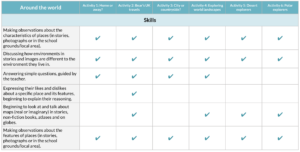
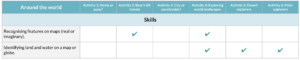
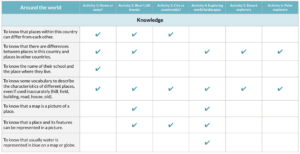
Activities can be organised to suit your setting. Options include:
- Using them as a whole-class lesson.
- Introducing activities to the whole class before setting them up as part of the enhanced provision.
- Allowing children to access the activities independently as part of the enhanced provision.
Further guidance
Ideas for topic links
Weather and Climate: Explore how weather patterns and climate vary across different parts of the world, affecting the way people live, the types of houses they build and the clothes they wear.
Transportation: Compare how people travel in different parts of the world, from sleds in polar regions to camels in deserts and relate these modes of transport to the geography of each area.
Food from Around the World: Investigate the diverse foods eaten in different countries and how local climates and landscapes influence diets. This can include tasting sessions, cooking simple recipes or exploring food sources.
World Languages: Introduce basic greetings and phrases from languages spoken in the countries studied. This can help the children appreciate linguistic diversity and cultural traditions.
Celebrations Around the World: Learn about various festivals and celebrations from different cultures, highlighting how these reflect aspects of the natural environment, such as harvest festivals or ceremonies that mark the changing seasons.
Endangered Animals: Discuss animals that are endangered in different parts of the world, linking to their habitats and how changes in the environment might affect their survival.
Recommended texts
‘This is How We Do It’ by Matt Lamothe.
‘One Day, So Many Ways’ by Laura Hall.
‘Over and Under the Snow’ by Kate Messner.
‘Children Just Like Me: A New Celebration of Children Around the World’ by DK.
‘One World, One Day’ by Barbara Kerley.
‘Atlas of Adventures’ by Rachel Williams and Lucy Letherland.
Continuous provision ideas:
Provide a large floor map of the world. The children can use toy vehicles, animals and figures to explore different continents and countries, fostering geographical awareness and storytelling.
Include blocks and construction materials along with pictures of famous landmarks from around the world. The children can attempt to recreate these structures, supporting their spatial awareness and knowledge of world geography.
Create a listening station with headphones, where the children can listen to traditional music from different countries. This can be paired with musical instruments from around the world for the children to explore.
Set up sensory boxes filled with natural materials representing different environments (e.g. sand for deserts, water and blue gel beads for oceans). Include relevant animal figures and plant materials for tactile exploration of different habitats.
Wider experiences
Visitor: Try to make contact with a school in another country where the children could prepare questions to ask, become pen pals and share pictures of school or home life. If a child has a parent or relative who grew up in another country, they could come in to talk and share photos of their childhood.
Event: Organise an International day where the children can taste foods, listen to and dance to music and hear stories and experiences from different cultures. This could be facilitated by parents/carers from different cultural backgrounds, local international restaurants and musicians or through cultural workshops or organisations.
Related content
Unit resources

Geography: Progression of skills and knowledge
Gives an overview of the skills and knowledge covered in each phase and strand the Geography curriculum.
