




Unit outcomes
Pupils who are secure will be able to:
- Label key organs found in the digestive system and describe each of their functions.
- Describe the functions of the four different types of adult human teeth using key vocabulary.
- Know that good dental care involves brushing their teeth twice a day with toothpaste and a soft toothbrush.
- Produce a food chain that begins with a plant and has arrows that move up the food chain.
- Define a producer, predator and prey and identify examples in food chains.
- Describe digestion, teeth and diets when talking about the observed poo clues.
- Write a letter that uses a range of scientific vocabulary from the unit.
When working scientifically, pupils who are secure will be able to:
- Evaluate a strength or weakness of the digestive system model.
- Describe an example of evidence that can be used to study teeth.
- Evaluate a method by considering its limitations.
- Recall that scientific research needs repeated results before being used in society.
- Identify trends in predators and prey.
- Draw a results table that has space for observations about different poo samples.
Please note that Kapow Primary Science lessons are designed to be 1 hour and 30 minutes long to reflect the requirements of a core subject.
Suggested prior learning
Y3/4 (A): Animals, including humans: Movement and nutrition
Get started
Lessons
Y3/4 (A): Lesson 1: The human digestive system
Y3/4 (A): Lesson 2: Human teeth
Y3/4 (A): Lesson 3: Investigating dental hygiene
Y3/4 (A): Lesson 4: Teeth of carnivores, herbivores and omnivores
Y3/4 (A): Lesson 5: Producers, predators and prey in food chains
Y3/4 (A): Lesson 6: Poo clues
Key skills
Planning
- Beginning to select from

This content is for subscribers only. Join for access today.
Key knowledge
To know:
- The main organs
This content is for subscribers only. Join for access today.
Key vocabulary
canine
carnivore (Y1)
This content is for subscribers only. Join for access today.
Equipment list
Equipment needed across all lessons in this unit.
This list does not include equipment which is usually readily available in the classroom (e.g pencils, A4 paper etc)
 Download
Full equipment list for the subject
Quantities marked × will update. Items without quantities are unaffected
-
Bread
×30 - Potato masher ×1
-
Large bowls/containers
2 - Jugs/bottles ×8
- Fruit juice ×1
-
Funnel (and tubing, if available).
×1 - Bag ×1
-
A pair of tights
×1 -
A sponge
×1 - Tray ×1
- Modelling dough ×30
- Mirrors ×30
-
Empty eggshells or whole eggs
×1 - Liquids in cups (juice, cola, coffee, vinegar, water - enough to immerse the shell) ×1
-
Soft, medium and hard toothbrushes, preferably of the same brand/size.
×8 -
Toothpaste
×1 - Stopwatch / timer ×8
- Hand lenses ×1
- Whistle ×1
- PE hoops ×15
-
Tennis balls or beanbags
×1 - PE bibs ×30
- Tag rugby bands ×30
The equipment below is optional
- Damp cloths ×8
- Homemade poo samples ×1
This content is for subscribers only. Join for access today.
Related content
Unit resources



Knowledge organiser – Science Y3/4 (A): Animals, including humans: Digestion and food
Aimed at pupils, two pages providing key facts and definitions from the mixed-age unit ‘Digestion and food’.
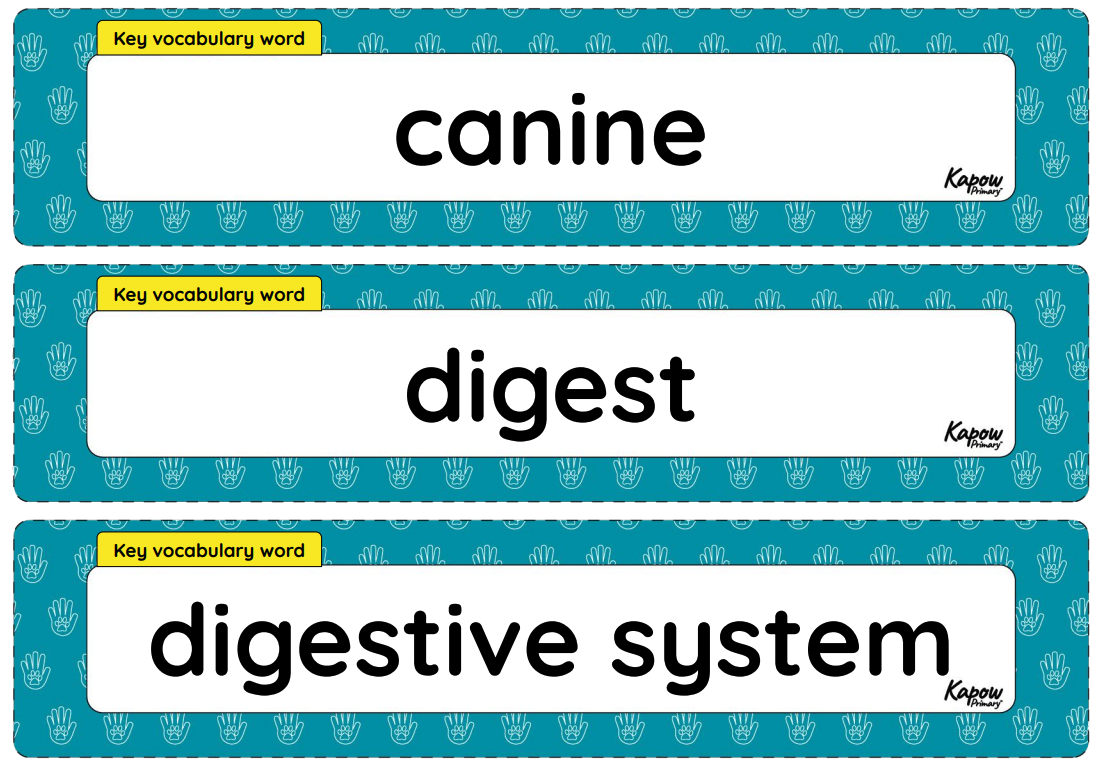
Vocabulary display – Science Y3/4 (A): Animals, including humans: Digestion and food
A display version of the vocabulary from the mixed-age unit ‘Digestion and food'.
Subject resources
This content is for subscribers only. Join for access today.
Cross-curricular opportunities
English: Spoken language; Writing – composition.
Mathematics: Number – addition and subtraction; Number – number and place value; Measurement; Statistics.
British values: The rule of law; Mutual respect; Tolerance of those with different faiths and beliefs.
Geography: Place knowledge; Human and physical geography.
RSE: Health and prevention.
Build on the learning
Y5/6 (A): Animals, including humans: Circulation and health
Get started
