


This lesson is archived.
Please note
Kapow no longer updates these lessons, and they may not reflect the national curriculum or current guidance. They remain a permanent part of your subscription and will continue to be available for reference and use. We recommend that you explore the new versions of the lessons.
Learning objective
- To know how to create tint and shade of a colour
National curriculum
Pupils should be taught:
- To develop a wide range of art and design techniques in using colour, pattern, texture, line, shape, form and space
Success criteria
- I know that tone is the areas of dark and light and can identify this in a painting or photograph
- I know that a tint is to make a colour lighter by adding white
- I know that a shade is to make a colour darker by adding black
- I can use tints and shades to paint from light to dark in smooth and neat strokes
Cross-curricular links
- Nothing relevant for this lesson
Before the lesson
Watch
- Teacher video: Tints and shades – Christmas themed
- Pupil video: Tints and shades – Christmas themed
Have ready
- *Link: 'Still Life with a Pewter Flagon and Two Ming Bowls by Jan Jansz. Treck' (This is an external website and we do not have control of its content – please check before showing to the children)
- Presentation: Tints and shades (see Attention grabber)
- Activity: Christmas shape templates – quantity of each dependent on the children’s preferences, can be copied at a reduced size to use to make cards (see Classroom resources)
- A selection of DIY shop paint shade cards that come in strips (optional)
- Water pots (one per pair of pupils)
- A palette per pupil – containing black, white and one colour based on their chosen template
- A flat brush (appropriate for the size of template they are using

Attention grabber
Key question
- What does the word tone mean?
‘In painting, tone refers to the relative lightness or darkness of a colour’ (Tate.org.uk).
Display the link: 'Still Life with a Pewter Flagon and Two Ming Bowls by Jan Jansz. Treck' on your interactive whiteboard. Ask the children if they can see all of the beautiful areas of dark and light in the painting? Can they see the way he has blended tones smoothly from dark to light?
Key question
- Where can you see dark areas?
- What do these dark areas show?
- How do you think you create a darker colour?
The figures and objects look realistic, almost like a photograph, as though you could touch them. Explain that the artist has created this illusion using tone – areas of dark and light.
Another good example of where an artist uses tints and shades of one colour is the painting ‘Green Apples’ by Paul Cezanne. You can find an image of this online.
Display slide 2 of the Presentation: Tints and shades, showing images of paint shade cards. Alternatively you can use a selection of paint shades cards on the table from a DIY store.
Presentation: Tints and shades
Display on your interactive whiteboard
Ask the children how they think we can make a colour lighter or darker?
Explain that an artist creates tone by adding darker or lighter colours to the original colour. The simplest way of creating tones of colour is by adding black or white to the paint. Adding white creates a tint, adding black creates a shade.
Ask the children to practise this by creating their own shade card of any chosen colour. They can do this by drawing a simple rectangle in their sketchbook, split into seven equal sections. Starting with the unchanged colour in the middle, work one way, adding black and then the other way, adding white. Demonstrate this, if needed, before the children try this for themselves.
Main event
Show the children how they will apply this using one of the Christmas themed shape templates.
Give each pupil a paint palette which includes:
- white (to create the tint)
- black (for the shade)
- one colour
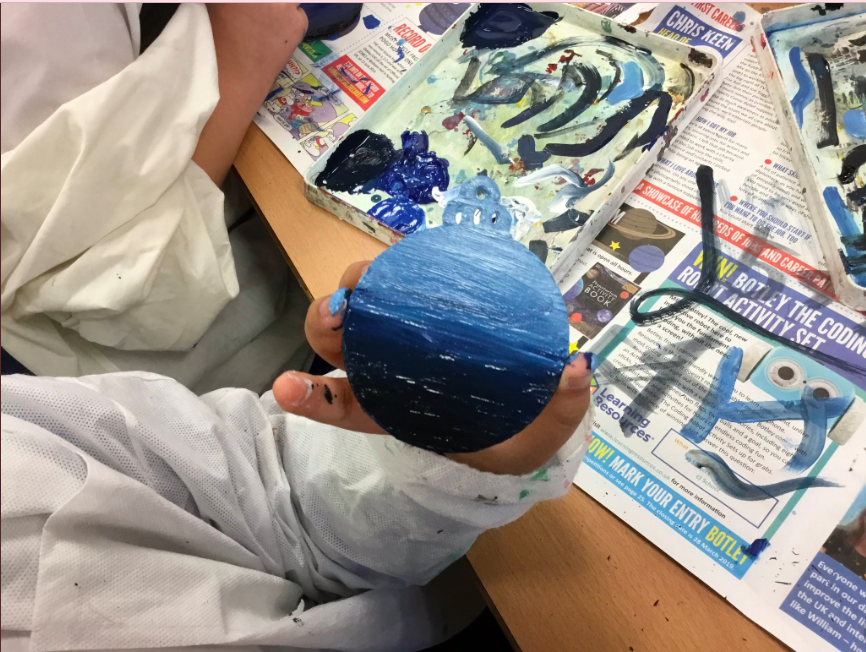
Demonstrate how they will paint the templates yourself, or using the Pupil video: Tints and shades – Christmas.
The emphasis should be on careful mixing to achieve a tonal transition from one shade or tint to the next. As well as painting neatly to the edges and blending tones from dark to light smoothly.
The children can choose a template from the Activity: Christmas shape templates (see Classroom Resources) to work within. Encourage them to paint the worksheet as accurately as they can.
You could leave the Pupil video: Tints and shades – Christmas playing for the children to refer to as they work, as the video is looped.
Differentiation
Pupils needing extra support: May struggle to paint neatly and blend tones from dark to light, encourage them to practise first. They may need to complete all the colour mixing first to have a palette ready to use before applying it to their work.
Pupils working at greater depth: Should be encouraged to repeat this process with another colour, and can create their own Christmas shapes, or Christmas scenes to apply this technique to.
Wrapping up
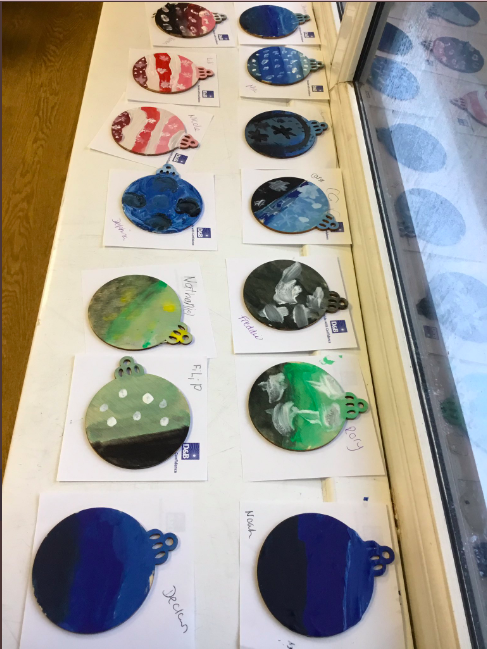
As a class, look at everyone’s work and refer back to the original art pieces from the start of the lesson.
Key question
Have we blended our tones smoothly without showing hard edges like the artists’ work we’ve looked at?
Developing the work further
- Scale the templates down to use the cut out shapes to make cards.
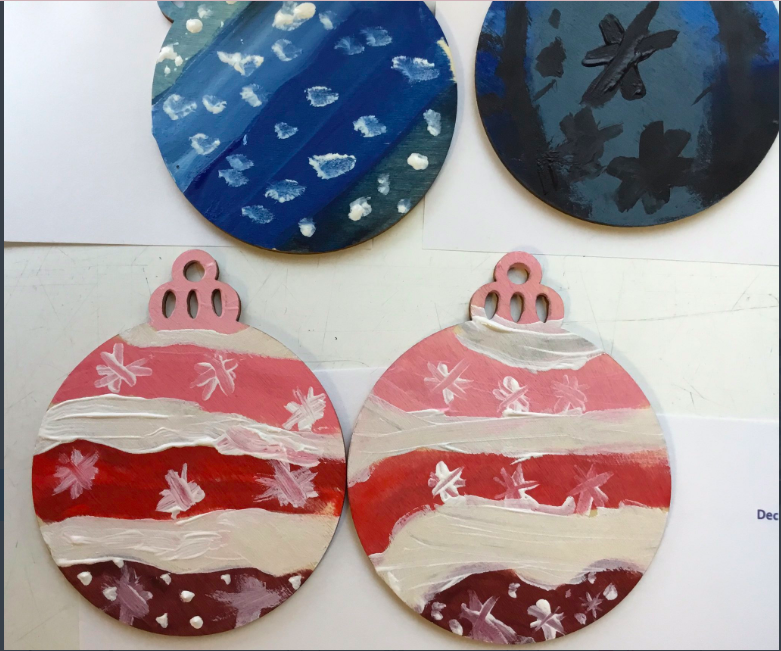
- Apply the same technique to create a Christmas scene, creating a background in one tonal colour and adding a second colour for objects, or paint foreground objects as black silhouettes.
Assessing pupils' progress and understanding
Pupils with secure understanding indicated by: Painting the templates accurately – to the edges. Able to move from one tone to the next.
Pupils working at greater depth indicated by: Painting the template with accuracy, able to blend smoothly between one tone to the next.
Vocabulary
Tone
Tint
Shade
Light
Dark
Blend
Template
Examples of completed work
In this unit
- Assessment - Art and design Y3: Art and design skills
- Introduction to sketchbooks
- Lesson 1: Learning about…Carl Giles
- Lesson 2: Painting: Tints and shades - Option 1 (Original scheme)
- Lesson 2: Painting: Tints and shades - Option 2: Christmas themed
- Lesson 3: Drawing: My toy story (Original scheme)
- Lesson 4: Craft and Design 1: Craft puppets
- Lesson 5: Craft and Design 2: Sock puppets
- Lesson 6: Craft and Design 3: Shadow puppets