


Primary Theme: The body
Lesson 3: Investigating dental hygiene
Investigating the effectiveness of toothbrushes and the role of evaluation in scientific progress.
Y3/4 (A): Lesson 4: Teeth of carnivores, herbivores and omnivores
Using knowledge of teeth to group animals as carnivores, herbivores and omnivores. This lesson is part of the mixed-age scheme.
Y5/6 (A): Lesson 4: Heart rate
Researching animals' average masses to compare with their heart rates and look for patterns. This lesson is part of the mixed-age scheme.
Y3/4 (A): Lesson 4: Eating for survival
Understanding how animals, including humans, need to eat to get the nutrition they need to survive and how the body may use that energy. This lesson is part of the mixed-age scheme.
Lesson 4: Heart rate
Researching animals' average masses to compare with their heart rates and look for patterns.
Lesson 4: Eating for survival
Understanding how animals, including humans, need to eat to get the nutrition they need to survive and how the body may use that energy.
Lesson 4: Teeth of carnivores, herbivores and omnivores
Using knowledge of teeth to group animals as carnivores, herbivores and omnivores.
Y5/6 (B): Animals, including humans: Human timeline
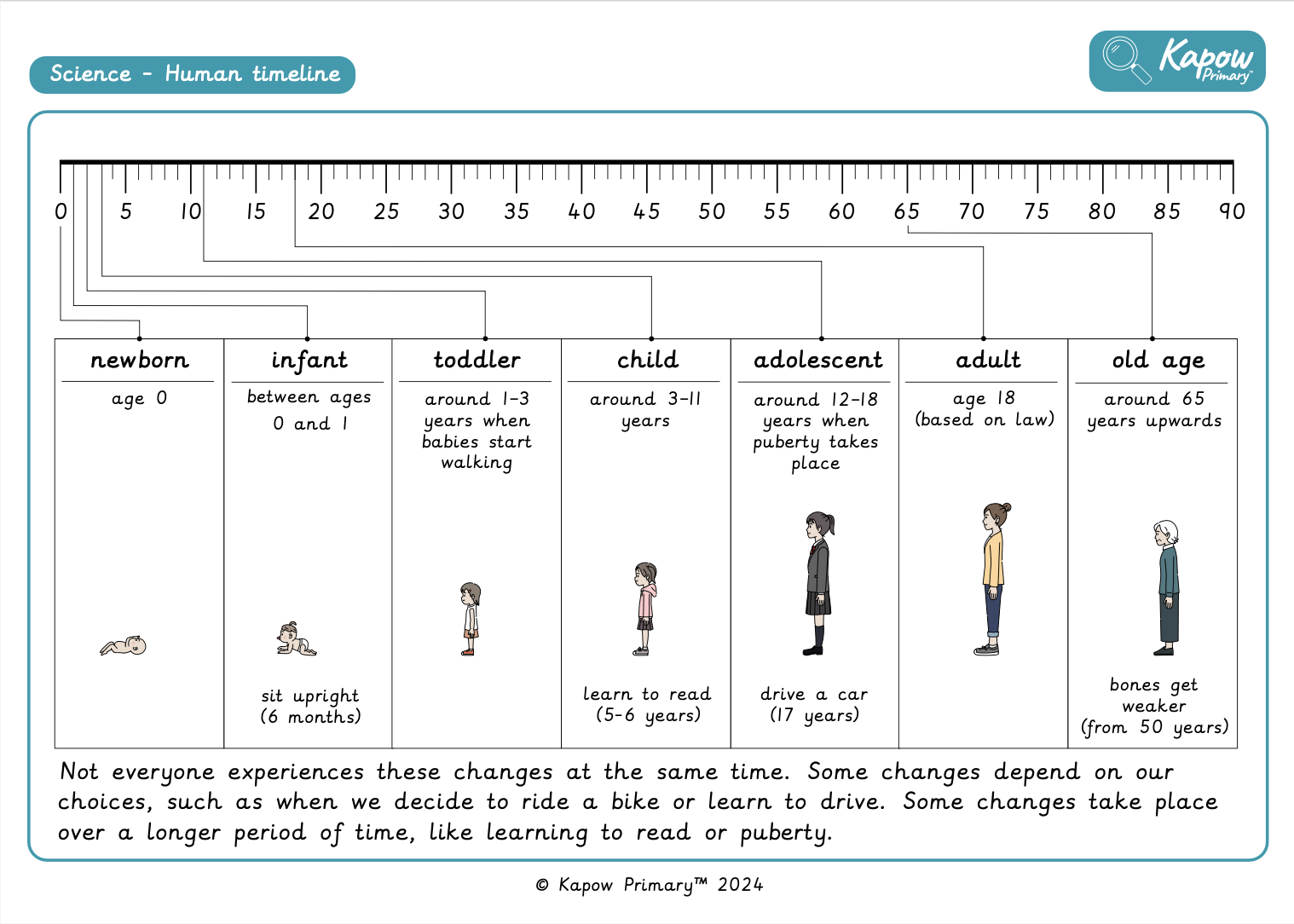
Exploring how humans change from a baby through to old age, including puberty, measurements of growth and gestation periods.
Unit outcomes
Pupils who are secure will be able to:
- Order the stages in growth and development from birth to old age.
- Describe physical and developmental changes from a baby through to old age.
- Describe changes that occur in males and females during puberty.
- Suggest ways to manage the changes that occur during puberty.
- Recall what is meant by a gestation period.
- Describe how gestation varies across animals and compare this to humans.
When working scientifically, pupils who are secure will be able to:
- Use data to describe growth from baby to adult.
- Identify where on the graph the rate of growth changes.
- Use a line graph to make predictions about height.
- Choose a suitable title and axes labels for the scatter graph and plot data on the scatter graph.
Please note that Kapow Primary Science lessons are designed to be 1 hour and 30 minutes long to reflect the requirements of a core subject.
This unit only has three lessons.
Suggested prior learning
Y5/6 (B): Living things: Life cycles and reproduction
Get started
Lessons
Y5/6 (B): Lesson 1: Growing old
Y5/6 (B): Lesson 2: Puberty
Y5/6 (B): Lesson 3: Comparing human gestation
Key skills
- Representing data by using line graphs and scatter graphs.
- Plotting points with greater accuracy.

This content is for subscribers only. Join for access today.
Key knowledge
- How to describe the human life cycle, including the stages of growth and development (baby, toddler, child, teenager, adult, elderly).
- How to describe changes that occur during puberty (in boys and girls).
This content is for subscribers only. Join for access today.
Key vocabulary
anomaly
evidence
This content is for subscribers only. Join for access today.
Equipment list
Equipment needed across all lessons in this unit.
This list does not include equipment which is usually readily available in the classroom (e.g pencils, A4 paper etc)
 Download
Full equipment list for the subject
Quantities marked × will update. Items without quantities are unaffected
-
Metre ruler
×1 -
Rulers, ideally transparent/translucent
×15 - Sticky notes ×30
The equipment below is optional
- A childhood photo of a well-known adult in the school ×1
- Photos of the class as babies or younger children ×1
-
Graph paper
×30 - Devices with internet access ×15
This content is for subscribers only. Join for access today.
Related content
Resources
Unit resources

Science
Knowledge organiser – Science Y5/6 (B): Animals, including humans: Human timeline (with named genitalia)
Aimed at pupils, two pages providing key facts and definitions from the mixed-age unit ‘Human timeline’.
Science
Knowledge organiser – Science Y5/6 (B): Animals, including humans: Human timeline (without named genitalia)
Aimed at pupils, two pages providing key facts and definitions from the mixed-age unit ‘Human timeline’.
Science
Vocabulary display – Science Y5/6 (B): Animals, including humans: Human timeline
A display version of the vocabulary for the mixed-age unit ‘Human timeline’.
Subject resources
This content is for subscribers only. Join for access today.
Cross-curricular opportunities
English: Spoken language.
Mathematics: Number – number and place value; Statistics.
RSE: Changing adolescent body.
Art.
British values: Rule of law; Democracy; Mutual respect.