


Primary Theme: French speaking world
Assessment - French Y5: French-speaking world
Assessment quiz and Knowledge catcher for use at the start and/or end of the unit to assess pupil progress.
Assessment resources
Quiz presentation - Y5: French-speaking world
Downloads


This content is for subscribers only. Join for access today.
Need help?
Watch the one-minute video to find out more
We’ve updated our assessments
Our French assessment spreadsheet to track pupil progress
Click to download the assessment spreadsheet for our French scheme of work.
Y5/6 (A): Lesson 2: Where in the world is French spoken?
Learning that French is spoken in many countries, the children use their knowledge of size and colour adjectives and their compass points to read clues in French to work out where French-speaking countries are located in the world and what their flags look like.
Y5/6 (A): Lesson 1: Directions in French
Mixed-age Year 5/6 French lesson on directions. Understand compass points and use numbers to describe distance in French. With teacher video.
Lesson 1: Directions in French
Y5 French lesson plan: Directions in French. Pupils use compass points vocabulary and instructions to find treasure. With teacher video and support.
Y5/6 (A): Lesson 3: Treasures of the French-speaking world
Broadening cultural understanding by exploring in more detail some French-speaking countries, the children read short sentences, matched with pictures and ask questions and make statements using , 'il y a...' to uncover which landscape and cultural treasure cards belong to a named country and which is the odd one out.
Are you ready to start the lesson?
Y5/6 (A): Lesson 4: Investigating climate in the French-speaking world
Using language detective skills to help with listening to a real weather forecast in French, analysing climate data and applying it to decoded climate statements using comparative language, to determine whether statements are true or false.
Y3/4 (B): Unit 3: Birthday celebrations
Use this unit hub to inform your medium-term plan and navigate to related resources
Unit outcomes
Pupils who are secure will be able to:
- Say the numbers 1-31 in French.
- Read and calculate Maths sums correctly.
- Match French months to their English equivalents.
- Ask when someone’s birthday is and say when their birthday is.
- Compare similarities and differences between birthdays in the UK and France.
- Write sentences to create a wish list, describing things orally and in writing.
- Appreciate songs in the language.
- Compare French festivals and their traditions with English ones.
Suggested prior learning
Y3/4 (B): Unit 2: School days
Get started
Lessons
Y3/4 (B): Lesson 1: Numbers 1-31
Y3/4 (B): Lesson 2: Months of the year
Y3/4 (B): Lesson 3: Seasons and dates
Y3/4 (B): Lesson 4: Celebrating a French birthday
Y3/4 (B): Lesson 5: Birthdays in France
Key skills
- Using a variety of conversational phrases.
- Applying knowledge of cognates and near cognates to work out the meaning of new vocabulary.
This content is for subscribers only. Join for access today.
Key knowledge
- To become familiar with the key phonemes oi, in, eu, eau and those that are represented by the letters z/s, x and i.
- To know months, seasons, and days of the week in French are not capitalised unless used at the beginning of a sentence.
This content is for subscribers only. Join for access today.
Key vocabulary
la date
quelle est la date ?
This content is for subscribers only. Join for access today.
Equipment list
Equipment needed across all lessons in this unit.
This list does not include equipment which is usually readily available in the classroom (e.g pencils, A4 paper etc)
 Download
Full equipment list for the subject
Quantities marked × will update. Items without quantities are unaffected
-
A small ball or soft toy
×1 - French – English dictionaries ×30
-
A class teddy or mascot
×1
The equipment below is optional
- Birthday cake
This content is for subscribers only. Join for access today.
Related content
Resources
Unit resources

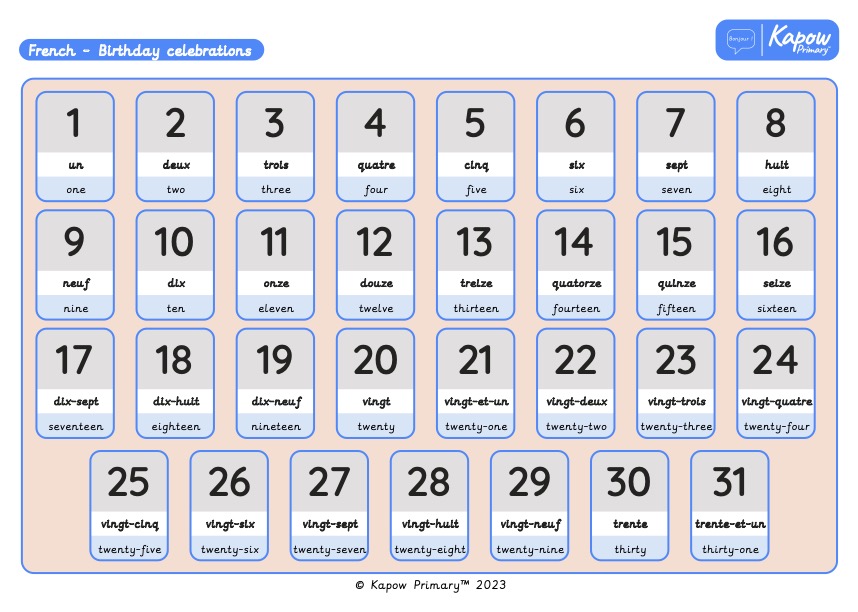
French
Knowledge organiser – French: Birthday Celebrations
A visual summary of key vocabulary, grammar and sentence structures from the unit.
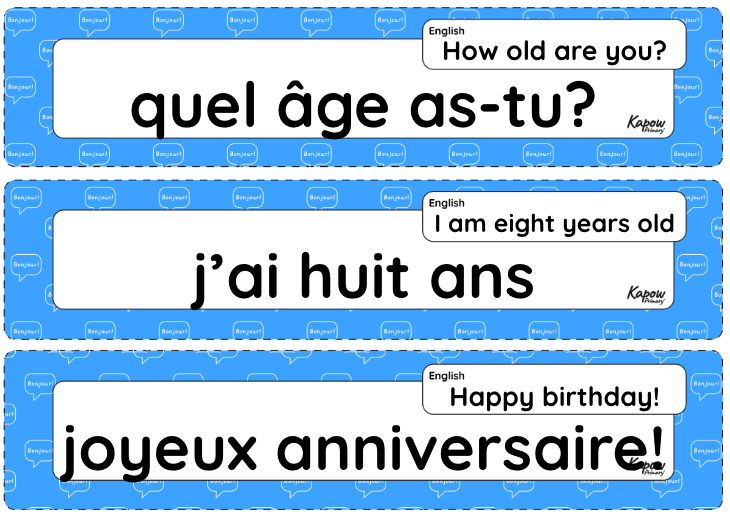
French
Vocabulary display: Birthday celebrations
A display version of the key vocabulary from the Birthday celebrations unit.
Subject resources
This content is for subscribers only. Join for access today.
Cross-curricular opportunities
British values
- Further tolerance and harmony between different cultural traditions by enabling students to acquire an appreciation of and respect for their own and other cultures.