


Primary Theme: Food and drink
Are you ready to start the lesson?
Lesson 3: How do we get our chocolate?
Discussing opinions on responsible trade and looking at the journey and process of a cocoa bean from farm to chocolate bar on a shop shelf.
Pre-lesson checklist
Y3/4 (A): Lesson 4: Eating for survival
Understanding how animals, including humans, need to eat to get the nutrition they need to survive and how the body may use that energy. This lesson is part of the mixed-age scheme.
Y3/4 (A): Lesson 4: Where does our food come from?
Mapping and measuring the distance food travels to reach the UK and using a scale bar to convert measurements.
Y3/4 (A): Lesson 4: What are the effects of a volcanic eruption?
Developing an understanding of how volcanoes have negative and positive effects on a community, using Mount Etna in Sicily as a case study.
Y3/4: Lesson 4 (Cycle B): French food
Extending knowledge of French food vocabulary, using dictionary skills to look up new words and giving opinions.
Unit 4: Spanish food and drink
Asking and answering questions about food preferences.
- Subjects >
- Spanish >
- Key stage 2 >
- Year 5 >
Unit outcomes
Pupils who are secure will be able to:
- Express likes and dislikes about singular and plural food items.
- Ask and answer questions about food likes and dislikes.
- Listen and select key information about food preferences.
- Deduce meal choices by finding out about food preferences.
- Conduct an interview about food preferences.
- Ask questions in a variety of formats to find out about food preferences.
Suggested prior learning
Unit 4: In a Spanish café
Get started
Lessons
Lesson 1: Food likes and dislikes
Lesson 2: Finding out food preferences
Lesson 3: Café conversations
Lesson 4: Guess my pizza
Lesson 5: Personalised pizzas
Lesson 6: Guess your partner’s answers
Key skills
- Using a range of language detective strategies to decode new vocabulary including context and text type.
- Identifying key information in simple writing.

This content is for subscribers only. Join for access today.
Key knowledge
- That phonic knowledge can be applied to pronounce unfamiliar words.
- That when expressing likes and dislikes about a noun, me gusta is followed by the definite article (el or la) then the noun e.g. Me gusta el pescado.
This content is for subscribers only. Join for access today.
Key vocabulary
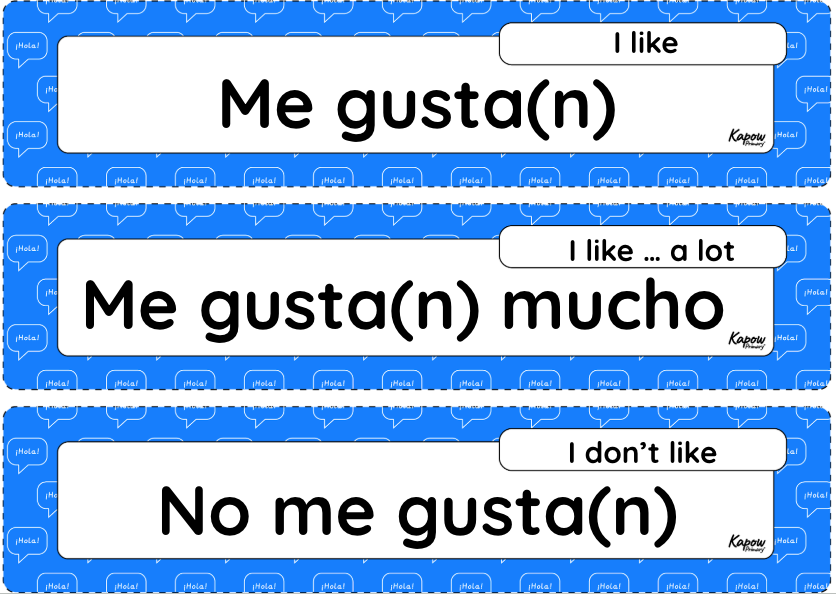
Me gusta(n)
No me gusta(n)
This content is for subscribers only. Join for access today.
Equipment list
Equipment needed across all lessons in this unit.
This list does not include equipment which is usually readily available in the classroom (e.g pencils, A4 paper etc)
 Download
Full equipment list for the subject
Quantities marked × will update. Items without quantities are unaffected
- Bilingual Spanish-English dictionaries ×15
- Counters Per pair: 7
This content is for subscribers only. Join for access today.
Spanish phonics videos
Explore the phonics videos used in this unit.
Related content
Resources
Unit resources

Spanish
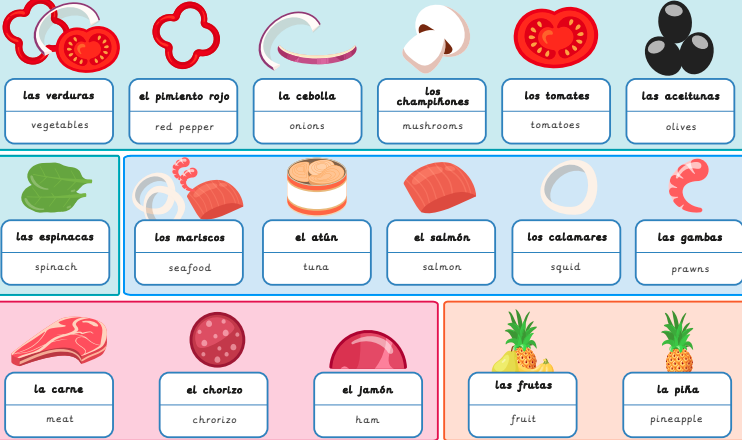
Knowledge organiser: Y5 – Spanish food and drink
Aimed at pupils, two pages providing key facts and definitions from the unit 'Unit 4: Spanish food and drink.'
Spanish
Vocabulary display: Spanish food and drink
A display version of the key vocabulary from the unit 'Spanish food and drink'.
Spanish
Translations: Spanish food and drink
Translations of key texts and transcripts from resources in this unit.
Subject resources
This content is for subscribers only. Join for access today.
Cross-curricular opportunities
None.
Build on the learning
Unit 2: School life in Spanish
Get started