




Unit outcomes
Pupils with secure understanding will be able to:
- Correctly order and date four photographs on a timeline and add some dates.
- Ask one question about schools in the past.
- Make one comparison between schools in the past and present.
- Use sources to research and develop an understanding of what schools were like 100 years ago.
- Identify three features of a classroom now and a classroom 100 years ago, identifying some similarities and differences.
- Recognise two similarities and two differences between schools now and schools in the past.
- State whether they would have preferred to go to school in the past or not and explain why.
Suggested prior learning
Y1/2 (B): What is history?
Get started
Lessons
Y1/2 (B): Lesson 1: Were schools different in the past?
Y1/2 (B): Lesson 2: How have schools changed within living memory?
Y1/2 (B): Lesson 3: How were schools different in the 1900s?
Y1/2 (B): Lesson 4: How have schools changed?
Y1/2 (B): Lesson 5: What is similar and different about schools now and in the past?
Y1/2 (B): Lesson 6: Would you prefer to have gone to school in the past?
Key skills
- Sequencing up to six

This content is for subscribers only. Join for access today.
Key knowledge
To know that:
- A decade
This content is for subscribers only. Join for access today.
Key vocabulary
beyond living memory
different
This content is for subscribers only. Join for access today.
Equipment list
Equipment needed across all lessons in this unit.
This list does not include equipment which is usually readily available in the classroom (e.g pencils, A4 paper etc)
 Download
Full equipment list for the subject
Quantities marked × will update. Items without quantities are unaffected
- Photographs of your school or local schools in the 1960s if possible, inside and out. ×8
- Photographs of life locally showing clothes, homes and transport. ×8
- Sources from the 1960s relating to school life include a school log book, registers, HMI reports, and an old map of the local area. ×8
- Photographs of your school or local schools in the 1900s if possible, inside and out ×8
-
Sources from the 1900s relating to school life include a school log book, registers and HMI reports
×1 -
An old map of the local area
×1 -
Modern map of local area
×1 - Sticky notes
This content is for subscribers only. Join for access today.
Related content
Unit resources


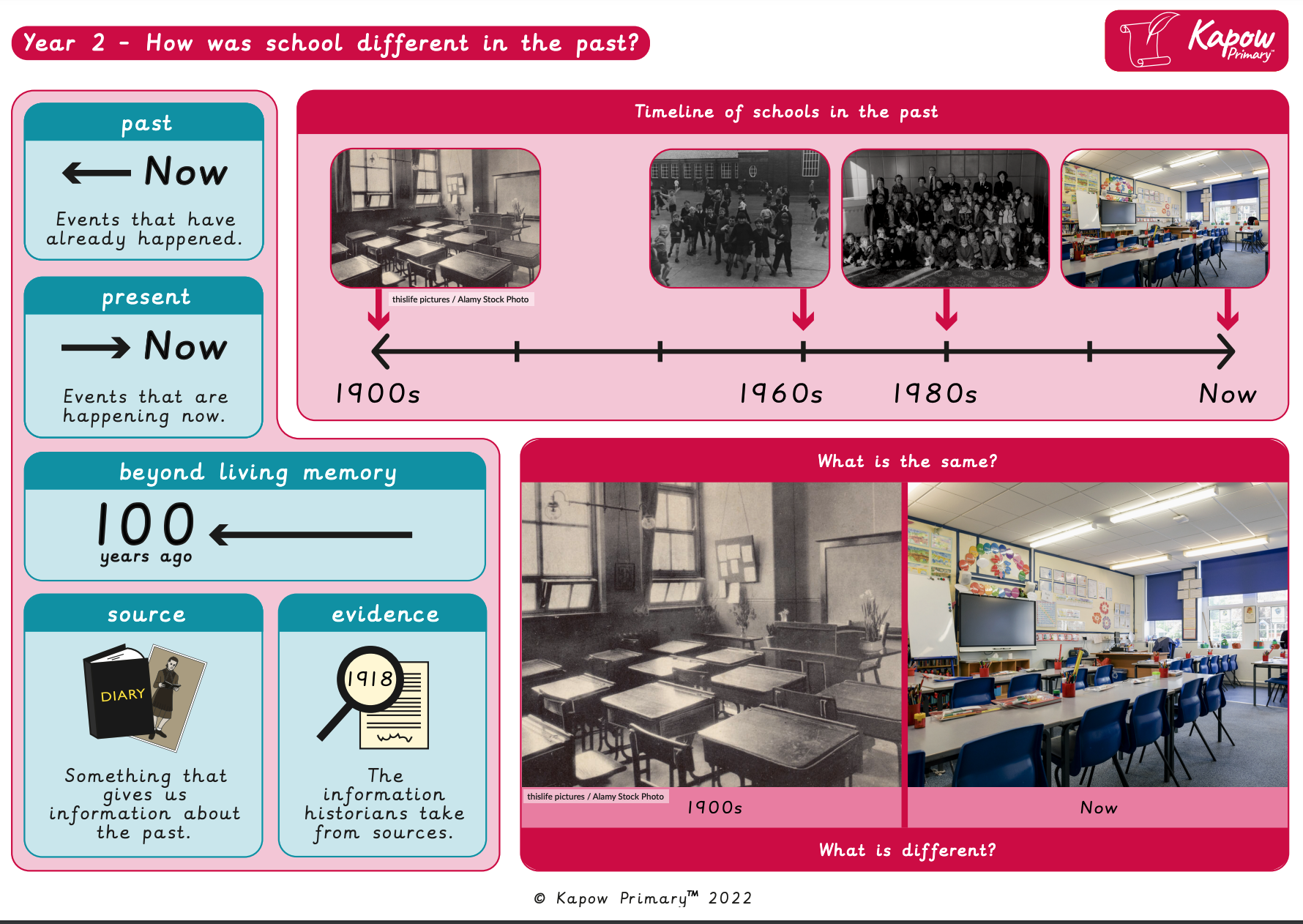
Knowledge organiser – History Y1/2 (B): How was school different in the past?
Aimed at pupils, two pages providing key facts and definitions from the ‘How was school different in the past?’ unit.
Vocabulary display – History Y1/2 (B): How was school different in the past?
A display version of the key vocabulary from the 'How was school different in the past?' unit.
Subject resources
This content is for subscribers only. Join for access today.
Cross-curricular opportunities
English
Pupils should be taught to:
- Maintain attention and participate actively in collaborative conversations, staying on topic and initiating and responding to comments.
- Ask relevant questions to extend their understanding and knowledge.
- Give well-structured descriptions, explanations and narratives for different purposes, including for expressing feelings.
See National curriculum - English key stages 1 to 2.
Geography
Pupils should be taught to:
- Use world maps, atlases and globes to identify the United Kingdom and its countries, as well as the countries, continents and oceans studied at this key stage.
See National Curriculum – Geography key stages 1 to 2.
Art and design
Pupils should be taught:
- To use drawing, painting and sculpture to develop and share their ideas, experiences and imagination.
See National curriculum - Art and design key stages 1 to 2.
Mathematics
Pupils should be taught to:
- Recognise and use language relating to dates, including days of the week, weeks, months and years.
See National curriculum - Mathematics key stages 1 to 2.
British values
- Rule of law.
Build on the learning
Y1/2 (B): What is a monarch?
Get started
