




Unit outcomes
Pupils who are secure will be able to:
- Identify the most densely and sparsely populated areas.
- Describe the increase in global population over time.
- Begin to describe what might influence the environments people live in.
- Define birth and death rates, suggesting what may influence them.
- Define migration, discussing push and pull factors.
- Explain why some people have no choice but to leave their homes.
- Describe the causes of climate change, explaining its impact on the global population.
- Suggest an action they can take to fight climate change.
- Calculate the length of a route to scale.
- Follow a selected route on an OS map.
- Use a variety of data collection methods, including using a Likert scale.
- Collect information from a member of the public.
- Create a digital map to plot and compare data collected from two locations.
- Suggest an idea to improve the environment.
Lesson 5 involves fieldwork in a local urban environment. It is important to risk-assess the proposed route taking into account any relevant school risk assessment policies and procedures. Refer to the Before the lesson section in Lesson 5 to prepare for this lesson. Please be aware this lesson may take longer than 1 hour.
Lessons 5 and 6 require a device (one each).
Suggested prior learning
Y5/6 (A): Where does our energy come from?
Get started
Lessons
Y5/6 (B): Lesson 1: How is the global population changing?
Y5/6 (B): Lesson 2: What are birth and death rates?
Y5/6 (B): Lesson 3: Why do people migrate?
Y5/6 (B): Lesson 4: How is climate change impacting the population?
Y5/6 (B): Lesson 5: How is population impacting our environment?: Data collection
Y5/6 (B): Lesson 6: How is population impacting our environment?: Findings
Key skills
- Locating more

This content is for subscribers only. Join for access today.
Key knowledge
- To know that the
This content is for subscribers only. Join for access today.
Key vocabulary
air pollution
birth rate
This content is for subscribers only. Join for access today.
Equipment list
Equipment needed across all lessons in this unit.
This list does not include equipment which is usually readily available in the classroom (e.g pencils, A4 paper etc)
 Download
Full equipment list for the subject
Quantities marked × will update. Items without quantities are unaffected
- Sticky notes
- Atlas ×15
- Felt tip pens ×30
- Paper ×30
- Colouring pencils
-
An OS map of the local area with pre-prepared route marked
×1 - Clipboards ×30
- Stopwatch / timer ×8
- Voice recorders ×8
- Digital device (internet-enabled) ×15
This content is for subscribers only. Join for access today.
Related content
Unit resources


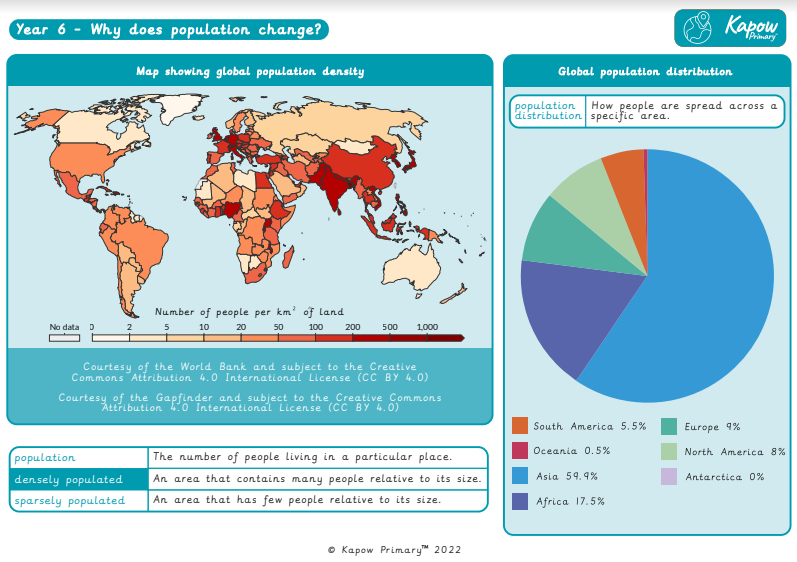
Knowledge organiser: Geography – Y6 Why does population change?
Aimed at pupils, a single page which gives key facts and definitions from the unit "Why does population change?".
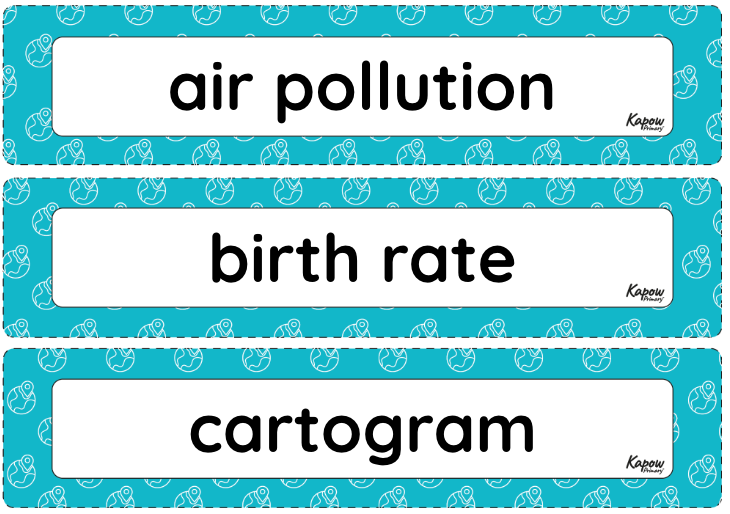
Vocabulary display: Why does population change?
A display version of the vocabulary from the unit 'Why does population change?'
Subject resources
This content is for subscribers only. Join for access today.
Cross-curricular opportunities
Mathematics: Statistics, number
English: Spoken language, writing
British values: Mutual respect, tolerance of those with different faiths and beliefs, individual liberty, democracy
History
Physical education
Computing
Build on the learning
Y5/6 (B): Why do oceans matter?
Get started
Popular content
- Geography: Curriculum portal
- Geography: Curriculum information
- Geography subject leader hub
- Geography: Fieldwork guide
- Geography: Staff Presentation
- Webinar: An introduction to geography
- Geography: Progression of concepts —mixed-age
- Ace your role as a D&T subject leader
- Ace Your Role As A Music Subject Leader
