




Unit outcomes
Pupils who are secure will be able to:
- Describe a biome and give an example.
- State the location and some key features of the Amazon rainforest.
- Name and describe the four layers of tropical rainforests.
- Understand that trees and plants adapt to living in the rainforest and give an example.
- Define the word indigenous and give an example of how indigenous peoples use the Amazon’s resources.
- Name one way in which the Amazon is changing.
- Articulate why the Amazon rainforest is important.
- Give an example of how humans are having a negative impact on the Amazon and an action that can be taken to help.
- Use a variety of data collection methods with support.
- Summarise how the local woodland is used and suggest changes to improve the area.
Lesson 5 involves fieldwork in a local woodland. It is important to risk-assess the proposed route taking into account any relevant school risk assessment policies and procedures. Refer to the Before the lesson section in Lesson 5 to prepare for this lesson. Please be aware this lesson may take longer than 1 hour.
Suggested prior learning
Y3/4 (A): Why do people live near volcanoes?
Get started
Lessons
Y3/4 (A): Lesson 1: Where in the world are tropical rainforests?
Y3/4 (A): Lesson 2: What is the Amazon rainforest like?
Y3/4 (A): Lesson 3: Who lives in the rainforest?
Y3/4 (A): Lesson 4: How are rainforests changing?
Y3/4 (A): Lesson 5: How is our local woodland used?: Data collection
Y3/4 (A): Lesson 6: How is our local woodland used?: Findings
Key skills
- Locating some

This content is for subscribers only. Join for access today.
Key knowledge
- To know where North
This content is for subscribers only. Join for access today.
Key vocabulary
analyse
biome
This content is for subscribers only. Join for access today.
Equipment list
Equipment needed across all lessons in this unit.
This list does not include equipment which is usually readily available in the classroom (e.g pencils, A4 paper etc)
 Download
Full equipment list for the subject
Quantities marked × will update. Items without quantities are unaffected
- Atlas ×15
- Globe ×30
- Scissors right- and left-handed options recommended. ×30
- Glue stick ×30
- Sticky notes
-
A list of groups of 5-7 children (depending on class size and the number of adults), each with a designated adult – brief the supervising adults before the lesson on the activities so they can support the children.
×1 -
Maps of local woodland (or park) added to Activity: Mapping my route – these can be found on Digimaps, OS maps or using a search engine if it is an extensive woodland or park. Alternatively, this can be hand-drawn if it includes walking paths.
×8 - Paper ×30
- Clipboards ×15
-
Display boards, i.e. large card or foam boards (one per fieldwork group)
×8 - Felt tip pens ×30
-
Large, poster-sized paper
×8
This content is for subscribers only. Join for access today.
Related content
Unit resources


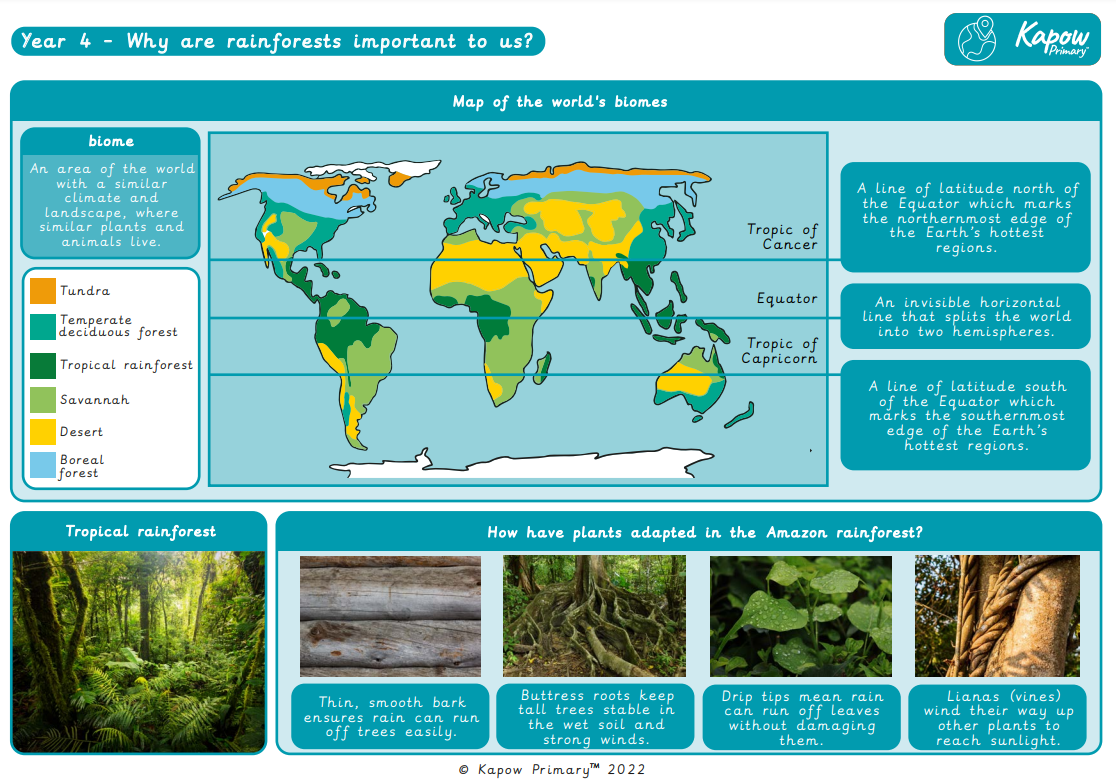
Knowledge organiser: Geography – Y4 Why are rainforests important to us?
Aimed at pupils, two pages providing key facts and definitions from the unit "Why are rainforests important to us?".
Vocabulary display: Why are rainforests important to us?
A display version of the vocabulary from the unit 'Why are rainforests important to us?'.
Subject resources
This content is for subscribers only. Join for access today.
Cross-curricular opportunities
English: Spoken language, writing
Science: Plants, animals including humans, living things and their habitats
Mathematics: Statistics
British values: Mutual respect; Tolerance of those with different faiths and beliefs
RSE/PSHE
Build on the learning
Y3/4 (A): Where does our food come from?
Get started
Popular content
- Geography: Curriculum portal
- Geography: Curriculum information
- Geography subject leader hub
- Geography: Fieldwork guide
- Geography: Staff Presentation
- Webinar: An introduction to geography
- Geography: Progression of concepts —mixed-age
- Ace your role as a D&T subject leader
- Ace Your Role As A Music Subject Leader
