




Unit outcomes
Pupils who are secure will be able to:
- Identify the common features and significance of both religious and non-religious gatherings.
- Suggest reasons people might attend such events.
- Explain the importance of place, people and practice in the context of gatherings.
- Articulate the importance of Jerusalem to Jewish people.
- Discuss why the Dome of the Rock is important to some Muslim people.
- Identify the significance of Makkah for many Muslims.
- Explain the significance of various pilgrimage sites in different religious worldviews.
- Make thoughtful connections between the pilgrimage sites and the concept of spirituality.
Due to the conflict in Israel and Palestine, extra care should be taken when teaching this unit, especially with regard to any children who may have connections with Israel, Palestine, or the broader region.
If you are aware of any particular issues that a child has, you might want to discuss the unit with the child beforehand and adapt it to accommodate them. Consider having an adult work with them for additional support. If issues arise during the lesson, it would be advisable to refer to your Senior Leadership Team.
In Lesson 1, the children produce words and phrases on sticky notes about different places. Keep these for future lessons in the unit.
For an extension of Lesson 4, if possible, invite a member of your local community who has experienced Hajj into school to give a first-hand account of their experience.
For Lesson 5, if possible, invite a member of your local community who has experienced a Humanist convention into school to give a first-hand account of their experience.
Suggested prior learning
Y5/6 (B): Why do Abrahamic religions look different around the world?
Get started
Teacher video: Why is it better to be there in person?

Lessons
Lesson 1: What can make a space significant?
Lesson 2: Why might a Jewish person want to visit Jerusalem?
Lesson 3: Why is Jerusalem significant to some Muslim people?
Lesson 4: How can shared challenge bring people together?
Lesson 5: Are all journeys pilgrimages?
Lesson 6: Why is it better to be there in person?
Key skills
Disciplinary
- Identifying key information from

This content is for subscribers only. Join for access today.
Related content
Unit resources


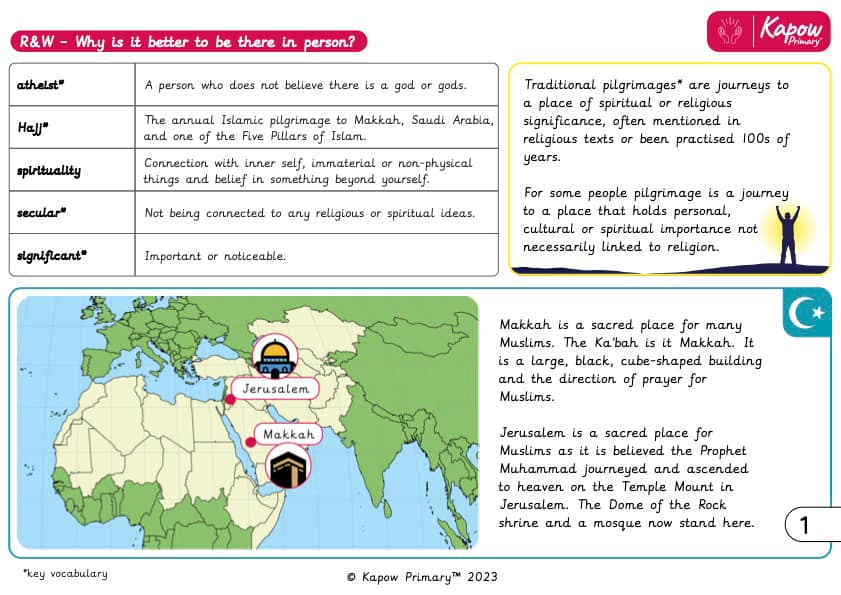
Knowledge organiser – R&W Y5/6 (B): Why is it better to be there in person?
Vocabulary display – R&W Y5/6 (B): Why is it better to be there in person?
Subject resources
This content is for subscribers only. Join for access today.
Cross-curricular opportunities
English: Spoken language; Writing.
RSE: Respectful relationships.
British values: Mutual respect; Tolerance of those with different faiths and beliefs.
Build on the learning
Coming soon - Why is there suffering? (Part 2)Popular content
- Religion & worldviews: Curriculum portal
- Religion & worldviews: Curriculum information
- R&W: Key skills and knowledge by unit
- Religion & worldviews: Vocabulary progression
- R&W: Transitioning to Kapow
- R&W: Personal development, SMSC and BV
- Webinar: Fieldwork And Your Local Area In Geography
- Webinar: Ace your role as a music subject leader