


Subject: Art and design
Lesson 2: Outdoor painting
Collecting materials and objects from nature to make painting tools; children use these to create abstract and figurative art.
Painting and mixed media: Paint my world
Exploring paint and painting techniques through nature, music and collaborative work. Developing creativity through child-led exploration of mixed-media, making collages and transient art.
Choose your lesson
Lesson 1: Finger painting
Lesson 2: Outdoor painting
Lesson 3: Painting to music
Lesson 4: Collage and transient art
Lesson 5: Landscape collage
Lesson 6: Group art
Key skills
- Talk about their ideas and explore different ways to record them using a range of media.
- Experiment in an exploratory way.

This content is for subscribers only. Join for access today.
Key knowledge
- Colour: The names of a wide range of colours.
- Colour: Colours can be mixed to make new colours.
This content is for subscribers only. Join for access today.
Key vocabulary
This content is for subscribers only. Join for access today.
Equipment list
Equipment needed across all lessons in this unit.
This list does not include equipment which is usually readily available in the classroom (e.g pencils, A4 paper etc)
 Download
Full equipment list for the subject
Quantities marked × will update. Items without quantities are unaffected
- Paint ×8
- Paint palette ×30
- Natural objects For example, feathers, grass, flower buds or heads, leaves twigs, pine cones. As needed
- Collected Sticks ×30
- String ×30
- Scissors right- and left-handed options recommended. ×30
- Mud As needed
- Bowls or Containers ×15
- Spoon or sticks for mixing mud paint ×15
- A painting surface ×15
- Paintbrushes ×30
- Water pots ×8
- Mixed-media scraps For example, crepe paper, fabric, tissue paper, corrugated card, magazines, ribbon, wool, foil etc. ×15
- Glue stick ×30
- PVA glue
- Sticky tape
- Loose parts (buttons, corks, bottle lids etc.) ×30
- Digital camera ×8
- Magazines ×8
- Teabags ×15
- Paper ×30
The equipment below is optional
- Tarpaulin
This content is for subscribers only. Join for access today.
Lesson 2: Mark making with felt tips
Investigating felt tips as a tool for mark making and developing fine motor skills as they create patterns.
Sculpture & 3D: Abstract shape
Transforming 2D card shapes into 3D structures and sculptures; exploring abstract shapes and space, developing skills in constructing 3D objects, and understanding the difference between 2D and 3D art.
- Subjects >
- Art and design >
- Key stage 2 >
- Year 3 >
Unit outcomes
Pupils who are secure will be able to:
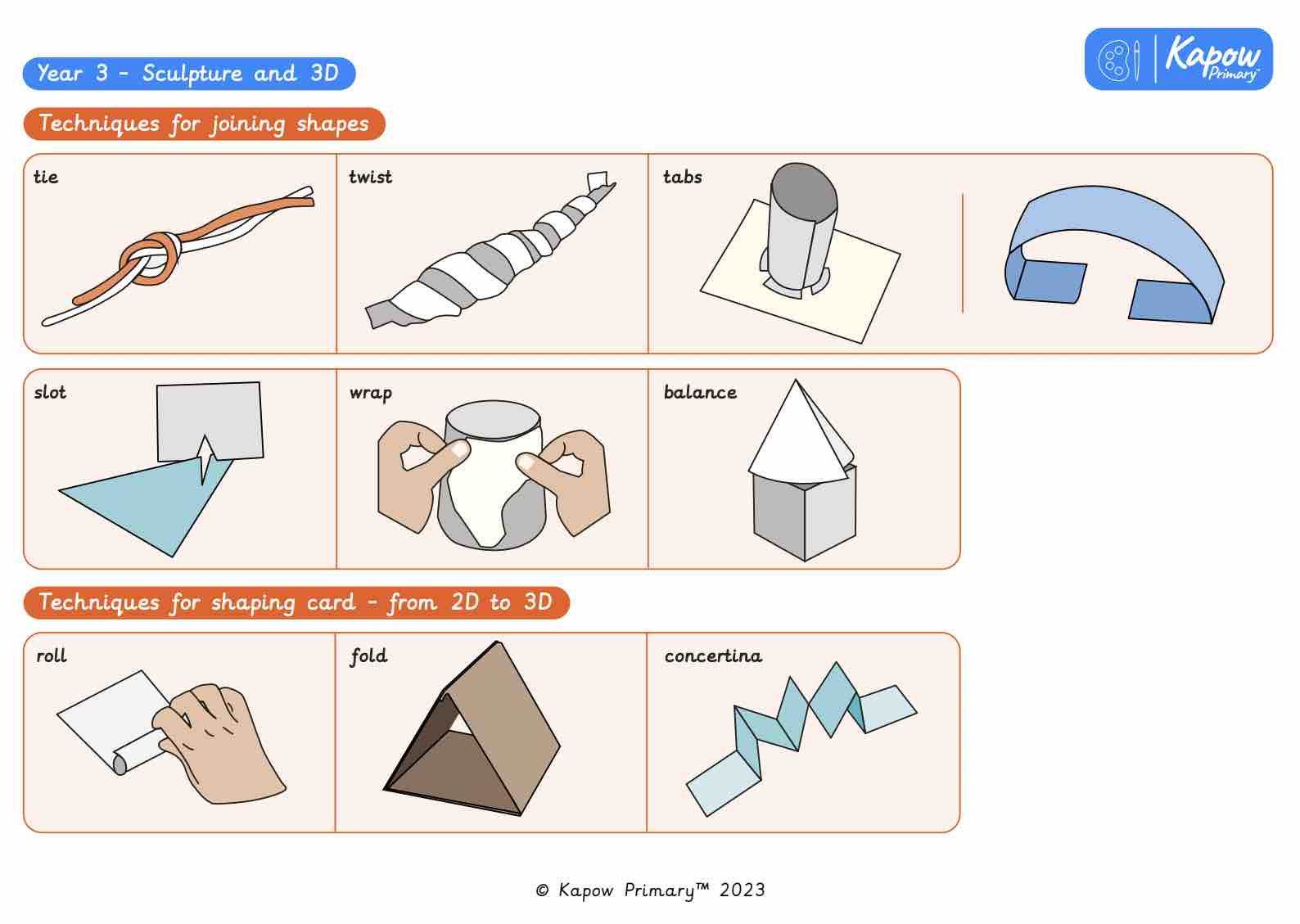
- Try out different ways to make card shapes three dimensional, e.g. folding and curving the card or joining the flat shapes together.
- Make a structure that holds its 3D shape.
- Explain in simple terms the difference between 2D and 3D art.
- Combine shapes together to make an interesting free-standing sculpture.
- Try out more than one way to create joins between shapes.
- Identify familiar 2D shapes in photographs.
- Identify shapes in the negative space between objects.
- Draw a cardboard model from different angles, focusing on shapes in the positive and negative space to achieve an abstract effect.
- Plan an abstract sculpture based on play equipment.
- Show that they have learned how to shape materials in more than one way (e.g. by folding and rolling).
- Choose appropriate methods for joining elements in their sculptures.
- Show that they have thought about how to improve their sculptures and made choices about what to add.
- Work cooperatively in pairs to add detail to their artwork.
Suggested prior learning
Sculpture and 3D: Clay houses
Get started
Lessons
Lesson 1: Structural shapes
Multiple options
Lesson 2: Constructing in 3D – Christmas themed
- To join materials in different ways when working in 3D.
Lesson 3: Seeing space
Lesson 4: Abstract sculpture
Lesson 5: Surface decoration
Key skills
- Generate ideas from a range of stimuli and carry out simple research and evaluation as part of the making process.
- Confidently use of a range of materials and tools, selecting and using these appropriately with more independence.
This content is for subscribers only. Join for access today.
Key knowledge
- Colour: Using light and dark colours next to each other creates contrast.
- Form: Three dimensional forms are either organic (natural) or geometric (mathematical shapes, like a cube).
This content is for subscribers only. Join for access today.
Key vocabulary
abstract
found objects
This content is for subscribers only. Join for access today.
Equipment list
Equipment needed across all lessons in this unit.
This list does not include equipment which is usually readily available in the classroom (e.g pencils, A4 paper etc)
Download
Full equipment list for the subject
Quantities marked × will update. Items without quantities are unaffected
- Strong card; packaging boxes or similar (the equivalent of a large box per child) ×30
- Cereal box cardboard ×8
- PVA glue
- Long cardboard tubes ×8
-
Clean newspaper sheets
×8 - Kitchen roll tubes ×30
- Pipe cleaners ×30
-
Paper for adding texture (such as: tissue, crepe, parcel paper)
×15
The equipment below is optional
- A selection of Straws
- A selection of Junk modelling packaging
- Coloured acetate sheets ×30
This content is for subscribers only. Join for access today.
Related content
Resources
Unit resources

Art and design
Knowledge organiser: Art & design – Sculpture and 3D: Abstract shape and space
Aimed at pupils, two pages providing key facts and definitions from the unit "Sculpture and 3D: Abstract shape and space".
Art and design
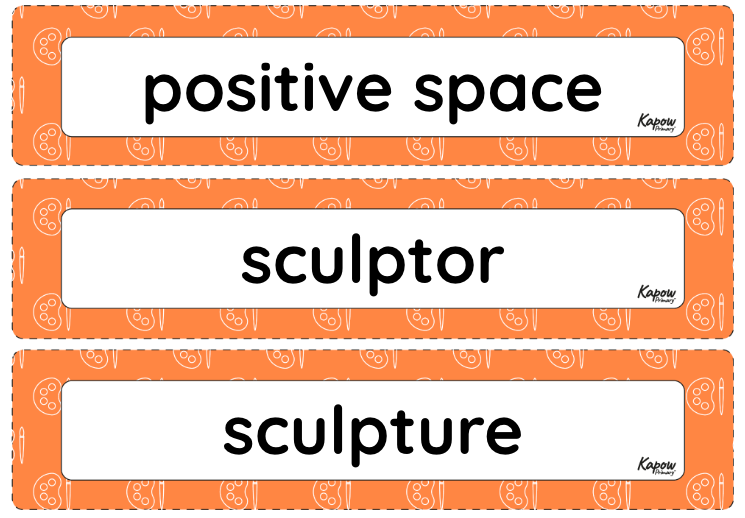
Vocabulary display – Art and design Y3: Abstract shape and space
A display version of the key vocabulary from the Abstract shape and space unit.
Subject resources
This content is for subscribers only. Join for access today.
Cross-curricular opportunities
Design and technology: Technical knowledge
Mathematics: Geometry – properties of shapes
Build on the learning
Sculpture and 3D: Mega materials
Get started