


Subject: Art and design
Are you ready to start the lesson?
Are you ready to start the lesson?
Are you ready to start the lesson?
Are you ready to start the lesson?
Are you ready to start the lesson?
Lesson 1: Tints and shades
Developing understanding of colour theory by mixing tints and shades.
Lesson 1: Romare Bearden
Understanding how Romare Bearden uses warm and cool colours to communicate ideas.
Painting and mixed media: Exploring texture with paint and collage
Creating textures with paint and exploring collage through the work of Romare Bearden.
- Subjects >
- Art and design >
- Key stage 2 >
- Year 3 >
Please note
This unit has been updated for 2026–2027 to provide a clearer progression of painting skills and knowledge.
The old unit has moved to the Content archive area, where it will remain permanently available.
Unit outcomes
Pupils who are secure will be able to:
- Explain how artists use colour and texture to communicate messages in their artwork.
- Identify warm and cool colours and use these deliberately to show mood or temperature.
- Talk about how colour choices in an artwork make them feel.
- Recognise different real and visual textures (in environment/artworks), using appropriate vocabulary to describe them.
- Use tools and materials in different ways to create a range of textured effects and patterns and explain, how tools and materials were used.
- Make choices about layout, materials and detail to strengthen the meaning or message in their artwork.
Suggested prior learning
Painting and mixed media: Colour mixing
Get started
Painting in the Primary classroom
Lessons
Lesson 1: Romare Bearden
Lesson 2: Collecting textures
Lesson 3: Making textured paper
Lesson 4: Story-inspired collages
Lesson 5: Adding detail
Optional: Every picture tells a story
Key skills
Key skills
- Generating ideas from a range of stimuli and carrying out simple research and evaluation as part of the making process.
- Using sketchbooks for a wider range of purposes, for example, recording things using drawing and annotations, planning and taking next steps in a making process.

This content is for subscribers only. Join for access today.
Key knowledge
- Understand that changing the paint’s consistency can affect texture and coverage.
- Intentionally use different brush techniques and brushstrokes to create effects.
This content is for subscribers only. Join for access today.
Key vocabulary
collage
composition
This content is for subscribers only. Join for access today.
Equipment list
Equipment needed across all lessons in this unit.
This list does not include equipment which is usually readily available in the classroom (e.g pencils, A4 paper etc)
 Download
Full equipment list for the subject
Quantities marked × will update. Items without quantities are unaffected
- PVA glue
- Clipboards ×15
-
Bags for collecting texture samples
×8 - Wax Crayons ×30
- Paint ×8
-
Varied tools for painting, such as sponges, forks, combs, cotton buds, cardboard.
×30 -
A range of materials suitable for painting onto
×30 -
A3 cartridge paper
×30 -
A variety of tools and materials for adding details, such as sponges, paintbrushes, pens, pastels and tissue paper
×15
The equipment below is optional
- Digital camera ×8
- Paper ×30
-
Additional collage papers, such as newspaper, magazine pages, wrapping paper or wallpaper
×15 -
A set of pencils, rubbers and cardboard shapes for a teacher demonstration
1 -
A set of everyday objects or recycled materials, such as wool, string or ribbon, bottle tops, paper clips, pencils, used envelopes or cardboard shapes
×8 -
A workspace, such as a tabletop, tray, large sheet of backing paper or floor area
×8
This content is for subscribers only. Join for access today.
Related content
Unit resources

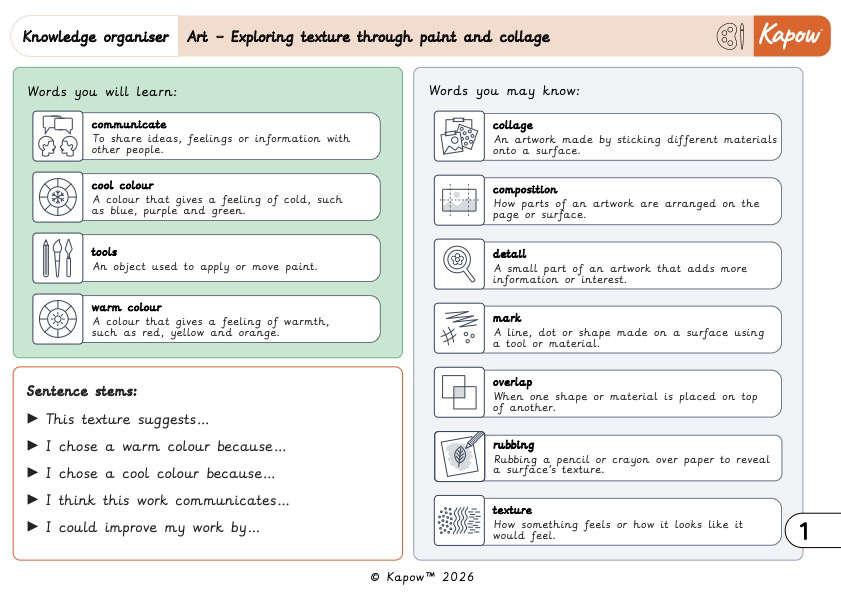
Knowledge organiser: Art and design – Y3: Exploring texture with paint and collage
Aimed at pupils, a page providing key facts and definitions from the unit 'Exploring texture with paint and collage'
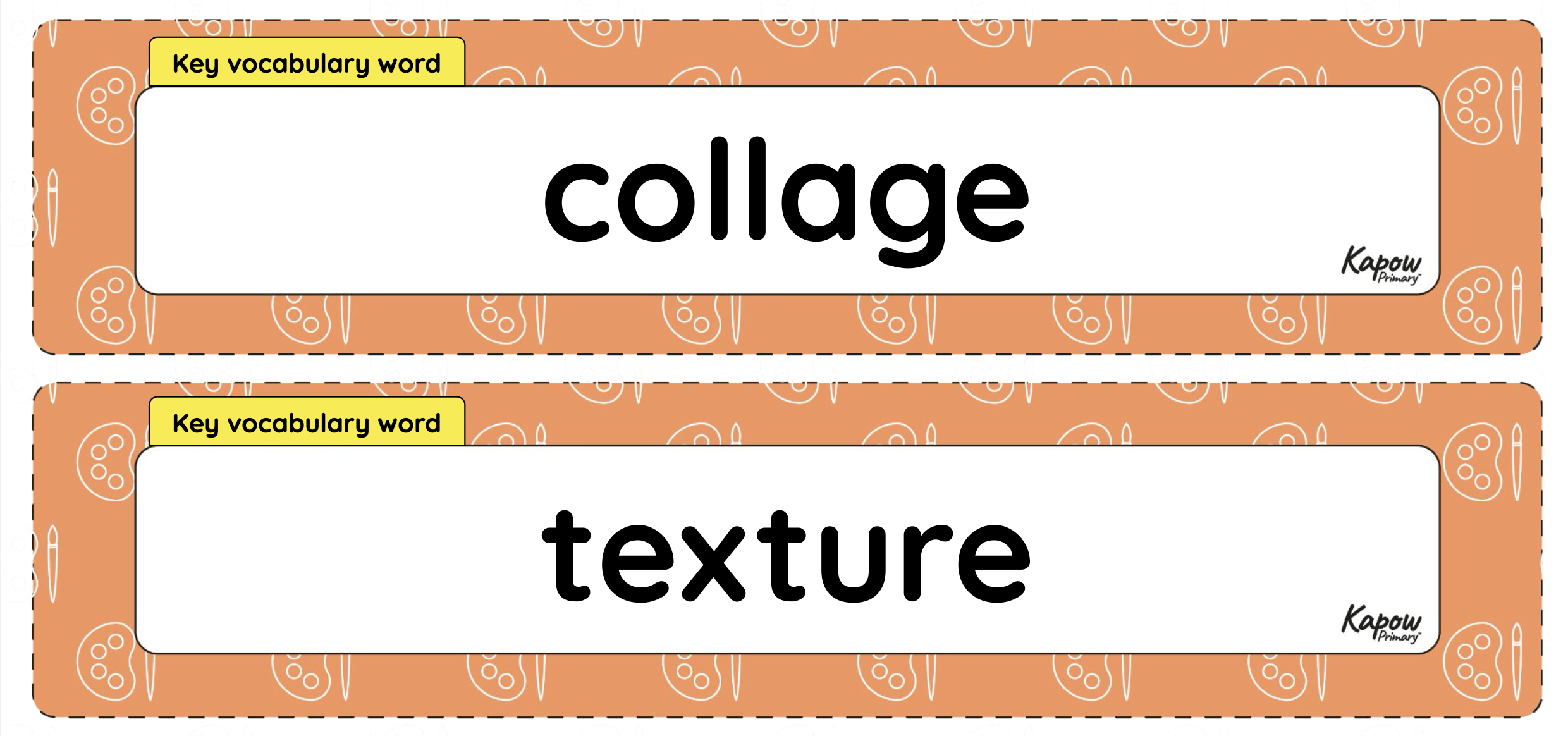
Vocabulary display: Painting & Mixed media – Exploring texture with paint and collage Y3
A display version of the key vocabulary from the painting & mixed media year 3 unit.
Subject resources
This content is for subscribers only. Join for access today.
Cross-curricular opportunities
English: Spoken language.
Build on the learning
Drawing: Exploring tone, texture and proportion
Get started