


This mapping document is suitable for use with the original Kapow Primary Art and design scheme (pre-September 2022). We recommend that schools no longer use this scheme and transition to our revised Art scheme.

This mapping document is suitable for use with the original Kapow Primary Art and design scheme (pre-September 2022). We recommend that schools no longer use this scheme and transition to our revised Art scheme.


A list of equipment and materials required to teach the Original Kapow Primary Art and design scheme (pre-September 2022). We recommend that schools no longer use this scheme and transition to our revised Art scheme.
This spreadsheet is suitable for use with the original Kapow Primary Art and design scheme (pre- September 2022). We recommend that schools no longer use this scheme and transition to our revised Art scheme.
This document allows you to record summative assessments for each pupil in Art and design.

A reference document providing a clear progression of key vocabulary across the original Kapow Primary Art and Design scheme (now archived).
This resource outlines the essential subject-specific terms introduced from Year 1 to Year 6, helping teachers build learners’ art literacy over time. It supports vocabulary-rich teaching by offering age-appropriate terms aligned with each unit, from simple descriptive language in lower years to more technical and conceptual terms in KS2. This progression encourages consistent use of artistic language and supports pupils’ ability to talk about their work confidently and accurately.

A Knowledge organiser that captures the essential knowledge and skills learnt throughout the now archived unit Art and Design, Year 6, Photography.
This Art and Design resource is designed to support the pupils as they explore key photographic techniques and concepts. It introduces key vocabulary such as composition, contrast, macro, lens, and photomontage, helping the pupils understand how photographers use framing, perspective, and digital tools to create compelling images. The pupils will also learn about cropping, self-portrait photography, and how expressions can convey emotions in photographs.

A Knowledge organiser that captures the essential knowledge and skills learnt throughout the now archived unit Art and Design, Year 6, Still Life.
This Art and Design resource is designed to support the pupils as they explore the techniques and concepts behind still-life artwork. It introduces key vocabulary such as composition, greyscale, hue, underpainting, and negative image, helping the pupils understand how artists use arrangement, tone, and colour to create depth and focus. The pupils will also learn about the use of charcoal, sketching, and visual minutes as methods of artistic expression.

A Knowledge organiser that captures the essential knowledge and skills learnt throughout the unit Art and Design, Year 6, Make My Voice Heard.
This Art and Design resource is designed to support the pupils as they explore how artists use visual language to express opinions, emotions, and messages. It introduces key vocabulary such as abstract, figurative, graffiti art, symbolism, and chiaroscuro, helping the pupils understand different artistic techniques and their impact. The pupils will also explore how composition, parallel lines, and serif fonts contribute to the overall meaning of an artwork.
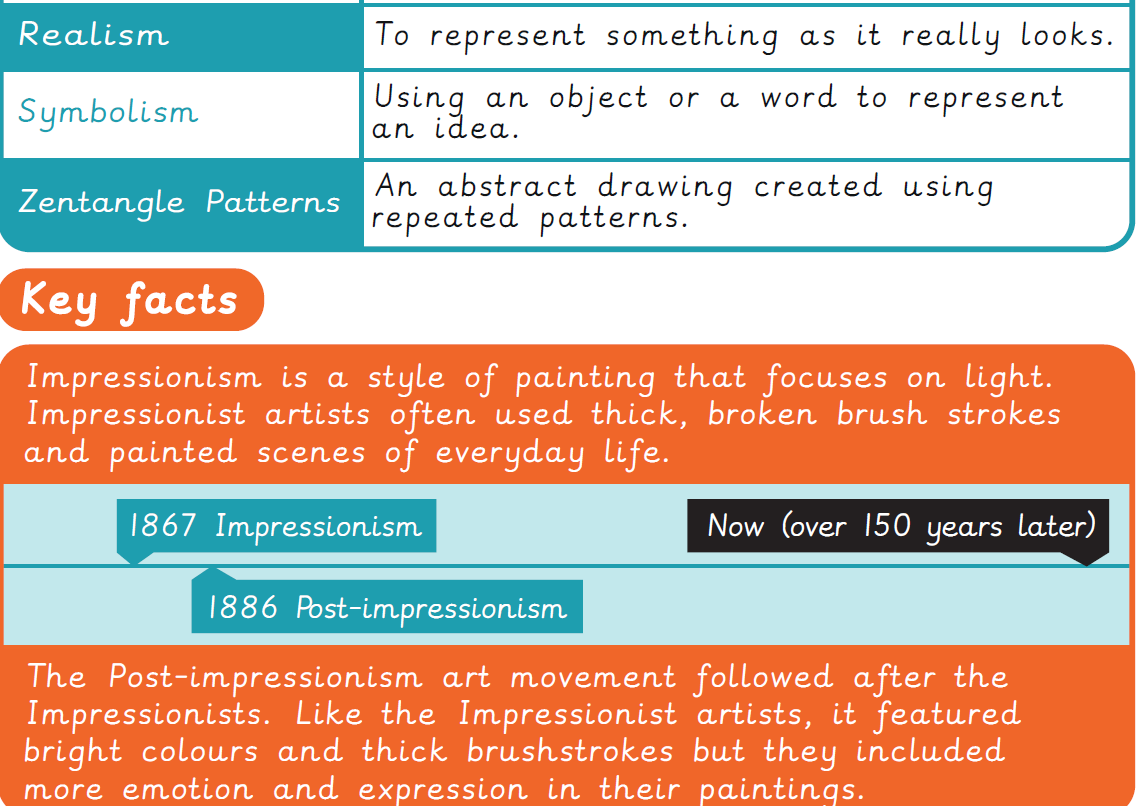
A Knowledge Organiser that captures the essential knowledge and skills learnt throughout the unit Archived – Art and design, Year 6, Art and design skills.
This resource supports pupils in deepening their understanding of key artistic styles and techniques, including abstract art, symbolism, realism, and the concept of mindfulness in creative practice. It introduces important terminology such as “herringbone,” “polyprint tile,” and “zentangle patterns,” alongside the design concept of prototyping. Pupils explore the work of influential artists and designers like Claude Monet, Edgar Degas, William Morris, and milliners such as Stephen Jones and Bundle MacLaren. The resource offers a strong foundation in recognising different art movements, including Impressionism and Post-impressionism, fostering analytical skills and creativity through both historical context and hands-on exploration.