


Primary Theme: landscapes
Pre-lesson checklist
Lesson 4: What are the effects of a volcanic eruption?
Developing an understanding of how volcanoes have negative and positive effects on a community, using Mount Etna in Sicily as a case study.
Y3/4 (B): Lesson 3: Who lives in Antarctica?
Discovering what it is like to visit Antarctica as a researcher, including the incredible sights they see, the work they do and how they adapt to life in a polar climate.
Y3/4 (A): Lesson 3: Why and where do we get volcanoes?
Learning why volcanoes erupt and about the two main types of volcano. Understanding how humans classify volcanoes. Mapping volcanoes globally and using digital imagery to explore them.
Lesson 3: Who lives in Antarctica?
Discovering what it is like to visit Antarctica as a researcher, including the incredible sights they see, the work they do and how they adapt to life in a polar climate.
Pre-lesson checklist
Lesson 5: What are earthquakes and where do we get them?
Learning what earthquakes are, why they happen and where they often occur. Understanding some of the negative effects that an earthquake can have.
Comparing animals
Comparing and grouping animals based on similarities and differences in their characteristics, physical features and diets.
- Subjects >
- Draft – HG >
- Year D/C/Sc >
- Sc – A2 >
Unit outcomes
Pupils who are secure will be able to:
- Name and describe the physical features of a range of animals.
- Sort animals into groups based on their similarities and differences.
- Identify characteristics specific to mammals, birds, reptiles, amphibians and fish.
- Recall the diets of carnivores, herbivores and omnivores.
When working scientifically, pupils who are secure will be able to:
- Use a non-fiction text to find out about specific animals’ diets.
- Recognise that there are different ways to gather data.
- Record data in a block graph and use this to answer questions.
- Recognise what the scientist Jane Goodall was known for.
- Recall some of Jane Goodall’s key findings.
Prior learning
Lessons
Key skills
- Recognising there are different types of enquiry (ways to answer a question).
- Responding to suggestions on how to answer questions.

This content is for subscribers only. Join for access today.
Key knowledge
- A variety of common animals (including fish, amphibians, reptiles, birds and mammals).
- The main body parts of common animals (arms, legs, wings, tails, fins, head, trunk, horns, tusks and shell).
This content is for subscribers only. Join for access today.
Key vocabulary
amphibian
bird
This content is for subscribers only. Join for access today.
Related content
Resources
Unit resources
Science
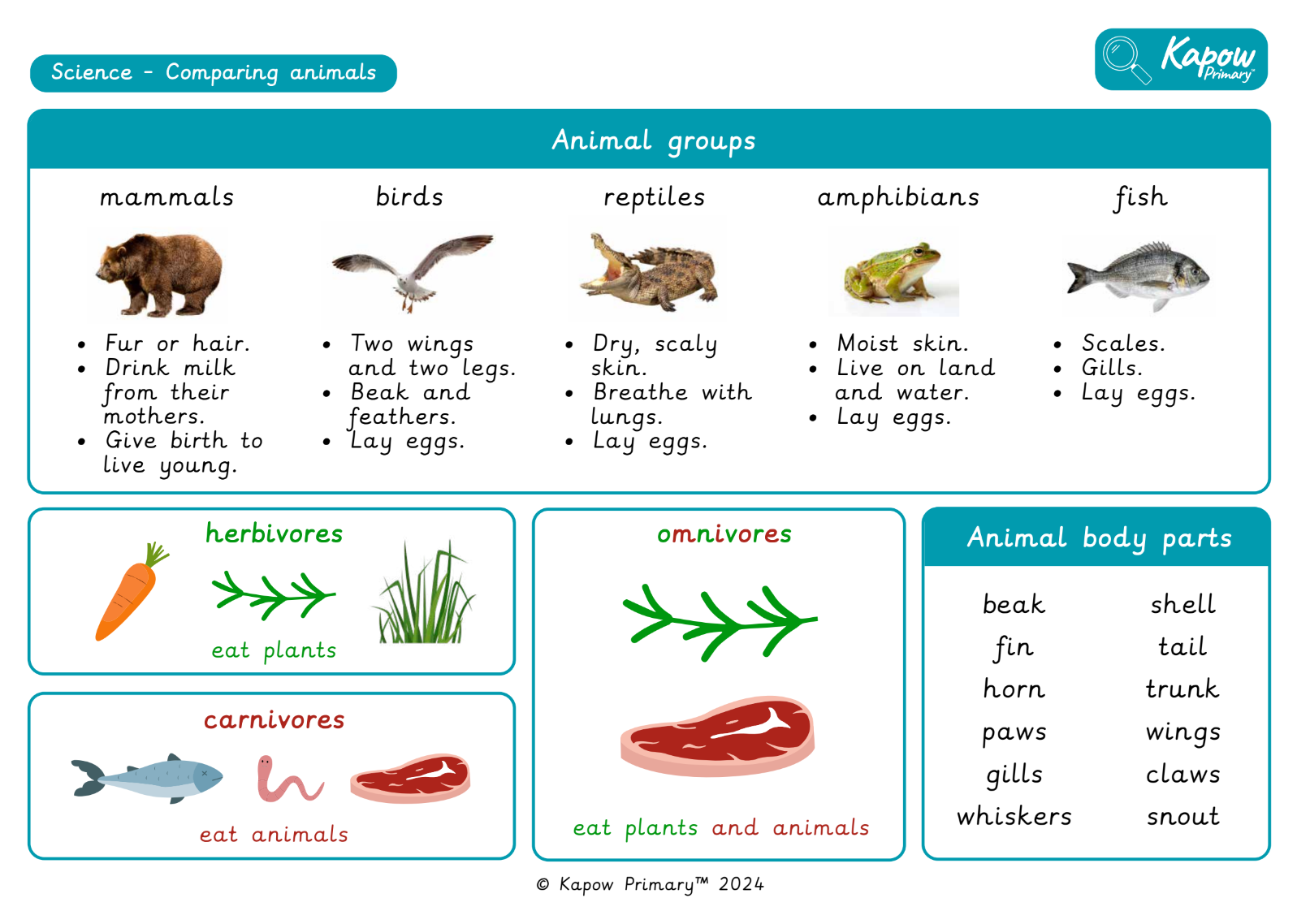
Knowledge organiser – Science Y1: Animals, including humans: Comparing animals
Aimed at pupils, a single page which gives key facts and definitions from the unit 'Comparing animals'.
Subject resources
This content is for subscribers only. Join for access today.
Cross-curricular opportunities
English: Composing sentences before writing; punctuating sentences with capital letters and full stops; using a capital letter for the pronoun ‘I’.
Maths: Representing numbers using objects; completing a block chart; using the language more than. less than, most and least.