




Unit outcomes
Pupils who are secure will be able to:
- Recall the three key functions of the skeleton (movement, support and protection).
- Describe a vertebrate, invertebrate, endoskeleton and exoskeleton.
- Identify and name the skull, spine, ribs and pelvis on a diagram.
- Recall that muscles cause movements in the body, some of which we control by choice and that they cause a movement by shortening and pulling on a bone.
- Recall that animals, including humans, need to eat food to survive.
- Describe some examples of how energy is used by the body and make comparisons about the energy demands between people.
- List some of the seven nutrient groups, name foods that are good sources of them and describe what they are needed for in the body.
- Compare two different meals and explain which is more balanced by naming the nutrient groups and commenting on the relevant proportions.
When working scientifically, pupils who are secure will be able to:
- Use information about skeletons to group animals.
- Record measurements of different bones and use the data to sort them into size order.
- Describe some ways scientific research has improved the field of bionics/prosthetics, such as the choice of materials or linking their movement to muscles in the arm.
- Find relevant data on food packaging and make numerical comparisons.
- Summarise key information using secondary sources.
- Describe some changes to scientific knowledge and jobs that require this information.
Please note that Kapow Primary Science lessons are designed to be 1 hour and 30 minutes long to reflect the requirements of a core subject.
Suggested prior learning
Lessons
Y3/4 (A): Lesson 1: Skeletons

Y3/4 (A): Lesson 2: The bones in our body
Y3/4 (A): Lesson 3: Muscles and movement
Y3/4 (A): Lesson 4: Eating for survival
Y3/4 (A): Lesson 5: Nutrient groups
Y3/4 (A): Lesson 6: Balanced diets
Key skills
Measuring
- Using standard

This content is for subscribers only. Join for access today.
Key knowledge
To know:
- Animals
This content is for subscribers only. Join for access today.
Key vocabulary
balanced diet
bone
This content is for subscribers only. Join for access today.
Related content
Unit resources


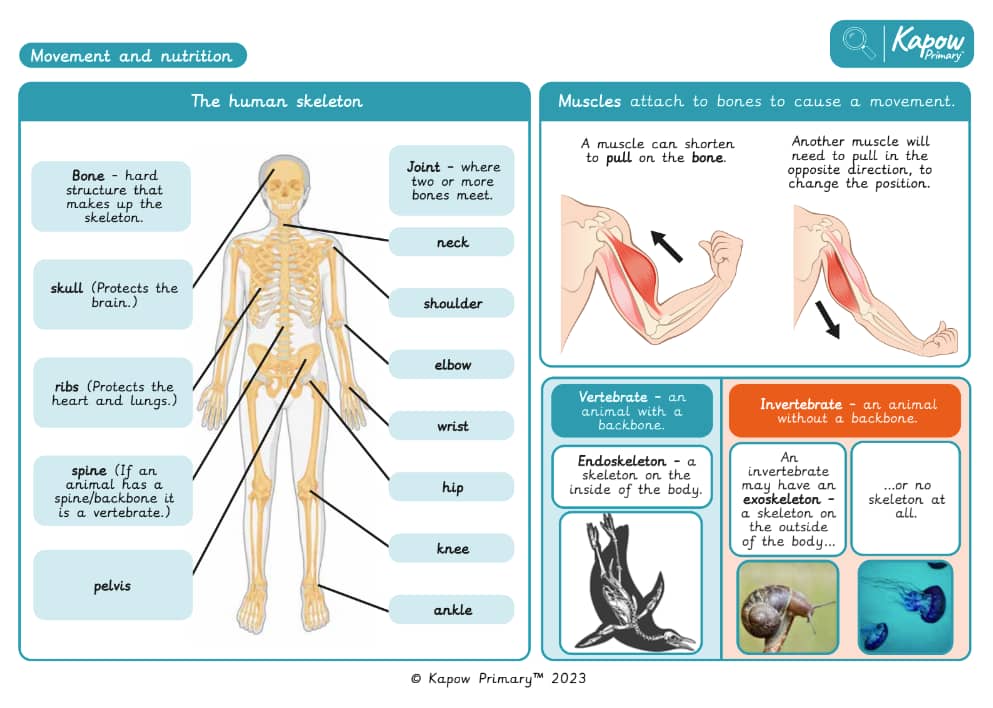
Knowledge organiser – Science Y3/4 (A): Animals, including humans: Movement and nutrition
Aimed at pupils, two pages providing key facts and definitions from the mixed-age unit ‘Movement and nutrition',
Vocabulary display – Science Y3/4 (A): Animals, including humans: Movement and nutrition
A display version of the vocabulary for the mixed-age unit ‘Movement and nutrition’.
Subject resources
This content is for subscribers only. Join for access today.
Cross-curricular opportunities
Mathematics: Number and place value, Number – addition and subtraction, Measurement.
English: Spoken language, Reading.
Design and technology: Cooking and nutrition.
RSE
British values: Mutual respect, Tolerance of those with different faiths and beliefs.