




Unit outcomes
Pupils who are secure will be able to:
- Explain how values guide behaviour choices.
- Set a personal growth goal and list at least two clear first steps.
- Identify behaviours that should change in disrespectful situations and name a specific respectful alternativefor each.
- Apply respectful behaviours in school, in public places, and online during activities.
- Describe what a personal boundary is and how it can change.
- Explain how crossing someone’s boundary, even as a joke, can harm trust.
- Apply consent language to model an appropriate response when a boundary is crossed.
- Identify stereotypes or discrimination accurately within the given scenarios.
- Choose and justify a safe response to bullying in person and online, including what they would say or do.
- Name trusted adults in and out of school and describe what they would tell them when asking for help.
Suggested prior learning
Why are healthy relationships important?
Get started
Lesson plans
Lesson 1: How does self-esteem help me?
Lesson 2: How can I be respectful in different situations?
Lesson 3: How can I set and respect boundaries?
Lesson 4: How can we challenge unfairness?
Lesson 5: How can we work together to stop bullying?
Lesson 6: When and how should I seek help?
Key skills
Key skills
- Analysing how different contexts

This content is for subscribers only. Join for access today.
Key knowledge
To know:
-
This content is for subscribers only. Join for access today.
Key vocabulary
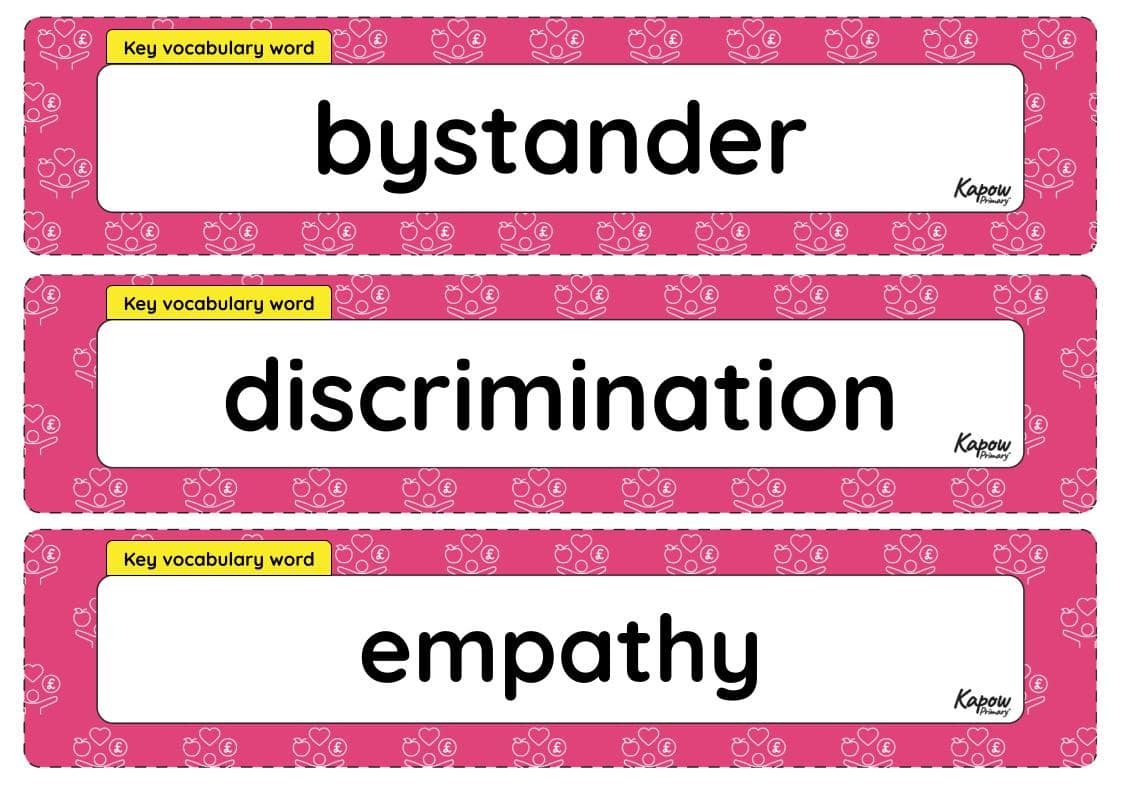
bystander
discrimination
This content is for subscribers only. Join for access today.
Related content
Resources
Unit resources


RSE & PSHE
Vocabulary display – RSE & PSHE Y6: What does it mean to stand up for myself and others?
A display version of the vocabulary for the unit 'What does it mean to stand up for myself and others?'
Cross-curricular opportunities
English: Spoken language.
Computing: Online safety.
British values: Individual liberty; Mutual respect; Rule of law; Tolerance of those with different faiths and beliefs; Democracy.