


Every Child Achieving and Thriving: What does the Schools White Paper mean for you?
Written by Kapow Primary team
Published on 5th March 2026
Last Updated: 5th March 2026
Written by Kapow Primary team
Published on 5th March 2026
Last Updated: 5th March 2026

In February 2026, the Government published the Schools White Paper: Every Child Achieving and Thriving. It sets out a 10-year plan to significantly reshape the education and Special Educational Needs and Disabilities (SEND) system. This summary has been provided by Kapow’s curriculum team.
It is clear that the paper places a strong and welcome emphasis on SEND reform, tackling disadvantage, and closing attainment gaps. Its message is clear: every child, regardless of their background, should expect to belong, achieve and thrive at school.
“We have a generational opportunity to deliver a school system which provides high standards and inclusion for every child, regardless of their background or need.”
Every Child Achieving and Thriving
The vision is ambitious, with some details still to be clarified. A key consideration will be how these changes are implemented, ensuring they are delivered in a way that is both supportive and sustainable for schools.
Use this blog to explore:
The reforms aim to create a clearer, fairer system of support.
The foundation will be Individual Support Plans (ISPs) for every child with SEND. Each ISP will set out the child’s needs and the support they receive. These will be created by schools with parental involvement.
Education, Health and Care Plans (EHCPs) will remain for children with the most complex needs and will be structured around nationally defined Specialist Provision Packages (SPPs).
Plans are expected to be reviewed annually, and children should be able to move between levels as their needs change. Importantly, children who already have EHCPs (from Year 3 upwards) will not automatically move to ISPs before leaving secondary school, unless families choose to do so.
The new system will operate across three layers:
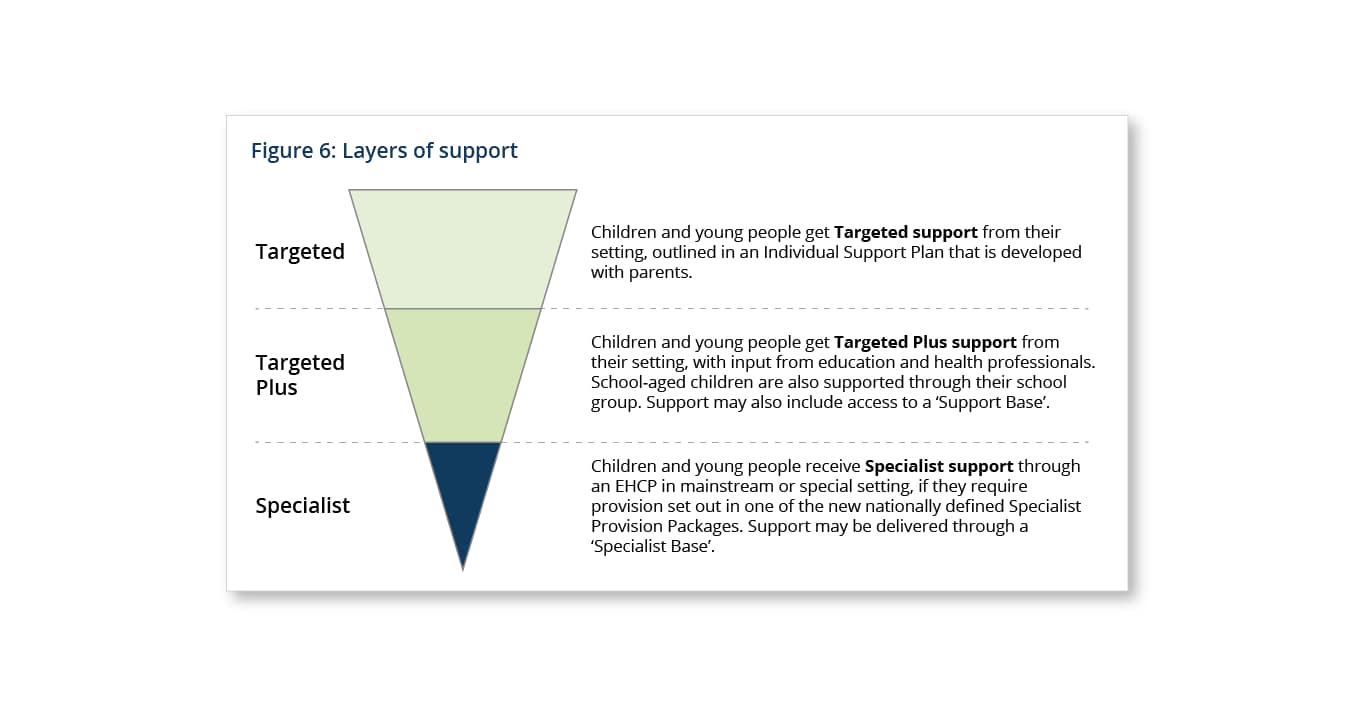
These proposals have the potential to broaden support for children with SEND and make entitlements more transparent and consistent across the country. If delivered well, the reforms could support earlier identification of children’s needs and reduce the time it takes for children to receive the support they need.
The reforms also focus on inclusion and opportunity for all, including:
Key proposals include a national target to halve the attainment gap alongside changes to funding models. There is also an important shift in language, with attendance and behaviour clearly framed as engagement issues rather than just compliance.
To address this, the paper introduces a new Pupil Engagement Framework and an enrichment entitlement, ensuring that all children have access to the arts, sport, culture, nature, civic engagement, and wider life skills.
This reflects the findings of the All-Party Parliamentary Group for Education’s (APPG) Loss of the Love of Learning report and what many primary teachers already know: engagement underpins attainment. A broad curriculum supports motivation. Stretch and challenge matter for all pupils. Inclusion and belonging are not “soft” issues; they are foundational.
In addition to creating and reviewing ISPs, and continuing to support pupils with EHCPs, teachers will be expected to strengthen their inclusive teaching practice. This includes drawing on evidence-based pedagogy, particularly adaptive teaching, to improve outcomes.
Teachers will work in line with the new National Inclusion Standards, designed to bring greater consistency to what inclusive practice looks like across schools. They will also be expected to engage in ongoing professional development through a new Teacher Training Entitlement.
The ambition is that staff feel confident and better equipped to meet a wider range of needs. The question is whether available time and capacity match that ambition.
The White Paper promises significant support at the system level. This includes a £1.6 billion Inclusive Mainstream Fund, alongside further investment in infrastructure and proposed changes to the way funding is distributed to better address disadvantages.
Schools are also promised improved access to specialist expertise. The proposal for “experts at hand” is intended to make educational psychologists, speech and language therapists and other specialists more readily available, reducing waiting times and enabling earlier intervention.
National Inclusion Standards, Specialist Provision Packages and the Pupil Engagement Framework all aim to bring greater clarity and consistency to what support children should expect, wherever they attend school.
There is also a strong emphasis on collaboration and school improvement. Expanded RISE teams are expected to spread best practices, and all schools are expected to be part of trusts, working more closely together.
Workforce development is positioned as central to reform, with a teacher retention programme and the new Teacher Training Entitlement to support ongoing professional growth.
The White Paper is currently in the consultation phase. Schools can formally respond before legislation is introduced and rollout begins.
Implementation will happen in overlapping phases:
The success of these reforms will depend less on vision and more on operational detail. Several practical questions remain:
The White Paper is ambitious and rightly focuses on SEND, disadvantage and inclusion; areas the sector agrees have long needed attention.
The promise is a clearer, more consistent system that expects more and supports more. The risk is added workload without capacity.
We will be submitting a response to the consultation shortly to help shape reforms that enable teachers to teach with clarity, confidence and the right support in place.
At Kapow, we are proud to be evidence-informed and inclusive by design, supporting teachers with adaptable, high-quality resources that help meet the needs of all pupils.
Attainment gap
The attainment gap is the difference in achievement between groups of pupils, most often between disadvantaged children and their peers. Closing the attainment gap means reducing this difference so that background does not determine outcomes.
EHCP (Education, Health and Care Plan)
An EHCP is a legal document for a child with complex special educational needs or disabilities. It sets out their needs and the support they must receive from education, health and care services.
Enrichment Entitlement
The enrichment entitlement is a proposed expectation that all children should have access to a broad range of experiences beyond core subjects. This includes arts, sport, culture, nature, civic participation and wider life skills.
Experts at hand
“Experts at hand” refers to improved access to specialist professionals, such as educational psychologists and speech and language therapists. The aim is to help schools access advice and support more quickly.
ISP (Individual Support Plan)
An ISP is a proposed plan for every child identified with SEND. It sets out the child’s needs and the support they will receive in school, and is created with parental involvement.
National Inclusion Standards
The National Inclusion Standards are proposed national guidelines setting out what inclusive practice should look like in mainstream schools. They are intended to create clearer, more consistent expectations for how schools identify and support children with SEND.
Pupil Engagement Framework
The Pupil Engagement Framework is a proposed national framework linking attendance, behaviour and belonging. It aims to recognise that engagement in learning is closely connected to feeling included and motivated.
RISE teams
RISE teams are Regional Improvement for Standards and Excellence teams. They are intended to support schools by spreading best practice and helping improve standards and inclusion.
Specialist Provision Package (SPP)
A Specialist Provision Package sets out nationally defined support for children with the most complex needs. It underpins EHCPs and aims to ensure consistency in what specialist support looks like.
Teacher Training Entitlement
The Teacher Training Entitlement is a proposed offer of ongoing professional development for teachers and leaders. It is intended to ensure staff have access to high-quality training throughout their careers.
