



Unit outcomes
Pupils who are secure will be able to:
- Identify solids, liquids and gases using their properties.
- Describe melting, freezing, condensing and evaporating.
- Describe the different stages of the water cycle.
- Describe how temperature affects the rate of evaporation and, therefore, the water cycle.
When working scientifically, pupils who are secure will be able to:
- Ask relevant questions.
- Use results to draw simple conclusions.
- Use thermometers to take accurate measurements.
- Make predictions for new values.
- Record findings using labelled diagrams.
- Research using more than one source.
Please note that Kapow Primary Science lessons are designed to be 1 hour and 30 minutes long to reflect the requirements of a core subject.
Suggested prior learning
Y1/2 (B): Materials: Everyday materials
Get started
Lessons
Y3/4 (B): Lesson 1: Solids
Y3/4 (B): Lesson 2: Liquids and gases
Y3/4 (B): Lesson 3: Melting and freezing
Y3/4 (B): Lesson 4: Condensing and evaporating
Y3/4 (B): Lesson 5: The water cycle
Y3/4 (B): Lesson 6: Climate change and the water cycle
Key skills
Posing questions
-

This content is for subscribers only. Join for access today.
Key knowledge
To know
This content is for subscribers only. Join for access today.
Key vocabulary
boiling point
climate change
This content is for subscribers only. Join for access today.
Related content
Unit resources


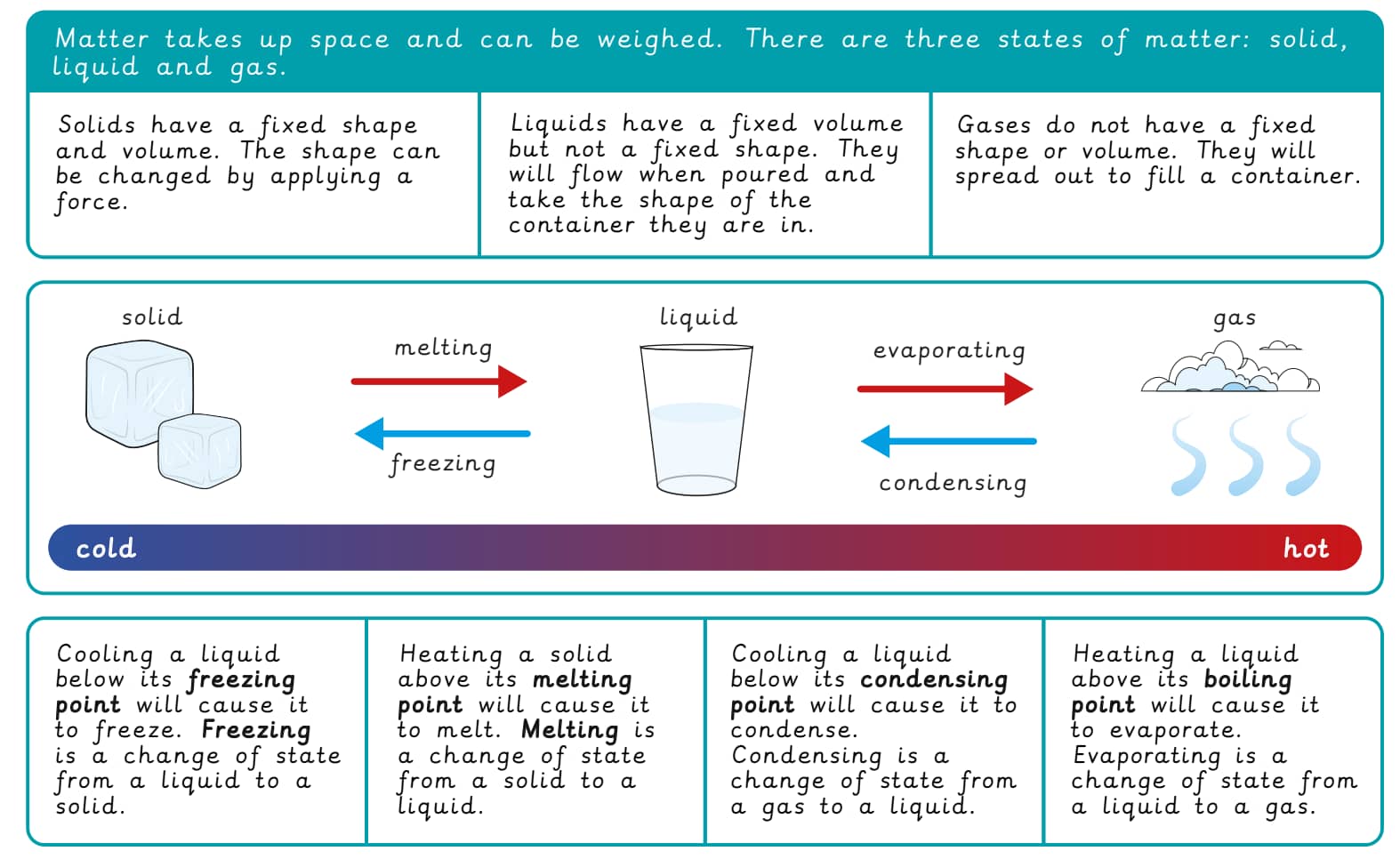
Knowledge organiser – Science Y3/4 (B): Materials: States of matter
Aimed at pupils, two pages providing key facts and definitions from the mixed-age unit ‘States of matter'.
Vocabulary display – Science Y3/4 (B): Materials: States of matter
A display version of the key vocabulary from the mixed-age unit 'States of matter'.
Subject resources
This content is for subscribers only. Join for access today.
Cross-curricular opportunities
British values – mutual respect.
Build on the learning
Y5/6 (A): Materials: Mixtures and separation
Get started
Popular content

This resource is being accessed through your school’s Kapow licence.
Thank you for respecting the work of the teachers who create these materials.