Y1/2 (A): Lesson 4: Ocean food chains
Revising food chains and considering how litter may affect what ocean animals eat. This lesson is part of the mixed-age scheme.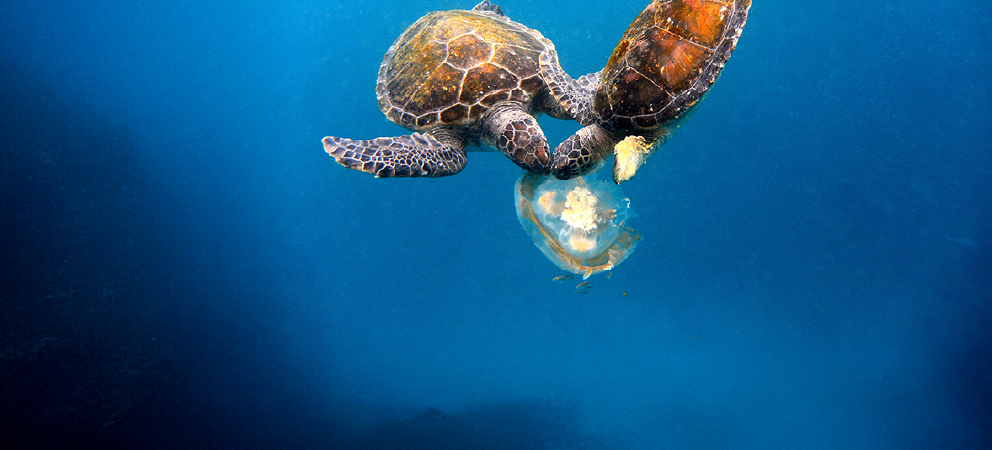
Learning objectives
Knowledge
-
To describe how litter affects food chains.
Working scientifically
-
To use results to advise about litter.
Success criteria
Knowledge
-
I can recall how to write a food chain.
-
I can create an ocean food chain.
-
I can describe how litter affects a food chain.
Working scientifically
-
I can summarise the results from the ocean litter investigation.
-
I can use the results to explain which litter is worst for the oceans.
-
I can give advice to people about their material choices.
Before the lesson
Check all images, videos, links and presentation slides are suitable for your class.
- Presentation: Gimme five!
- Presentation: Investigating ocean litter.
- Presentation: Ocean food chains.
- The children's bottles of soaked ocean litter from the investigation in Lesson 3: Ocean litter.
- The Resource: Ocean food chain spinner cut out and stuck onto thick card with a pencil or pen pushed through the centre (one between four).
Whiteboards and pens (one between four).
A device for taking photos (support - see Adaptive teaching).
The book 'Alba the Hundred Year Old Fish' by Lara Hawthorne (optional - see the Wrapping up).
Subject knowledge
This lesson revises subject knowledge from the units Science, Year 1/2 (A), An introduction to plants, Science, Year 1/2 (A), Habitats, Science, Year 1/2 (A), Life cycles and health and Science, Year 1/2 (A), Plant growth. Find any associated misconceptions in the unit lessons.
Investigating ocean litter
The children may notice that the paper straws do not break up as much as expected. It is because they are often coated with wax or plastic to stop them from going soggy while in use.
Paper straws may break down quicker than plastic alternatives, but some research suggests they contain other 'forever chemicals' that can contaminate water supplies and cause problems. It may suggest they are not a better sustainable alternative to plastic straws.
However, plastic straws' rigidity is more likely to harm animals that come into contact with them.
Ocean food chains
Seaweed is a producer that makes its own food using sunlight.
Shrimp are omnivores and scavengers; they eat small plants, animals and decaying matter.
Jellyfish are carnivores and will eat small animals such as fish and crustaceans.
Fish diets depend on the specific species and can appear in different places within the food chain.
Sea turtles' diets depend on the species. Some are carnivorous and eat crustaceans, jellyfish and other marine life. Green turtles are coloured this way because of their herbivorous diet.
Enquiry type
- This lesson includes the reviewing of an observing over time enquiry that It looks for changes in litter integrity when soaked in water over time.
Lesson organisation
It is recommended that The children should investigate a range of litter for first-hand experience.
- Examples of biodegradable and non-biodegradable materials being experimented on can be seen and shared with the class in the Pupil video: Investigating ocean litter (from 0:00). There are some examples of biodegradable and non-biodegradable materials being experimented on from 00:00 in the Pupil video: Investigating ocean litter that can be shared with the class.
Lesson plan
Display the Presentation: Gimme five! Ask the children to think of five things they remember about plants from their Science lessons this year, tell them to a partner, then give them a high five.
Key facts they remember may include:
Key plant structures (stem, root, leaf and flower).
Examples of plants (which could include seaweed as an example of an ocean plant).
What plants are used for (such as food or medicine).
The plant life cycle (including the role of seeds or bulbs).
What plants need to grow (light, water and warmth).
Arrange the class in the experiment pairs from the previous lesson. Ask one member from each pair to collect their bottle of soaked ocean litter from the investigation in Lesson 3: Ocean litter. If required, play the Pupil video: Investigating ocean litter from 0:50 to share the results.
Select the observe, test and measure tile from the enquiry cycle in the Presentation: Investigating ocean litter and click forward to the results table.
Allow the pairs to discuss how the litter has changed in appearance, using the keywords in the presentation if required. Hand out a copy of Activity: Investigating ocean litter (one each) and allow time for the children to circulate the class and record how each litter type has changed over a week, soaked in ocean water.
Choose one bottle for each type of litter that has been soaking. Ask for a volunteer to hold each bottle at the front of the class. Invite the class to carefully observe the changes to the materials inside the bottles. Ask the class to help rearrange the volunteers from ‘most changed’ to ‘least changed’, based on what they can see.
Return to the enquiry cycle and select the conclusion tile to display slide 3. Take feedback on the questions and click to reveal answers to demonstrate how the children can summarise their conclusions from the experiment. Allow time for the children to discuss what they would include in a conclusion about their own results.
Optional: allow the children to add to their written conclusions on the worksheet using the model conclusion as a guide.
Questions
- What have you learnt about the different materials and what happens when they end up in the ocean? (Some materials easily break up when soaked in water; some materials do not break up when soaked in water; animals may eat the ones that do not.)
- What advice would you give people about what materials they choose and how they may affect the ocean? (Paper versions of objects may break up if they end up in water but plastic ones will not; plastic objects may stay in the water and cause harm to ocean habitats; consider 'reduce, reuse, recycle' when making choices to reduce the amount of items at risk of ending up in the oceans.)
- Which litter is ok to end up in the water? (None!)
Display slide 1 of the Presentation: Ocean food chains. Ask the children to discuss with a partner how they would rearrange the items to make an ocean food chain.
Ask the class:
- What should go at the start of every food chain? (A plant.)
- Which of these items should go at the start of this food chain? (The seaweed.)
Ask a volunteer to move the seaweed to the start of the food chain. Ask the class what should come next (the shrimp) and drag it to the second position in the food chain. Establish with the class that the jellyfish, followed by the turtle, should come next in the food chain. Drag them to the correct position and click forward.
Ask the children:
- What has happened? (The sea turtle accidentally ate the carrier bag because it looked like a jellyfish.)
- What should the food chain look like? (The turtle should be eating the jellyfish, which eats the shrimp. Seaweed → shrimp → jellyfish → sea turtle.)
Ask a volunteer to swap the carrier bag for a jellyfish. Click forward to show the correct food chain and discuss this with Year 2 pupils to revise the keywords herbivore, carnivore (jellyfish and this type of sea turtle) and omnivore (the shrimp).
Display slide 2 and repeat the process for the next piece of rubbish mistaken for food (the washing-up sponge) and establish the correct food chain (seaweed → fish → seal). Revise the keywords herbivore (some fish), carnivore (the seal) and omnivore (some fish) in the context of this second food chain with Year 2 pupils.
Ocean food chain game
Arrange the class into groups of four and hand each group a whiteboard, pen and one game spinner (see Have ready). Ask one volunteer to spin their spinner four times and write the items collected on the board or flipchart. Ask the class:
- Have I got the correct items to build a food chain? (For the answer to be yes, there must be at least one plant, an animal that eats the plant and something that eats that animal.)
- Is there anything I should not have? (The answer will be yes if any litter was selected; litter should be crossed off the list if this is the case.)
If sufficient items were collected to build a food chain, ask volunteers to help rearrange them to the correct order with appropriate arrows.
If insufficient items were collected for an ocean food chain, spin again and repeat the process until a food chain can be built on the board.
Allow the children to play the food chain game in their groups, listing collected items on their whiteboard and crossing out litter. They should begin by spinning four times and then continue until they have enough items to make a food chain. Display a copy of the Resource: Correct ocean food chains somewhere in the room and explain to the children that they can use this to check whether their completed food chain is correct.
Instruct the children to write their verified food chain in their book, adding labels for the plant and animals and arrows to show 'is eaten by'. They should also add a sentence underneath to add information about animals eating litter found in the ocean. (Year 1 pupils can describe what may happen and Year 2 pupils should add the word 'because' to explain why animals may eat the litter accidentally.) If required, display slide 3, which gives sentence stems to help with the written task. If there is time, the class can repeat the process to form a different ocean food chain.
Ask for volunteers to share their food chain and sentence. Encourage the class to provide valuable feedback, including:
Correctly ordered food chains.
Good use of vocabulary.
Using a capital letter and a full stop in their sentence.
Good explanations for why some animals eat litter using 'because'.
Optional: read 'Alba the Hundred Year Old Fish' by Lara Hawthorne with the class to learn about further examples of marine life affected by litter and pollution.
Full-screen slides, ready for your classroom, chosen by you.
Knowledge
-
To describe how litter affects food chains.
Working scientifically
-
To use results to advise about litter.
We value your feedback
We welcome your feedback to help make our resources even better